A 5-ply (double-wall) corrugator adds a second single-facer and a second bonding pass that a 3-ply line never has to manage. Before comparing quotes, audit three non-negotiable benchmarks: dual single-facer speed synchronization, independent servo-controlled glue metering per layer, and PLC-regulated double-facer heating pressure that holds flatness across five webs instead of three. A supplier who can’t isolate these three systems on a spec sheet is quoting a 3-ply line with an extra glue station bolted on.
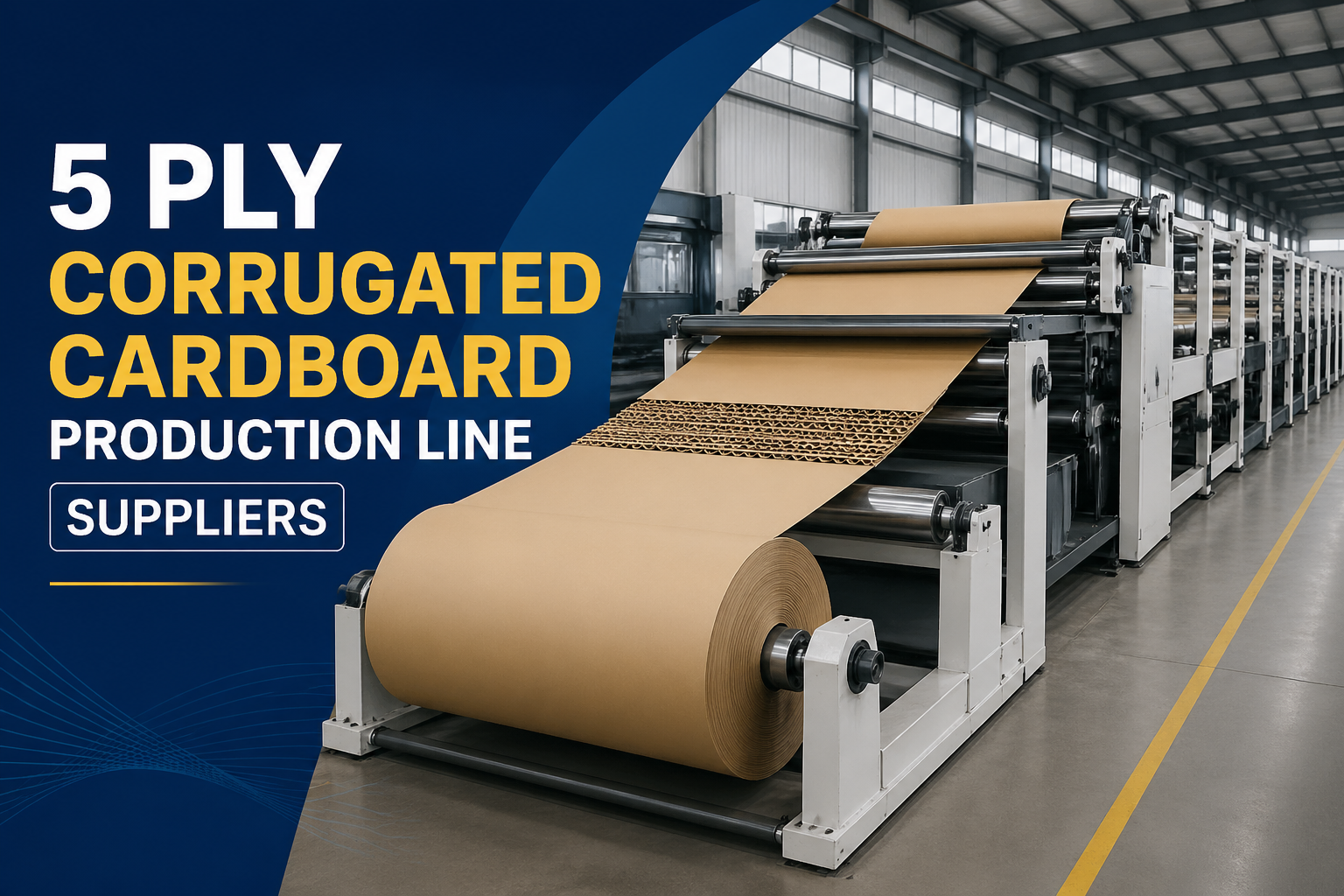
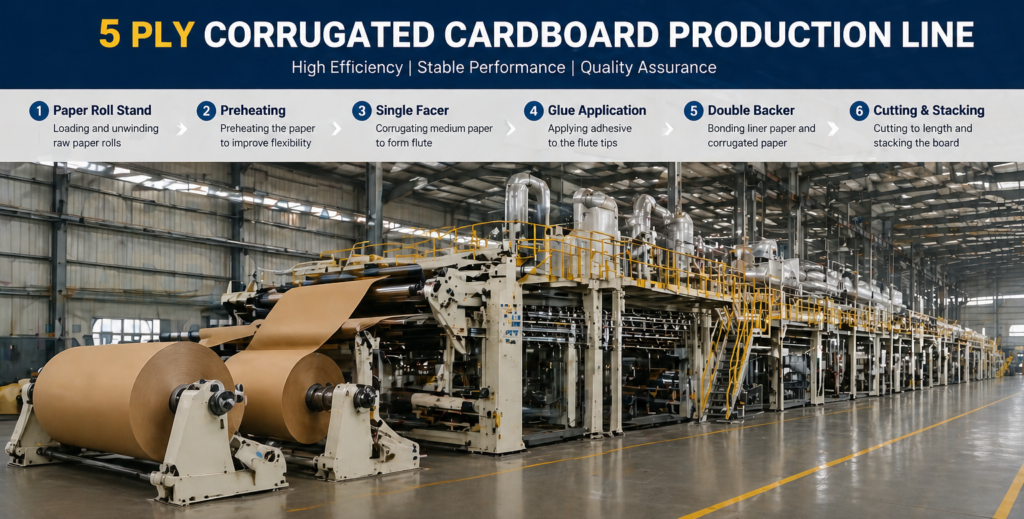
A 5 ply corrugated cardboard production line supplier specializes in industrial systems that bond three liners and two fluted mediums to create high-strength, double-wall board. In today, leading suppliers like Guangzhou Smart Machinery utilize Multi-Stage Pre-heaters and Independent Servo-Driven Double Backers to produce BC, BE, or AB flute combinations. These lines are engineered for heavy-duty applications, such as industrial shipping and moving boxes, providing a production speed of up to 250m/min while ensuring maximum Edge Crush Test (ECT) values and vertical stacking durability.
https://gzsmartmachinery.com/product/corrugated-cardboard-production-line/
Engineering Benchmark: 5-Ply Line Tiers Compared
Most “5 ply corrugated cardboard production line suppliers” listings show a single-facer speed rating and stop there — which hides where a double-wall line actually loses money. The gap between tiers shows up in single-facer synchronization, roller-change downtime, and bonding consistency across the wider stack, not in the headline speed number.
| Engineering Criterion | Legacy Mechanical Line | Semi-Servo Hybrid Line | Guangzhou Smart Machinery (3/5/7-Ply Line) |
|---|---|---|---|
| Single-Facer Sync (2 required for 5-ply) | Independent drives, manual speed matching | Shared line-shaft, limited digital correction | Central Monitoring Industrial PC synchronizes both single facers through the stacker |
| Glue/Bonding Control | Single fixed-viscosity glue head for all layers | Basic PLC pressure control | Independent servo-motor glue control per layer; PLC-controlled double-facer heating plates |
| Roller Changeover | Full teardown, 2+ hours per set | Partial quick-release | Quick-change drawer design: full roller swap in 10 minutes |
| Cut-Off Precision | ±2–3 mm, blade-wear dependent | ±1 mm typical | AC servo helical knife: ±0.5 mm (±0.02 in) |
| Corrugating Roller Wear | Untreated steel, frequent regrind | Hardened steel | Tungsten carbide via supersonic spraying |
| Flute/Working-Width Range | Fixed configuration, single flute | 2–3 flute combinations | A/B/C/E/F/BC-AAA flutes; 1800–3300 mm (70.9–129.9 in) working width |
Inside the Line: Why 5-Ply Doubles the Synchronization Problem
A 5 ply corrugated cardboard production line runs two single facers instead of one — each forming a separate fluted medium web that has to hit the double facer at matched speed and matched moisture state, or the finished board warps under its own bonding stress. High-performance single facers rated up to 300 m/min (984 FPM) use vacuum suction structures to hold flute geometry stable at that speed, on both webs simultaneously, not just the primary facer.
The Central Monitoring Industrial PC is what actually closes this gap: it synchronizes the full line — from both single facers through the double facer, dry end, and stacker — as one digital order-management system rather than two machines running on adjacent timers. That synchronization is also what makes rapid non-stop order changeovers possible when a plant switches board caliper mid-shift instead of scheduling a separate changeover window for each facer.
Flute tooling wears the fastest part of either single facer, which is why the quick-change drawer design matters twice as much on a 5-ply line — two roller sets need swapping instead of one. A 10-minute complete roller-set swap keeps a flute-combination change (B/C to E/B, for example) from consuming half a production shift.
Bonding Control Across Five Layers
Lamination quality on a double-wall board is decided at the double facer, where two fluted mediums and three liners have to bond under even pressure without crushing either flute profile. The glue machine uses independent servo-motor controls for each layer, so glue-film thickness stays consistent even as line speed changes — a fixed-rate glue head can’t make that correction mid-run.
PLC-controlled double-facer heating plates apply precise, evenly distributed pressure across the width of the board, which is what preserves flute integrity through all five layers instead of only the outer two. Request a Factory FAT (Factory Acceptance Test) Protocol Sheet that documents heating-plate pressure uniformity and per-layer glue-film consistency before you commit capital to a double-wall line — a brochure claim of “even bonding” is not a substitute for that data.
Bond failure on a double-wall board rarely shows up as delamination on day one; it shows up as edge-crush loss weeks later, after warehouse humidity cycling. That’s a downstream cost a buyer only discovers after the boxes are already stacked five-high in a client’s DC — which is why bonding-pressure documentation belongs in the purchase contract, not just the sales pitch.
Material Science: Why the Corrugating Rollers Set the Real Service Life
Corrugating roller wear is the single largest driver of long-term flute-quality drift on any multi-ply line, and it compounds faster on a 5-ply configuration because two roller sets are running continuously instead of one. Tungsten carbide corrugating rollers, applied via supersonic spraying, hold flute height constant through the roller’s service life — a wear-resistant coating matters here specifically because flute height directly determines board caliper and, downstream, the printed-box dimensions your customer’s automated equipment expects.
A roller that loses geometry gradually doesn’t fail outright — it produces board that slowly drifts out of caliper tolerance over months, which is far harder to catch on an incoming-inspection line than an outright defect. Ask any 5 ply corrugated cardboard production line supplier for the roller coating specification and expected regrind interval in writing, by roller position (both single facers, not just one), before signing.
AC servo helical-knife cut-off, holding ±0.5 mm (±0.02 in) accuracy, is the other wear-sensitive component worth auditing — a dulling blade drifts cut-length tolerance long before it visibly fails, and on a double-wall board that tolerance stack compounds with any bonding-pressure inconsistency already present from the double facer.
Matching Flute Combinations and Working Width to Application
Double-wall (5-ply) board exists specifically for loads a single-wall line can’t protect — heavy appliance packaging, industrial parts, large-format e-commerce mailers, and palletized transit cartons that need higher edge-crush and stacking strength than a 3-ply BC or single-flute board provides. Standard double-wall combinations like BC-flute (B-flute paired with C-flute) stack roughly a B-flute height near 2.5 mm / 0.10 in against a C-flute height near 3.6 mm / 0.14 in — a generic corrugated-industry reference figure, not a claim specific to any one machine, but the number that determines how much cushioning and crush resistance the finished board carries.
The line’s A/B/C/E/F/BC-AAA flute support covers that full double-wall combination range on one machine, so a plant running mixed orders — heavy transit cartons one shift, retail-ready display board the next — doesn’t need a second dedicated line. Working width from 1800 mm to 3300 mm (70.9 to 129.9 in) sets the ceiling on sheet size per pass; undersizing this against your largest SKU is the most common reason a 5-ply line runs below its rated daily tonnage.
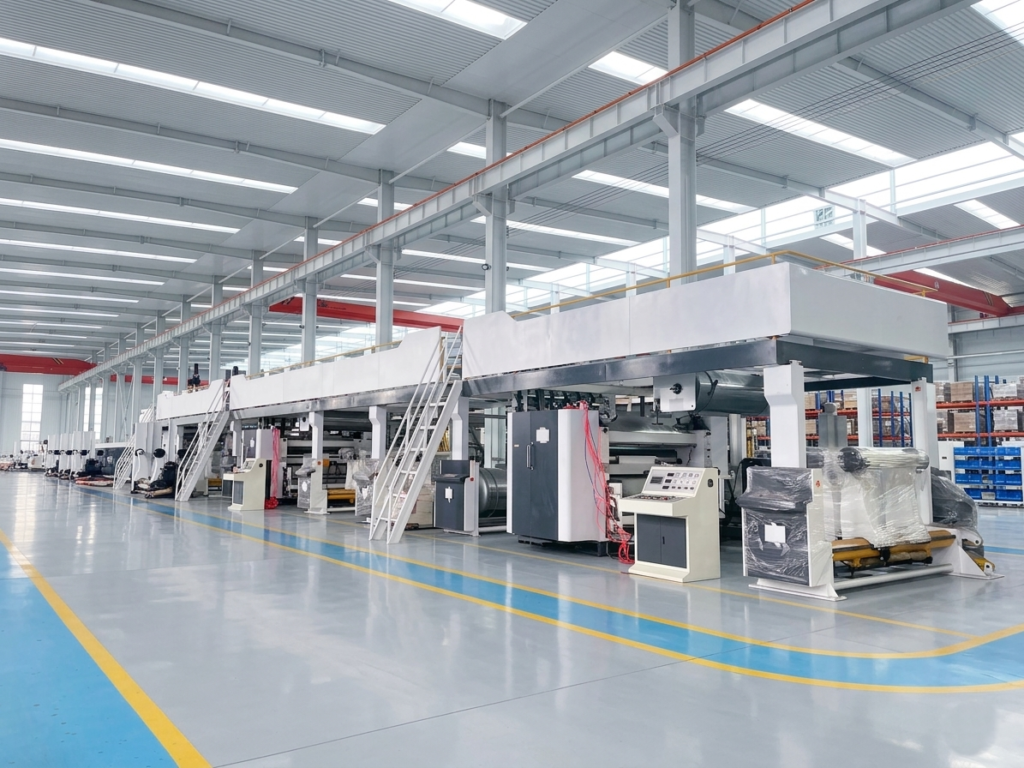
For the full working-width and flute-combination specification sheet matched to your board mix, inquire for Direct-Factory Wholesale B2B Pricing & Lead Times and specify your target flute combinations and maximum sheet width up front.
Vetting a First-Tier Supplier: The Closing Checklist
Return to the three benchmarks that opened this audit — dual single-facer synchronization, independent per-layer glue control, and PLC-regulated bonding pressure across all five layers — and require documented data for each, not a brochure adjective. A supplier who can’t isolate these three systems on paper is not built for double-wall production at scale.
A practical due-diligence checklist before you sign:
- Request synchronization data for both single facers, captured at running speed, not idle
- Confirm glue-film consistency and heating-plate pressure uniformity across the full board width
- Ask for corrugating-roller coating specification and regrind interval, by roller position
- Verify flute-combination support matches your actual order mix (not just the flutes on the spec sheet)
- Confirm working width covers your largest SKU with margin, not exactly to the limit
Guangzhou Smart Machinery’s Corrugated Cardboard Production Line — built for 3, 5, and 7-ply configurations on one platform — is the 5 ply corrugated cardboard production line supplier this audit was built around: synchronized dual single-facer control, tungsten carbide corrugating rollers, and ±0.5 mm (±0.02 in) cut-off precision engineered for continuous double-wall production.
Frequently Asked Questions
Q: What makes a 5-ply (double-wall) production line different from a 3-ply line, beyond adding a glue station? A: A 5-ply line runs two single facers instead of one, each forming a separate fluted medium that must reach the double facer at matched speed and moisture state. That requires whole-line synchronization — handled here by a Central Monitoring Industrial PC — rather than the single-facer-only control a 3-ply line needs.
Q: Can one machine switch between 3-ply, 5-ply, and 7-ply production without a full retool? A: Yes. The line is built to switch between 3, 5, and 7-ply configurations, supported by the quick-change drawer roller design that completes a full roller-set swap in 10 minutes rather than requiring hours of teardown per flute-combination change.
Q: What flute combinations does a 5-ply double-wall line support? A: The line supports A, B, C, E, F, and BC/AAA flute profiles, covering the standard double-wall combinations (such as B-flute paired with C-flute) used for heavy transit and appliance-grade packaging as well as lighter retail-ready double-wall board.
Q: What documentation should I request before signing a purchase order for a double-wall line? A: A Factory FAT (Factory Acceptance Test) Protocol Sheet covering dual single-facer synchronization data, glue-film and bonding-pressure consistency across the double facer, corrugating-roller coating specification, and cut-off precision — all captured at running speed for your target working width.
Ready to Specify Your 5-Ply Production Line?
A single-facer speed rating on a brochure doesn’t tell you how a double-wall line bonds, synchronizes, or holds flute geometry over thousands of operating hours — that data has to come from the supplier in writing. Request a Factory FAT Protocol Sheet documenting dual single-facer synchronization and bonding-pressure data for the working width your board mix requires.
For plants ready to move on pricing and lead times, inquire for Direct-Factory Wholesale B2B Pricing & Lead Times and speak directly with Guangzhou Smart Machinery’s engineering team about your flute-combination mix, target daily tonnage, and site infrastructure.