Vetting a 3 ply corrugated cardboard production line comes down to three checks that a brochure won’t answer for you. First, corrugating roller metallurgy — an untreated steel roller loses flute geometry within a few thousand running hours, and every micron lost there gets paid for in extra starch and paper. Second, servo-synchronized bonding across the single facer and double facer, since independent glue control per layer is what keeps a 5-ply or 7-ply run from delaminating at speed.
Third, changeover architecture — how fast the line swaps rollers and reconfigures for the next order, since that number, multiplied across a production year, is often the single largest hidden cost in the machine. A line that scores well on top speed alone but weak on these three will show it in starch consumption, board rejects, or idle changeover hours within the first year.
A 3 ply corrugated cardboard production line (Single Wall) is an industrial system that bonds a fluted medium between two flat liners. In today, leading manufacturers like Guangzhou Smart Machinery utilize Lead-Edge Feeding and Multi-Stage Tension Control to produce high-strength board for RSC (Regular Slotted Containers). Modern lines are engineered to handle various flute profiles (A, B, C, or E) while maintaining a linear production speed of up to 150-250m/min, ensuring maximum board stiffness and vertical stacking strength for relocation and industrial shipping.
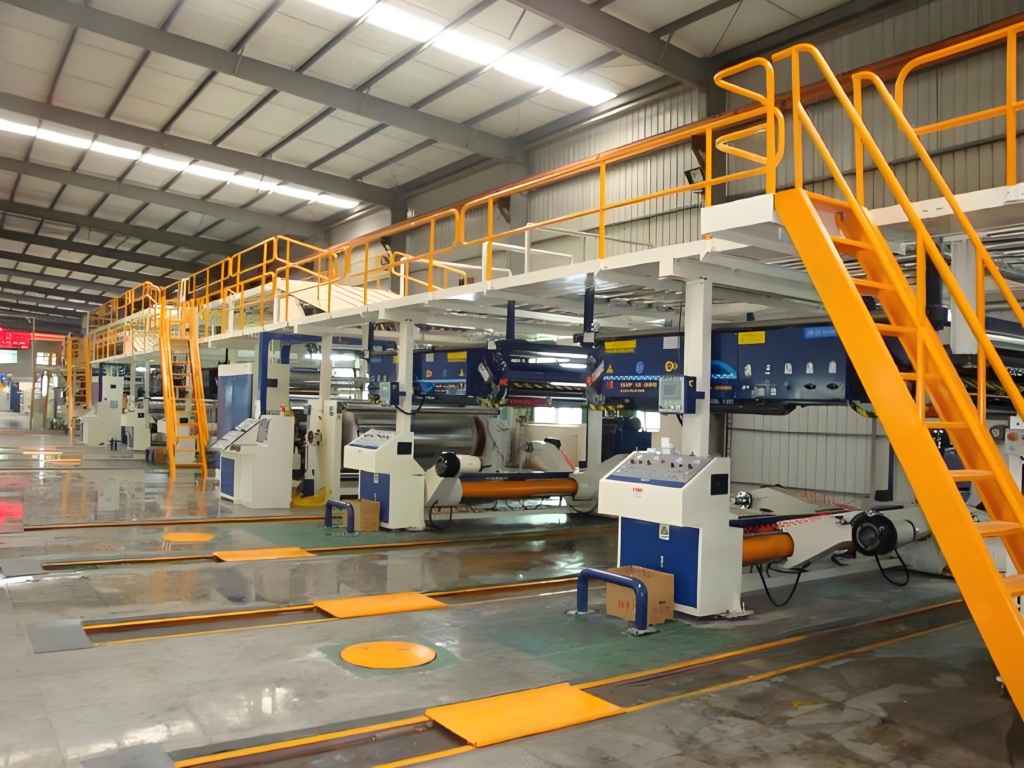
https://gzsmartmachinery.com/product/corrugated-cardboard-production-line/
Engineering Benchmark: Corrugator Line Tier Comparison
| Engineering Criterion | Entry-Level Line | Mid-Tier Automated Line | Guangzhou Smart Machinery (3/5/7-Ply) |
|---|---|---|---|
| Corrugating Roller Metallurgy | Untreated steel, wears within months | Hardened steel, moderate lifespan | Tungsten carbide coating (supersonic spraying), constant flute height across roller life |
| Flute Forming Method | Mechanical pressure only | Basic vacuum assist | Vacuum suction structure for stable, consistent flute formation |
| Bonding / Glue Control | Fixed-rate glue application | Single-zone servo control | Independent servo-motor glue metering per layer, uniform film at any speed |
| Roller / Order Changeover | Full manual teardown, 45+ min | Partial quick-release, ~20–30 min | Quick-change drawer design, complete roller swap in 10 minutes |
| Line Speed | Under 150 m/min (492 FPM) | 150–250 m/min (492–820 FPM) | Up to 300 m/min (984 FPM) on single facer |
| Layer Versatility | Fixed configuration | 3-ply or 5-ply, hardware swap required | Switches between 3-ply, 5-ply, and 7-ply on one line |
| Cut-Off Precision | ±2.0 mm (±0.08 in) or looser | ±1.0 mm (±0.04 in) | AC servo helical knife, ±0.5 mm (±0.02 in) |
| Control Architecture | Standalone panel per section | Partial line integration | Central Monitoring Industrial PC synchronizing single facer through stacker |
Filtering a 3 Ply Corrugated Cardboard Production Line Supplier from a Catalog Reseller
Most catalog resellers of a 3 ply corrugated cardboard production line sell whatever corrugator is available from a third-party fabricator that quarter, with no control over roller metallurgy or PLC integration. An OEM that engineers its own single facer, double facer, and control architecture as one synchronized system can document flute consistency and glue-film uniformity in writing — a reseller re-badging someone else’s line usually cannot.
That distinction matters most once the line has run for a year. A reseller’s warranty covers the machine; it rarely covers a starch-consumption or flute-height guarantee, because the reseller doesn’t control the roller coating process. An OEM that manufactures its own tungsten-carbide-coated rollers can put a number on flute-height retention because they control that variable directly.
Roller Metallurgy: Why Tungsten Carbide Coating Determines Starch and Paper Cost
Flute height degrades gradually on an untreated or basic hardened-steel roller, and the operator response is almost always the same — increase starch dosage to compensate for a weaker mechanical bond. That fix hides the real problem while quietly inflating consumable cost every shift the roller keeps wearing. Tungsten-carbide corrugating rollers, applied via supersonic spraying, hold flute geometry across the roller’s service life instead of degrading month over month, which is what actually protects starch and paper consumption rather than just delaying the symptom.
Ask any 3 ply corrugated cardboard production line supplier for the roller coating specification and expected service interval in writing before ordering, not a verbal assurance about “durability.” A supplier unwilling to commit that number in a technical spec sheet is telling you the roller is a commodity part, not an engineered one.
Bonding Integrity: Independent Servo Control Across the Single Facer and Double Facer
Uniform bonding at 300 m/min (984 FPM) requires glue metering that adjusts with speed, not a fixed-rate pump tuned for one line setting and left alone. Independent servo-motor control for each layer keeps the glue film consistent whether the line is running 3-ply at full speed or reconfigured for a 7-ply heavy-duty board at a slower rate. Request a Factory FAT (Factory Acceptance Test) Protocol Sheet documenting glue-film consistency data across speed changes before signing — bond failure under load almost always traces back to a glue system that couldn’t adjust fast enough during a speed or order change.
PLC-controlled heating plates on the double facer apply the pressure needed to preserve flute structural integrity through the bonding stage, which is the difference between a board that holds its edge crush strength and one that looks fine off the line but crushes in the warehouse stack. That pressure control matters more, not less, as layer count increases from 3-ply to 5-ply or 7-ply configurations.
Changeover Economics: The 10-Minute Roller Swap and Digital Order Management
A corrugator that runs fast but changes over slowly loses those speed gains back in idle time between orders. The quick-change drawer design completes a full roller swap in 10 minutes, against 20 minutes or more on a partial quick-release system and 45 minutes or more on a fully manual teardown — a gap that compounds daily on a plant running multiple SKUs per shift.
A Central Monitoring Industrial PC ties the single facer through the stacker into one synchronized system, supporting digital order management so a changeover is a stored parameter recall rather than a manual re-set of every station by hand. That same system is what minimizes material waste during the changeover window itself, since stations reconfigure together instead of drifting out of sync one at a time.
Run the arithmetic on your own shift pattern before comparing quotes on speed alone. A plant running six order changes per shift loses roughly two to three hours a week to changeover on a 45-minute manual teardown system, against roughly 20 minutes a week on the 10-minute drawer design — a gap that shows up directly in billable production hours, not just on a spec sheet.
Layer Versatility: Specifying for 3, 5, or 7-Ply Without New Capital
A line locked into a fixed 3-ply configuration forces a full capital re-purchase the moment a customer specifies a heavier 5-ply or 7-ply board for a bulkier or heavier product line. A corrugator engineered to switch between 3-ply, 5-ply, and 7-ply on the same hardware protects that capital decision against a shift in your customer mix over the next five to ten years.
Working width of 1,800 mm to 3,300 mm (70.9 in to 129.9 in), combined with support for A, B, C, E, F, and BC/AAA flute profiles, is what determines whether a 3 ply corrugated cardboard production line can actually cover your full box-size and board-strength range from one machine, rather than one width band of it.
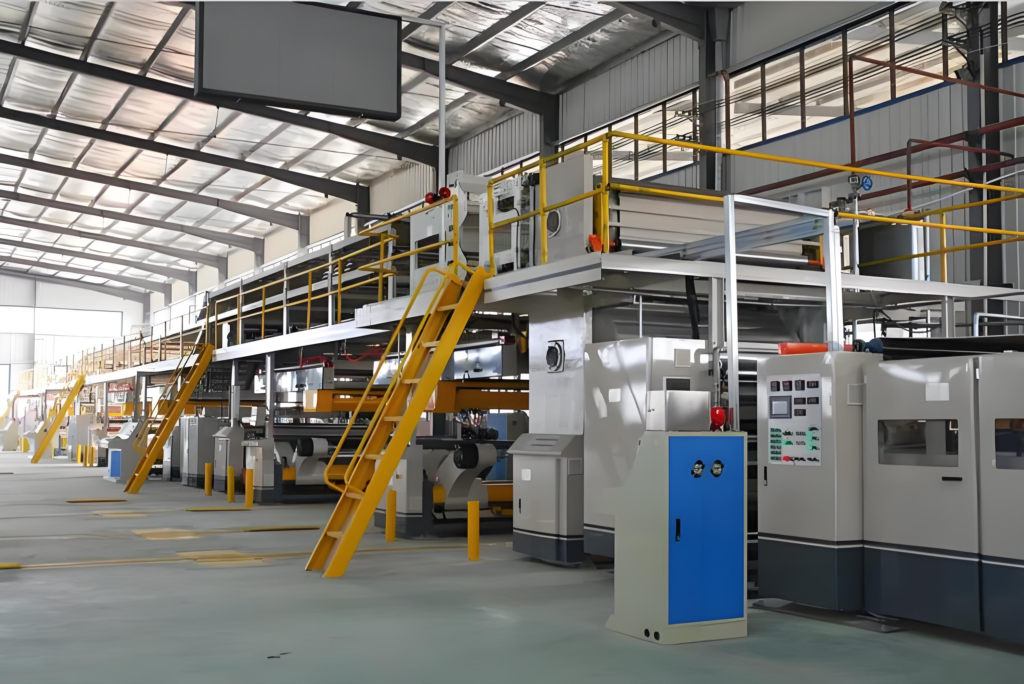
inquire for Direct-Factory Wholesale B2B Pricing & Lead Times
Vetting a 3 Ply Corrugated Cardboard Production Line Supplier: The Non-Negotiable Checklist
Return to the three checks that opened this audit — roller metallurgy, servo-synchronized bonding, and changeover architecture — and require documentation for each rather than a verbal assurance.
A practical due-diligence checklist before you sign:
- Request the corrugating roller coating specification and expected flute-height retention interval in writing
- Confirm glue-film consistency data across a full speed range, not just top-speed conditions
- Verify actual roller-swap time on a reference installation, not a spec-sheet estimate
- Confirm working width (1,800–3,300 mm / 70.9–129.9 in) and flute profile support match your current and planned box range
- Ask whether the line supports 3/5/7-ply switching on existing hardware or requires a future capital purchase
Frequently Asked Questions
Q: What actually causes flute height to degrade on a corrugator line over time? A: Roller wear on untreated or basic hardened-steel corrugating rollers is the primary cause. As the roller surface wears, flute geometry weakens and operators typically compensate by increasing starch dosage, which raises consumable cost without solving the underlying wear problem.
Q: Can one line really run 3-ply, 5-ply, and 7-ply board without buying separate equipment? A: Yes, provided the single facer, double facer, and glue-metering system are engineered for multi-layer synchronization from the start. A line locked into one layer configuration at purchase typically cannot be retrofitted for this without significant rebuild cost.
Q: How much does changeover speed actually matter if the line’s top speed is already fast? A: Considerably — a line running 300 m/min (984 FPM) but taking 45 minutes to change rollers loses more production time per week than a slightly slower line with a 10-minute changeover, especially on plants running multiple SKUs per shift.
Q: What should we request before signing a purchase order for a 3-ply corrugator line? A: A Factory FAT (Factory Acceptance Test) Protocol Sheet documenting roller coating specification, glue-film consistency across speeds, cut-off accuracy, and verified changeover time on a reference installation.
Ready to Specify Your Next Corrugator Line?
Brochure speed ratings are a starting point, not a purchase decision. Request a Factory FAT Protocol Sheet documenting roller metallurgy, bonding consistency, and changeover time before you commit capital.
For plants ready to move on pricing and lead times, inquire for Direct-Factory Wholesale B2B Pricing & Lead Times and speak directly with Guangzhou Smart Machinery’s engineering team about your working-width, flute-profile, and layer-configuration requirements.