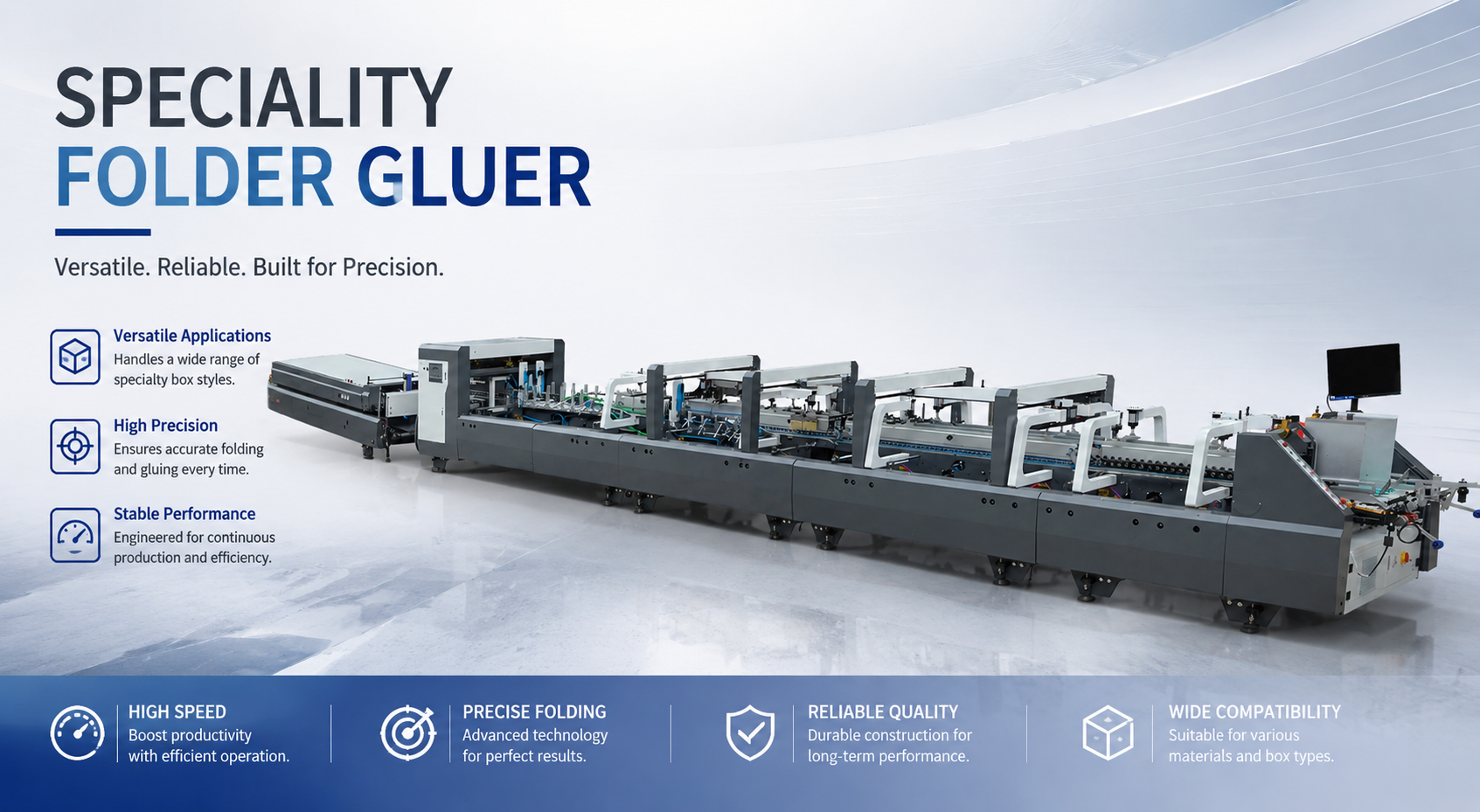
A speciality folder gluer isn’t a standard line with the chassis scaled down — it’s a different engineering problem. Three benchmarks separate a purpose-built small-format machine from a shrunk large-format one: pre-fold geometry engineered for short, tall cartons rather than adapted from RSC tooling, dedicated bottom-lock hardware for irregular box shapes instead of a bolt-on accessory, and independent servo control per section so small-format kinetics don’t inherit the inertia problems of a downsized large machine.
A supplier who can’t explain why their small-format line isn’t just a large machine with narrower belts isn’t selling a speciality folder gluer — they’re selling a compromise.
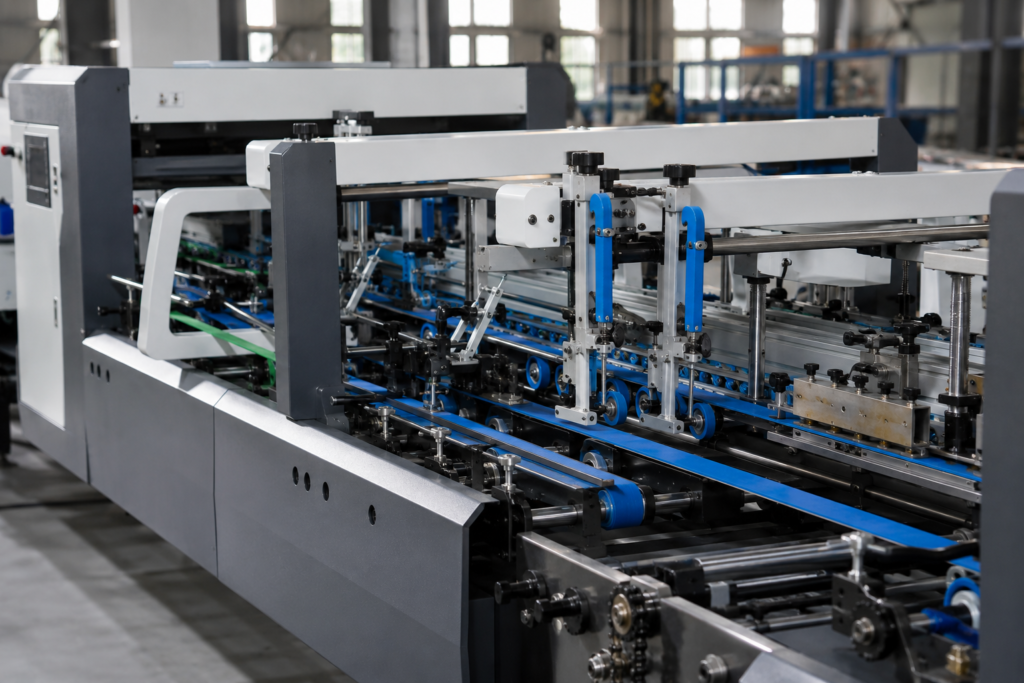
https://gzsmartmachinery.com/product/mini-flexo-folder-gluer/
Engineering Benchmark: Why a Scaled-Down Large Machine Isn’t a Speciality Folder Gluer
Most listings for a “speciality folder gluer” show a compact footprint and call it purpose-built. The real test is whether the pre-fold geometry, bottom-lock tooling, and control architecture were engineered from the ground up for small and irregular formats, or whether they’re a large-format design running narrower belts.
Downsized legacy equipment tends to fail on small blanks in predictable ways — disproportionate belt tension, excessive pulley inertia, and vacuum zones sized for board that’s twice as large. Those failure modes don’t show up on a brochure spec sheet; they show up on the production floor once the machine is running your actual box sizes.
| Engineering Criterion | Tier 3 Scaled-Down Machine | Tier 2 Partial-Servo Assembler | Guangzhou Smart Machinery (SHH-AKJ Series) |
|---|---|---|---|
| Pre-Fold Geometry | Fixed 180° only, adapted from large-format tooling | Limited adjustment, single angle | Fold 1/3 at 180° and 135°, Fold 2/4 at 180°, purpose-built for small but high cartons |
| Bottom-Lock Tooling | Not available or manual retrofit | Fixed bracket, slow changeover | 3-board tracking structure with reversible bracket for fast swap between box types |
| Irregular Box Gluing | Standard glue wheel only | Basic spray, single gun | Dedicated spraying system, 3 guns, water-based cold glue for irregular shapes |
| Control Architecture | Shared motor across sections | Partial servo, shared timing | Independent servo motor per section, electrical regulating board |
| Board Compatibility | Single GSM range | 2–3 GSM bands | 200–800 GSM, E-flute/F-flute |
| Max Liner Speed | 100–150 m/min (328–492 FPM) | 180–220 m/min (591–722 FPM) | Up to 300 m/min (984 FPM) |
Inside the Line: Feeding, Alignment, and Pre-Fold Architecture
A genuine speciality folder gluer starts with feeding calibrated for small blanks rather than large-format tooling running at reduced width. Adjustable feeding belts paired with a continuously variable speeder hold stable, smooth transmission, and a one-touch pneumatic knife lets an operator adjust belt position without a tool change between jobs.
An aligner section corrects the board as it leaves the feeder, with drive pressure adjustable up and down to accommodate different paper thicknesses — a detail that matters more on small blanks, where minor misalignment compounds faster than on large-format sheets. The pre-fold section uses a double-board structure with a dedicated pre-folding knife, holding fold angles of 180° and 135°, purpose-built for cartons that are small in footprint but tall in profile.
That 135° angle is the tell for genuine speciality engineering: standard large-format lines fold at 180° because that’s what RSC geometry requires, and retrofitting a 135° pre-fold onto that architecture is a compromise, not a design choice. On this line, folds 1 and 3 run at 180° and 135°, folds 2 and 4 hold 180°, and the bottom is folded and glued as part of the same pass.
Bottom-Lock and Irregular-Box Tooling: The Reversible Bracket Advantage
Special-shaped cartons need bottom-lock tooling engineered as a first-class feature, not a manual workaround. A 3-board tracking structure drives the upper gluer through automatic gluing and forming for bottom-locked boxes, with bottom-folding speed of 50–200 pieces per minute depending on box complexity.
The bottom-lock assembly sits in a reversible bracket, which is what actually determines changeover time between a bottom-fold box and a standard box style — a fixed bracket forces a full mechanical rebuild, while a reversible one flips into position in a fraction of that time. For boxes with irregular geometry that a standard glue wheel can’t reach cleanly, a dedicated spraying system with three guns applies water-based cold glue with the sizing accuracy that irregular shapes demand.
Ask for changeover-time data between box types before comparing peak speed. Request a Factory FAT (Factory Acceptance Test) Protocol Sheet documenting bottom-lock changeover time, spray-gluing accuracy, and pre-fold angle repeatability at running speed.
Board Compatibility and Surface Treatment: GSM Range and the Grinding Station
A speciality folder gluer earns that label partly through the range of substrates it handles cleanly, not just box geometry. This line runs 200–800 GSM cardboard across E-flute and F-flute — a range that covers everything from lightweight retail cartons to heavier micro-flute board without a tooling swap.
A grinding station treats the paper surface ahead of gluing, which matters specifically for UV-coated or laminated board where a standard glue wheel would bond poorly to the treated surface. This is a detail most standard folder-gluer spec sheets don’t address at all, because it’s only relevant once you’re running the coated and laminated stock that speciality small-format cartons — cosmetics, electronics, premium retail — actually use.
- Confirm GSM range and flute compatibility against your actual board stock, not a generic range
- Ask specifically whether coated or laminated board requires the grinding station or a different glue formulation
- Request the pre-fold angle tolerance data, not just the nominal 180°/135° spec
- Verify the spray-gluing system’s gun count and coverage against your most irregular box shape
Changeover and Throughput for Mixed Special-Shape Runs
Peak speed of 300 m/min (984 FPM) only holds meaning against real changeover data, since speciality lines by definition run smaller, more varied batches than a standard RSC line. Photo electronic counting and a kicking paper device handle output pressing and packing after the count, while a feeding paper inspection device catches misfeeds before they cascade into a jam.
Independent servo control on each section — feeder, aligner, pre-fold, folding, pressing — is what lets the machine hold registration across a genuinely mixed run of box sizes and shapes, rather than requiring a full mechanical reset between jobs. That per-section independence is the same architecture that supports the 24–35 kW, 380V/50Hz, 3-phase power draw scaling to whichever combination of stations a given job actually uses.
Vetting a First-Tier Speciality Folder Gluer Supplier: The Closing Checklist
Return to the three benchmarks that opened this audit — purpose-built pre-fold geometry, dedicated bottom-lock tooling, and independent per-section servo control — and require evidence for each rather than a brochure claim. A supplier who can’t explain their pre-fold angle engineering or produce bottom-lock changeover data is likely selling a scaled-down standard line.
A practical checklist before you sign:
- Request the Factory FAT Protocol Sheet with pre-fold angle repeatability and bottom-lock changeover time
- Confirm GSM range (200–800) and flute compatibility (E/F-flute) against your actual board stock
- Verify the spray-gluing system’s accuracy on your most irregular box shape, not a standard RSC sample
- Get weight (5,500 kg / 12,125 lb) and footprint (15,000 x 1,700 x 1,400 mm / 590.6 x 66.9 x 55.1 in) confirmed against your floor layout
Guangzhou Smart Machinery’s Mini Folder Gluer (SHH-AKJ 1100AKJ) — purpose-built 180°/135° pre-fold geometry, reversible bottom-lock bracket, and independent servo control per section at up to 300 m/min (984 FPM) — is the speciality folder gluer this audit was built around.
Frequently Asked Questions
Q: What actually makes a folder gluer “speciality” rather than just a smaller standard machine? A: Pre-fold geometry engineered specifically for small, tall cartons — 180° and 135° folds rather than a single 180° angle adapted from large-format tooling — combined with dedicated bottom-lock hardware and independent servo control per section.
Q: Can this line handle irregular or special-shaped boxes that a standard glue wheel can’t reach? A: Yes. A dedicated spraying system with three guns applies water-based cold glue for irregular geometries, separate from the standard bottom-lock gluing and forming process.
Q: What board thickness and flute types does this machine support? A: 200–800 GSM cardboard across E-flute and F-flute, with a grinding station available for UV-coated or laminated stock that needs surface treatment before gluing.
Q: How fast is changeover between a bottom-fold box and a standard box style? A: The bottom-lock assembly sits in a reversible bracket specifically to cut that changeover time, rather than requiring the full mechanical rebuild a fixed bracket would demand.
Q: What should I request before signing a purchase order? A: A Factory FAT Protocol Sheet documenting pre-fold angle repeatability, bottom-lock changeover time, and spray-gluing accuracy on your specific box geometry, along with confirmed GSM range and footprint dimensions.
Ready to Specify Your Speciality Line?
A compact footprint alone doesn’t make a machine purpose-built — pre-fold geometry, bottom-lock changeover time, and per-section servo control are what actually determine whether it handles your specific box mix. Request a Factory FAT Protocol Sheet documenting all three before committing capital.
For plants ready to move on pricing and lead times, inquire for Direct-Factory Wholesale B2B Pricing & Lead Times and speak directly with Guangzhou Smart Machinery’s engineering team about your board mix, box geometry, and target daily volume.