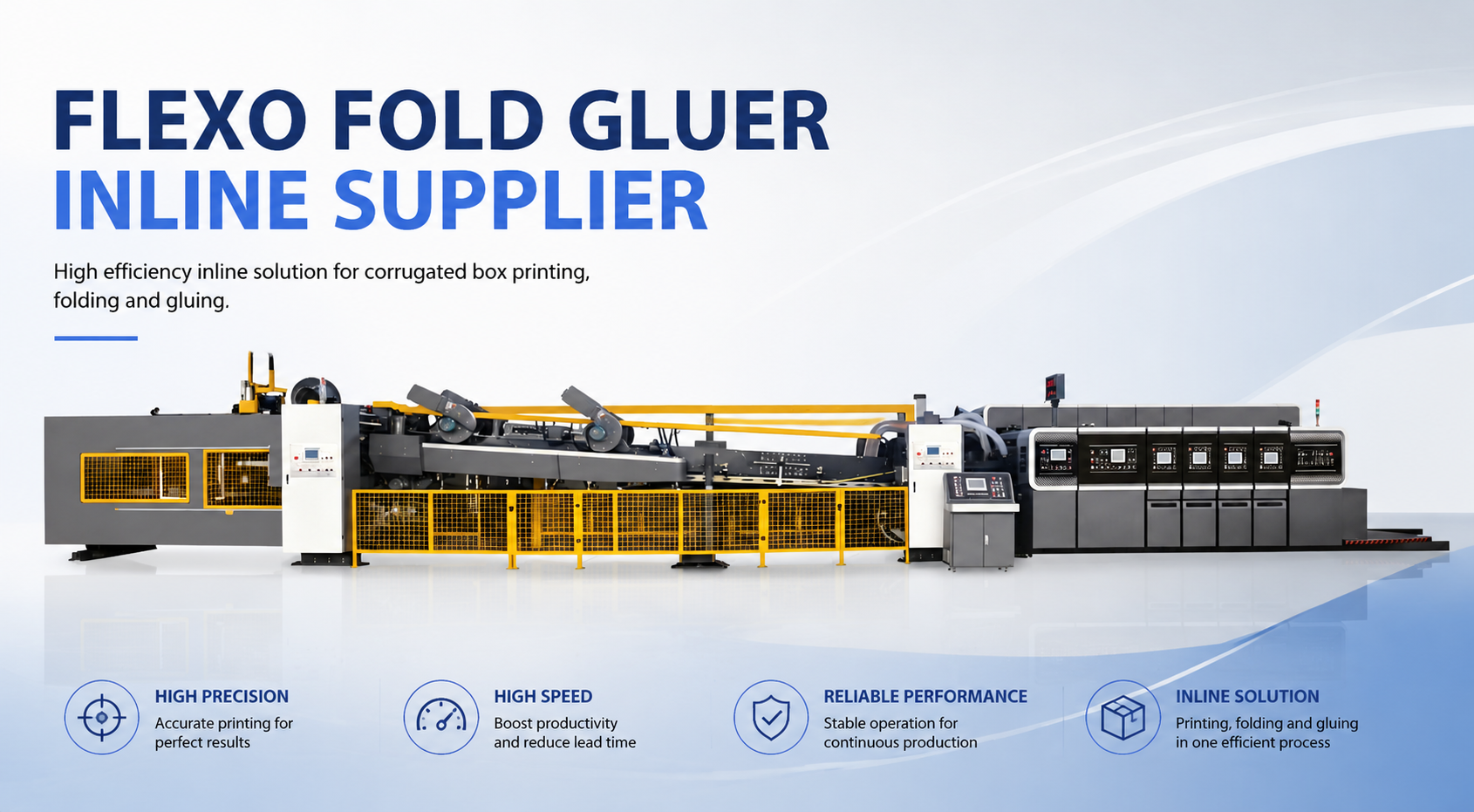
Vetting a flexo fold gluer inline supplier means checking one thing most sales decks never address directly: does this factory manufacture every module in the line, or assemble modules sourced from elsewhere and sell it as one system. First, confirm printing, slotting, die-cutting, folding, and gluing are built by the same factory, because an inline system has no work-in-progress buffer between stations — one weak module stops the entire line, not just its own station. Second, get one documented service and spare-parts contact for the whole line, not a different vendor per module. Third, require registration tolerance published as one accuracy chain across all modules, not blended marketing language. A supplier who can’t confirm all three is selling you a shared point of failure, not an integrated system
https://gzsmartmachinery.com/product/flexo-folder-gluer-inline-printing-machine/
Engineering Benchmark: Three Tiers of Inline Supplier Accountability
Most companies marketing a “flexo fold gluer inline” system are system integrators — they source a printing unit from one factory, a folder-gluer from another, and bolt them together under one brand name. The gap that actually matters shows up in three places: whether one factory manufactures every module, whether there’s a single service contact when something fails, and whether registration tolerance is published as one continuous chain.
| Engineering Criterion | System Integrator (Bolted Modules) | Partial-Manufacturer (Builds Some, Sources Rest) | Guangzhou Smart Machinery (Full In-House Inline) |
|---|---|---|---|
| Module Manufacturing Origin | Multiple factories, rebadged under one name | Frame in-house, electronics/printing sourced | Printing, slotting, die-cutting, folding, and gluing built by one factory |
| Service Contact Structure | Different vendor per module | One frame contact, printing issues redirected | Single service contact for the entire line |
| Downtime Risk Profile | Cascading failure, no shared diagnostics | Partial — frame issues isolated, print issues not | Documented cascading-downtime risk, single point of accountability |
| Registration Chain | Separate tolerances per vendor, rarely reconciled | Partially published | Topping, feeding, slotting, die-cutting published as one chain — ±0.5 mm / ±0.02 in topping |
| Spare-Parts Catalog | Multiple catalogs, multiple lead times | Split catalog | One catalog, one lead time, across all modules |
| Warranty Scope | Fragmented, module-by-module | Partial coverage | Single warranty covering the full inline system |
What “Inline” Actually Means — and Why a Bolted-Together Line Multiplies Supplier Risk
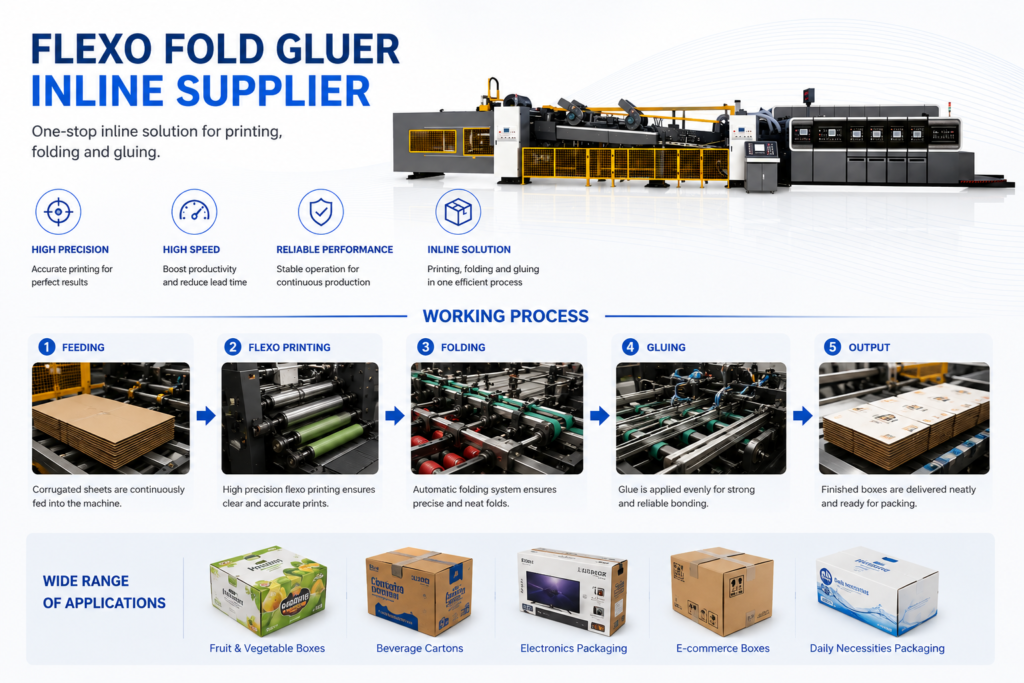
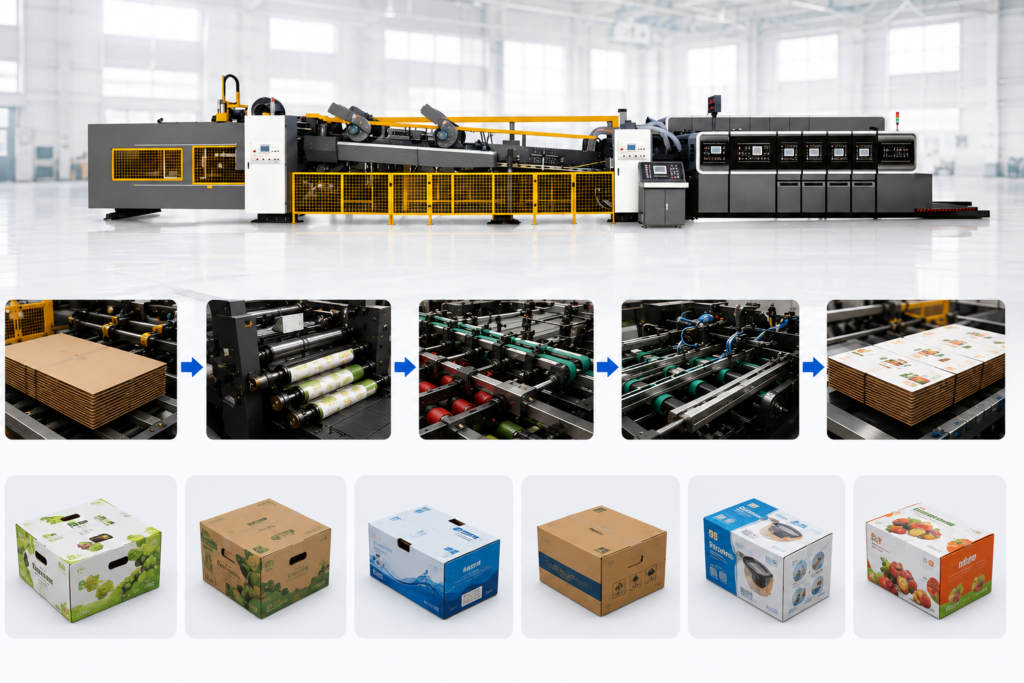
An inline flexo fold gluer runs printing, slotting, die-cutting, folding, and gluing as one continuous, synchronized pass — board enters at the feeder and exits as a finished, counted carton with zero intermediate staging. That synchronization only works if every module’s drive timing references the same control architecture, which means the safest engineering assumption is that one factory built the entire line, not that five separately-designed machines happen to run at compatible speeds.
A system integrator selling a “bolted-together” inline line is selling five points of failure instead of one. When the printing unit’s phase timing drifts against the die-cutter’s cylinder rotation, no single engineer at the integrator’s company owns the fix, because the printing module and the die-cutting module were never designed by the same team against the same specification.
Single-Source Manufacturing: Why Module Origin Determines Who Answers When the Line Stops
The single question that separates a real flexo fold gluer inline supplier from a system integrator is simple: who built the printing unit, and who built the folder-gluer at the other end of the same line. On Guangzhou Smart Machinery’s 920–1632 model range, the lead-edge feeder, the flexo printing unit with ceramic anilox rollers, the motorized slotting unit, the rotary die-cutter, and the folder-gluer are engineered on one platform architecture, not sourced separately and matched at final assembly.
That single-source origin is what makes the published accuracy chain mean something. Topping accuracy runs ±0.5 mm / ±0.02 in, feeding accuracy ±1 mm / ±0.04 in, slotting accuracy ±1.5 mm / ±0.06 in, and die-cutting accuracy ±1 mm / ±0.04 in — four figures that only stay consistent across a full production run if one factory engineered all four modules against the same drive logic from the start.
The Cascading Downtime Math: Why One Weak Module Idles the Whole Inline System
A standalone converting line has work-in-progress buffers between stations — printed sheets stack up while the folder-gluer catches up, and the printing press keeps running. An inline system has none of that by design, which is precisely what eliminates forklift transit and floor space, but it also means a jam or fault in any single module stops board flow through every module behind it.
That cascading structure changes what “downtime” costs on an inline line compared to a standalone setup. A worn die-cutting pad on a standalone system idles one machine; the same worn pad on an inline system idles the printing unit, the slotter, and the folder-gluer simultaneously, because none of them can process board that hasn’t cleared the station ahead of it.
Request a Factory FAT (Factory Acceptance Test) Protocol Sheet confirming registration tolerance across every module — not just the printing unit — before specifying an inline configuration.
Wear-Component Metallurgy the Supplier Should Document Across Every Module
Cascading downtime risk means wear-component quality matters more on an inline system than on a standalone line, because a single worn part takes down five production stages instead of one. Guangzhou Smart Machinery specifies high-grip, tensile-reinforced folding belts through the vacuum-assisted fold section, holding board flat against the fold bar without slipping as belt tension changes over the duty cycle.
The feed section runs tungsten-carbide-coated friction plates to resist abrasive board dust at high throughput, and the glue station meters adhesive through high-frequency electronic glue valves rather than a mechanical cam-timed nozzle. The die-cutting unit adds imported polyurethane rubber pads with linear velocity compensation, and all drive gears across every module are alloy steel, heat-treated and ground — a supplier who can name these materials for each module has actually engineered the line as one system; a supplier who can only describe the frame’s construction is likely reselling the printing and die-cutting units from someone else.
Spare-Parts and Service Architecture for a True Single-Source Inline Supplier
A genuine single-source flexo fold gluer inline supplier maintains one spare-parts catalog and one documented lead time across every module, because it manufactures every module. A system integrator cannot do this — a failed anilox roller routes through the printing module’s original vendor, while a failed folding belt routes through an entirely different supply chain, and the plant is left coordinating between two companies while the line sits idle.
Ask directly whether service response and spare-parts sourcing are handled by one team or routed by module. If a supplier’s answer requires naming more than one factory, the line was never engineered as a single system in the first place, regardless of what the sales brochure calls it.
Vetting a Flexo Fold Gluer Inline Supplier: The Closing Checklist
Return to the three benchmarks this audit opened with — single-source module manufacturing, one documented service contact, and a published cross-module registration chain — and require evidence of each before signing.
A practical due-diligence checklist before you commit capital:
- Ask directly which factory manufactures each module — printing, slotting, die-cutting, folding, gluing — and require a single name in writing
- Confirm whether service and spare-parts requests route through one contact or get redirected by module
- Request topping, feeding, slotting, and die-cutting accuracy as one published chain, not separate figures from separate vendors
- Ask how the supplier’s warranty is structured — one document covering the full line, or module-by-module coverage with gaps between them
- Confirm a Factory Acceptance Test runs on the complete assembled line, not individual modules tested in isolation
Guangzhou Smart Machinery’s Flexo Folder Gluer Inline Printing Machine is the single-source platform this audit was built around — the flexo fold gluer inline supplier relationship it supports covers printing, slotting, die-cutting, folding, and gluing from one factory, with ±0.5 mm / ±0.02 in topping accuracy and board thickness capacity up to 2–11 mm / 0.08–0.43 in, backed by one service contact and one spare-parts catalog across the full line.
Frequently Asked Questions
Q: What’s the real risk of buying an “inline” flexo fold gluer from a system integrator instead of a single-source manufacturer? A: Cascading downtime — because an inline system has no work-in-progress buffer between modules, a fault in any single station (printing, slotting, die-cutting, folding, or gluing) stops the entire line, and a system integrator selling modules from multiple factories can’t offer one accountable service contact when that happens.
Q: How do I confirm a supplier actually manufactures every module in-house? A: Ask directly which factory builds each module and require a single name in writing; a supplier who can only speak confidently about the frame or one module while deflecting on the others is likely reselling sourced components under one brand.
Q: What registration accuracy should a genuine inline flexo fold gluer supplier publish? A: A full chain, not one blended number — Guangzhou Smart Machinery publishes ±0.5 mm / ±0.02 in topping accuracy, ±1 mm / ±0.04 in feeding accuracy, ±1.5 mm / ±0.06 in slotting accuracy, and ±1 mm / ±0.04 in die-cutting accuracy across its full model range.
Q: What should I request before signing a purchase order for an inline system? A: A Factory FAT Protocol Sheet testing the complete assembled line rather than individual modules, written confirmation of single-source manufacturing across every module, and one documented service and spare-parts contact for the whole system.
Ready to Specify a True Single-Source Inline System?
A brand name on the frame doesn’t tell you who built the printing unit or who answers when the die-cutter jams at 2 a.m. Request a Factory FAT Protocol Sheet confirming single-source manufacturing and cross-module registration accuracy before you commit capital.
For plants ready to move on pricing and lead times, inquire for Direct-Factory Wholesale B2B Pricing & Lead Times and speak directly with Guangzhou Smart Machinery’s engineering team about your board format, order volume, and service requirements.