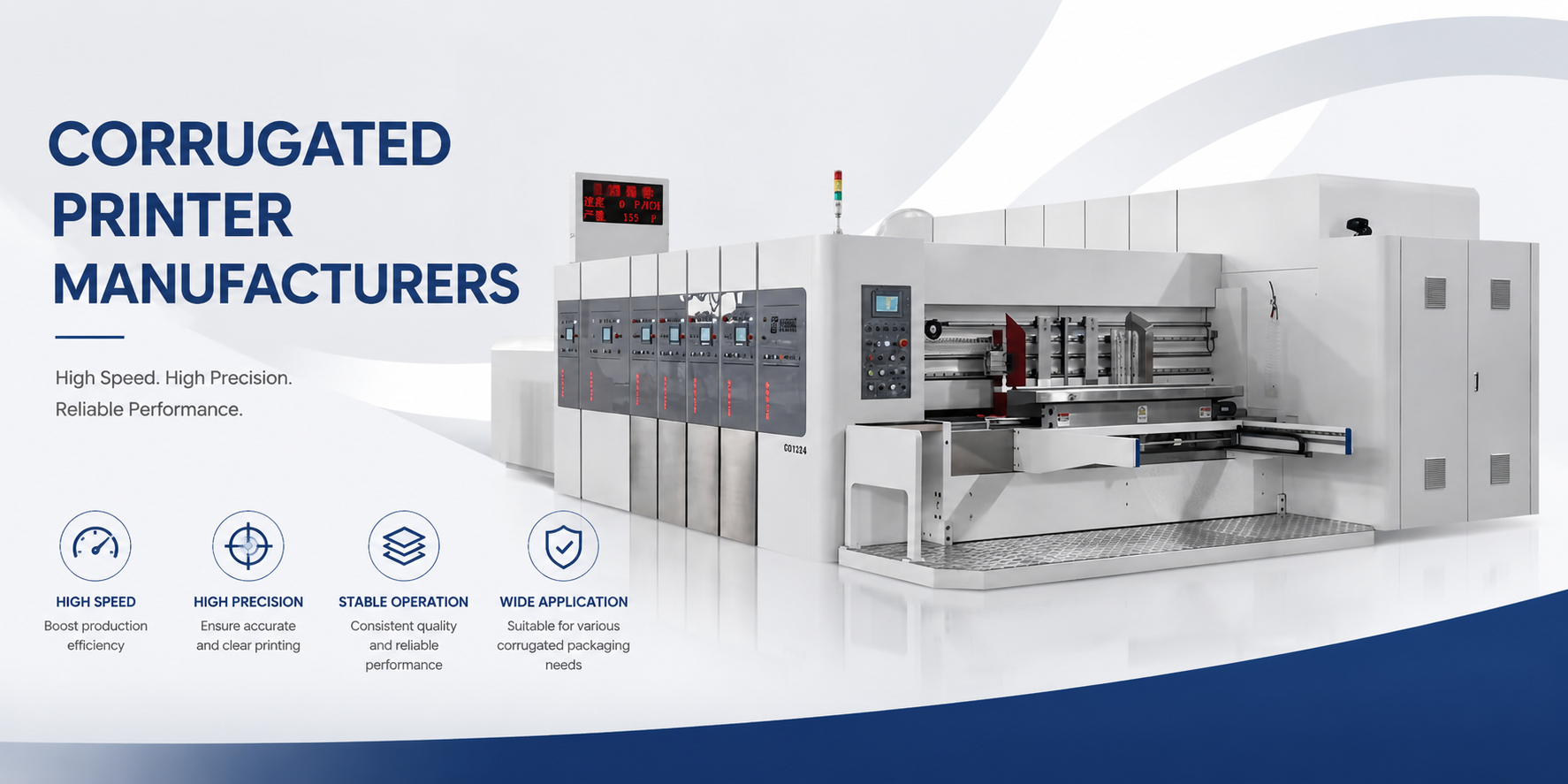
Vetting corrugated printer manufacturers means checking what happens when a repeat order comes back six months later, not just how the machine performs on day one. First, confirm the printing unit stores registration settings per job and recalls them automatically, because re-registering a repeat order from scratch burns setup time and scrap board on every changeover. Second, confirm wear-independent alignment — a printer that drifts out of registration as the die-cutting pad wears is quoting day-one accuracy, not five-year accuracy. Third, check the feeder is rated for the full board range you actually run, 3-ply through 7-ply, without crushing flutes at the higher end. A manufacturer who can’t document all three is selling a printing press, not a production asset.
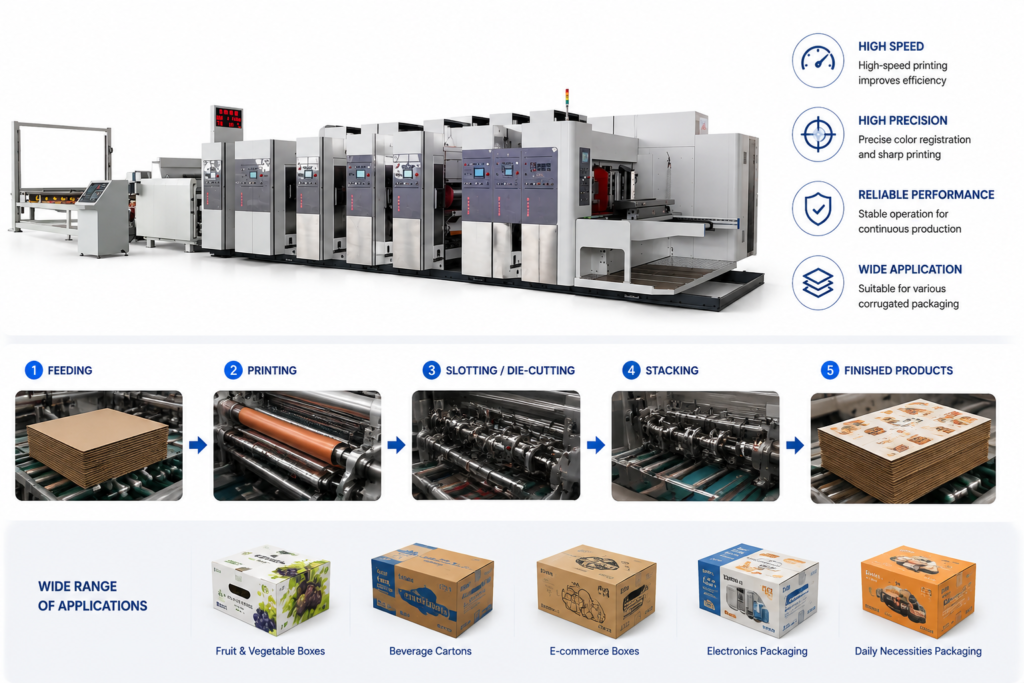
https://gzsmartmachinery.com/product/corrugated-box-printing-machine/
Engineering Benchmark: Three Tiers of Corrugated Printer Manufacturer Capability
Most corrugated printer manufacturer listings quote a single accuracy figure at time of installation and stop there, without addressing what happens to that figure after a few thousand operating hours or on a repeat job six months out. The gap that matters shows up in three places: whether registration settings recall automatically on repeat jobs, whether alignment holds as components wear, and whether the feeder is rated across the board-ply range a mixed-order plant actually runs.
| Engineering Criterion | Entry-Level / Trading-Co. Printer | Regional Fabricator | Guangzhou Smart Machinery (920–1632 Series) |
|---|---|---|---|
| Registration Recall on Repeat Jobs | Manual re-registration every run | Partial memory, manual verification required | “Automatic Zero-Return” and Memory functions, instant resume |
| Wear-Independent Alignment | Drifts with pad and gear wear | Periodic manual recalibration | Linear velocity compensation, alignment holds as components wear |
| Feeder Board-Ply Range | Rated for single board weight class | 3-ply to 5-ply, inconsistent above | 3-ply through 7-ply, adjustable without crushing flutes |
| Topping (Print Registration) Accuracy | Unpublished | ±1.0–1.5 mm, inconsistent by model | ±0.5 mm / ±0.02 in, published across the model range |
| Drive Gear Metallurgy | Standard steel, unspecified treatment | Partial heat treatment | Alloy steel, heat-treated and precision-ground |
| Model Range | Single fixed width | 2–3 widths | 920–1632, nine widths on one platform |
What Separates a Corrugated Printer Manufacturer from a General Converting-Line Assembler
A genuine corrugated printer manufacturer designs and builds the print engine itself — the anilox roller system, the phase-adjustment mechanism, the ink circulation path — rather than buying a generic print head and building a frame around it. That distinction matters because print quality on corrugated board isn’t just about ink transfer; it’s about holding registration between the printing unit and the downstream slotting and die-cutting stations that reference the same board.
A converting-line assembler that treats the printing unit as one purchased component among several has no engineering reason to guarantee that component’s registration will still track the die-cutter’s cylinder rotation after months of independent wear on each part. A manufacturer that designs both from the same drive logic does.
Inside the Print Engine: Anilox Rollers, Phase Adjustment, and the “Zero-Return” Registration Claim
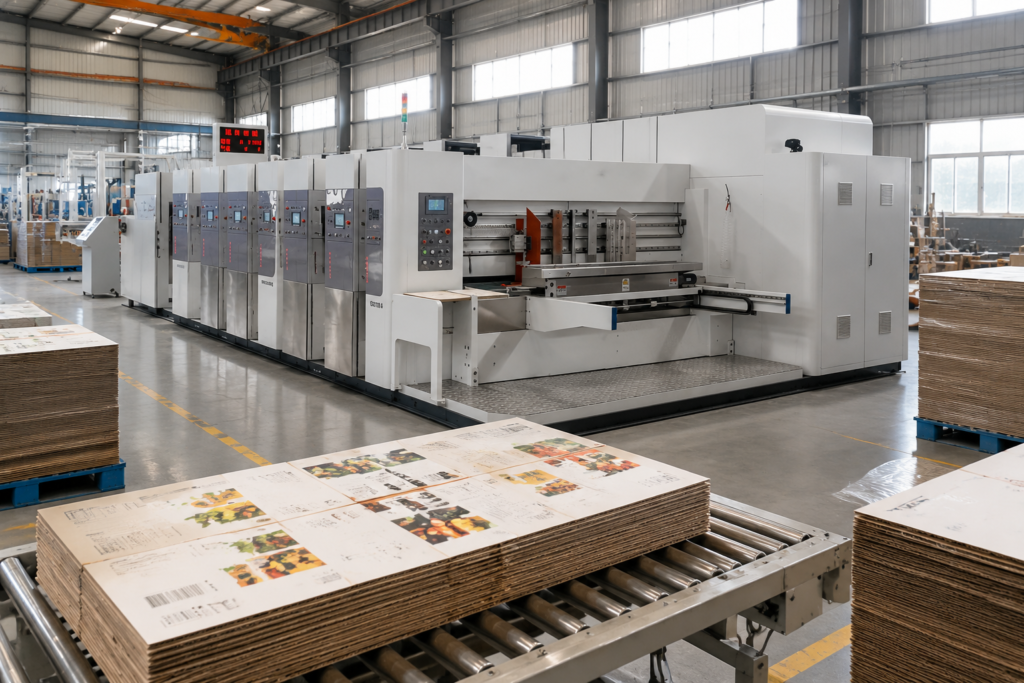
The print engine on a corrugated printer manufacturers shortlist should include laser-engraved ceramic anilox rollers paired with a motorized, PLC-controlled phase adjustment system — the mechanism that positions each printing unit’s plate cylinder relative to the board as it passes through. Guangzhou Smart Machinery’s 920–1632 series backs this with an “Automatic Zero-Return” and Memory function, which stores a job’s exact registration settings and recalls them on the next run instead of forcing a full manual re-registration.
That recall function is the print-specific benchmark most competitor spec sheets skip, because it only matters on repeat orders — a one-time demo run always looks accurate regardless of whether the memory function exists. A plant running the same customer’s box design monthly loses real setup time and scrap board every cycle it has to re-register a printing unit from zero instead of recalling a stored job.
Feeder Engineering for 3/5/7-Ply Board Without Crushing Flutes
The lead-edge feeder is a suction-assisted system, adjustable across 3-ply, 5-ply, and 7-ply board without crushing the flutes — a real engineering constraint, since a feeder tuned for single-wall board applies too much mechanical force to heavier double-wall and triple-wall stock, collapsing flute structure before the board ever reaches the print station. Suitable cardboard thickness runs 2–10 mm / 0.08–0.39 in on the compact end of the model range up to 2–11 mm / 0.08–0.43 in on the larger models, with standard printing plate thickness holding at 7.2 mm / 0.28 in across every model.
Max continuous feeding size scales from 860 × 2,150 mm / 33.9 × 84.6 in on the compact Model 920 up to 1,540 × 3,350 mm / 60.6 × 131.9 in on the jumbo Model 1632, so a plant running mixed board formats can specify one width class rather than qualifying a separate feeder design per size.
Request a Factory FAT (Factory Acceptance Test) Protocol Sheet confirming registration recall and feeder performance on your actual board-ply mix before specifying a model.
Wear-Independent Registration: Linear Velocity Compensation and Drive-Gear Metallurgy
Registration accuracy on a new machine is a starting number, not a guarantee. Linear velocity compensation technology is what keeps die-cutting and printing aligned as mechanical wear accumulates, adjusting for the slight timing drift that untreated components develop over thousands of operating hours rather than letting registration decay silently until scrap rates climb.
The feed section runs tungsten-carbide-coated friction plates to resist the abrasive wear high-volume board dust causes on unprotected steel, and board transport through the printing and slotting stages runs on high-grip, tensile-reinforced transport belts rather than standard rubber. Ink delivery runs through a precision metering and circulation system rather than a simple gravity-fed trough, holding consistent ink volume on the anilox roller as viscosity shifts with ambient temperature. All drive gears are alloy steel, heat-treated and precision-ground, which is the actual mechanical reason registration holds at ±0.5 mm / ±0.02 in rather than the marketing phrase “industrial-grade construction” on a generic spec sheet.
Model Range and the Accuracy Chain Behind the Print Engine
The full accuracy chain behind this print engine runs four published figures across every model in the 920–1632 range: topping (print registration) accuracy at ±0.5 mm / ±0.02 in, feeding accuracy at ±1 mm / ±0.04 in, slotting accuracy at ±1.5 mm / ±0.06 in, and die-cutting accuracy at ±1 mm / ±0.04 in. Printing roll position adjustment runs ±6 mm / ±0.24 in, and lateral displacement of the die-cutting anvil pad runs ±20 mm / ±0.79 in, both figures relevant to how much registration correction range an operator has available mid-run without a full mechanical reset.
Die cutter knife height holds at 25.4 mm / 1.0 in across the entire range, and max slot depth scales from 230 mm / 9.06 in on Model 920 to 410 mm / 16.14 in on Model 1632 — a wide enough range that a plant printing everything from small retail cartons to large transit boxes can stay on one manufacturer’s platform instead of qualifying two separate suppliers.
Vetting Corrugated Printer Manufacturers: The Closing Checklist
Return to the three benchmarks this audit opened with — automatic registration recall on repeat jobs, wear-independent alignment, and feeder capacity across your real board-ply range — and require documented proof of each before signing.
A practical due-diligence checklist before you commit capital:
- Request a live demonstration of the registration-recall function on a stored job, not just a fresh setup run
- Ask specifically how the manufacturer compensates for wear-driven registration drift — name the mechanism, don’t accept “high precision” as an answer
- Confirm the feeder’s rated board-ply range against your actual mix, especially at the heavier end where flute-crushing risk is highest
- Request topping, feeding, slotting, and die-cutting accuracy as four separate published figures for your specific model width
- Confirm a Factory Acceptance Test runs on your exact configuration, testing registration recall as part of the protocol, not just single-run accuracy
Guangzhou Smart Machinery’s Corrugated Box Printing Machine is the platform this audit was built around — the corrugated printer manufacturers comparison above maps directly to its published specifications: ±0.5 mm / ±0.02 in topping accuracy, automatic registration recall, and board handling from 3-ply through 7-ply without crushing flutes.
Frequently Asked Questions
Q: What does registration recall actually save on a repeat printing order? A: Setup time and scrap board on every changeover — Guangzhou Smart Machinery’s “Automatic Zero-Return” and Memory functions store a job’s exact registration settings and recall them instantly on the next run instead of requiring a full manual re-registration.
Q: How does a corrugated printer stay in alignment as it wears? A: Linear velocity compensation technology adjusts for timing drift between the printing and die-cutting stages as mechanical components wear, which is what keeps registration close to its rated ±0.5 mm / ±0.02 in figure well past the first few months of operation.
Q: What board thickness and ply range can this printer handle? A: 3-ply through 7-ply corrugated board, with suitable cardboard thickness running 2–10 mm / 0.08–0.39 in on compact models up to 2–11 mm / 0.08–0.43 in on the largest models in the 920–1632 range.
Q: What should I request before signing a purchase order with a corrugated printer manufacturer? A: A Factory FAT Protocol Sheet that tests registration recall on a stored job (not just a fresh setup run), documented wear-compensation mechanisms, and feeder performance across your actual board-ply mix.
Ready to Specify a Print Engine Built for Repeat Orders?
A single accuracy figure quoted at installation tells you nothing about registration six months and several thousand operating hours later. Request a Factory FAT Protocol Sheet confirming registration recall, wear compensation, and feeder performance across your board-ply mix before you commit capital.
For plants ready to move on pricing and lead times, inquire for Direct-Factory Wholesale B2B Pricing & Lead Times and speak directly with Guangzhou Smart Machinery’s engineering team about your board format range, order mix, and repeat-job volume.