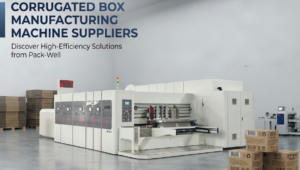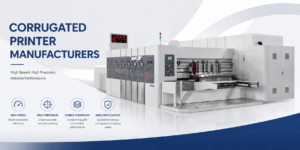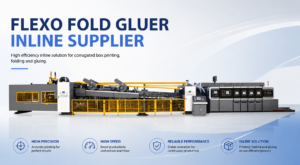
Vetting carton box flexo printing machine manufacturers starts with one question most brochures dodge: what’s the published registration tolerance across every module, not just the headline speed. First, get topping, slotting, and die-cutting accuracy figures for the specific model width you need, not a single “±0.5mm precision” claim covering an entire product line. Second, confirm the platform scales across formats — compact to jumbo — on one architecture, not a different frame design bolted together for each size. Third, check how the machine compensates for wear at speed: linear velocity compensation on the die-cutting pad, phase-adjustment memory on the printing unit. A manufacturer who can’t produce model-specific numbers for all three is selling a brochure, not an engineering spec.

https://gzsmartmachinery.com/product/flexo-folder-gluer-inline-printing-machine/
Engineering Benchmark: Three Tiers of Flexo Printing Manufacturer Capability
Most manufacturer listings quote one precision figure and stop, without breaking out where in the process that tolerance actually applies — printing registration, slotting, or die-cutting are three different accuracy chains, and a single “±0.5mm” headline number often only describes one of them. The gap shows up in whether a manufacturer publishes all four accuracy specs, whether they hold across the full model range, and whether wear compensation is built in or bolted on.
| Engineering Criterion | Entry-Level / Trading-Co. Machine | Regional Fabricator | Guangzhou Smart Machinery (920–1632 Series) |
|---|---|---|---|
| Topping (Print Registration) Accuracy | Unpublished, “high precision” only | ±1.0–1.5 mm, inconsistent by model | ±0.5 mm / ±0.02 in, published across the full range |
| Feeding Accuracy | Unpublished | ±1.5–2 mm | ±1 mm / ±0.04 in |
| Slotting Accuracy | Unpublished | ±2–3 mm | ±1.5 mm / ±0.06 in |
| Die-Cutting Accuracy | Unpublished | ±1.5–2 mm | ±1 mm / ±0.04 in |
| Model Range Scalability | Single fixed width | 2–3 widths, separate designs | 9-model range (920–1632), one platform architecture |
| Wear Compensation | None — accuracy decays with use | Manual recalibration only | Linear velocity compensation on die-cutting pad, printing-unit phase memory |
What Carton Box Flexo Printing Machine Manufacturers Actually Sell: One Line vs. Four Bolted-Together Machines
A genuine inline flexo folder gluer manufacturer sells one synchronized system — printing, slotting, rotary die-cutting, folding, and gluing running on a shared drive architecture in a single pass. A large share of the market instead assembles four separately-designed standalone machines, paints them the same color, and calls the result an “inline” system.
The difference shows up in registration. On a genuinely synchronized line, the printing unit’s phase position, the slotter’s blade timing, and the die-cutter’s cylinder rotation all reference the same drive logic, so a board that prints square also slots and cuts square. Bolted-together standalone units each run their own independent timing, and small phase drift between them compounds into a box that’s off-register by the time it reaches the folder-gluer stage.
Inside the Registration Chain: Topping, Slotting, and Die-Cutting Accuracy Across the Model Range
Vetting carton box flexo printing machine manufacturers means separating four accuracy figures that get blurred into one marketing number more often than not. Topping accuracy — the print registration to the board’s leading edge — is rated at ±0.5 mm / ±0.02 in, and this is the number that determines whether printed graphics land where they’re supposed to relative to the box’s fold lines and slots.
Feeding accuracy is rated separately at ±1 mm / ±0.04 in, governing how consistently the lead-edge feeder positions each board before printing starts — a looser tolerance here compounds into the topping accuracy figure downstream. Slotting accuracy runs ±1.5 mm / ±0.06 in and die-cutting accuracy ±1 mm / ±0.04 in, both published across the full model range rather than quoted for a single flagship size. Four separate numbers, each governing a different failure mode, is the actual audit — not one blended tolerance claim.
Board-Handling Range: Model Scalability From Compact to Jumbo Format
The model range runs from 920 up to 1632 — nine platform widths on one shared architecture rather than separate designs per size class. Suitable cardboard thickness runs 2–10 mm / 0.08–0.39 in on the compact end of the range up to 2–11 mm / 0.08–0.43 in on the largest models, and standard printing plate thickness holds at 7.2 mm / 0.28 in across every model.
Max continuous feeding size scales from 860 × 2,150 mm / 33.9 × 84.6 in on the compact Model 920 up to 1,540 × 3,350 mm / 60.6 × 131.9 in on the jumbo Model 1632, with max die-cutting size scaling in step from 880 × 2,080 mm / 34.6 × 81.9 in to 1,600 × 3,280 mm / 63.0 × 129.1 in. Slot depth capacity scales with the model too — 230 mm / 9.06 in maximum on Model 920 up to 410 mm / 16.14 in on Model 1632 — so a plant running mixed order sizes can specify one width class rather than qualifying a separate machine for every box format.
Request a Factory FAT (Factory Acceptance Test) Protocol Sheet confirming topping, slotting, and die-cutting accuracy on your specific model width before specifying an order.
Wear-Component Metallurgy Behind Consistent Registration at Speed
Registration accuracy on a new machine tells you nothing about registration accuracy at year five. Guangzhou Smart Machinery’s inline printing platform runs high-grip, tensile-reinforced folding belts through the vacuum-assisted fold section, holding board flat against the fold bar instead of letting it drift as belt tension changes with use.
The feed section uses tungsten-carbide-coated friction plates to resist the abrasive wear that high-volume board dust causes on unprotected steel, and glue metering runs through high-frequency electronic glue valves rather than a mechanical cam-timed nozzle. The die-cutting unit adds imported polyurethane rubber pads with linear velocity compensation, adjusting cut pressure as the pad wears rather than letting cut depth drift until an operator notices scrap increasing. All drive gears are alloy steel, heat-treated and ground, which is what actually determines whether the printing unit’s phase timing holds at ±0.5 mm / ±0.02 in after several thousand operating hours instead of only on day one.
Changeover and Control Architecture: What “Smart Control” Actually Means on the Floor
“PLC touchscreen control” appears on nearly every flexo printing machine manufacturer’s spec sheet, and it means almost nothing without specifics on what it actually adjusts. On this platform, the printing unit’s phase movement, slotter box height, slotter box length and width, and die-cutting roll position are all touchscreen-controlled independently, which is what makes a changeover between box formats a setting change instead of a mechanical re-tool.
A “Zero-Return” memory function stores prior print-registration settings, so a repeat order recalls its exact phase position instead of requiring the operator to re-register from scratch. Computerized slot spacing with both positive-knife and reverse-knife configurations available by model lets one line handle standard RSC slotting and more complex box styles without swapping tooling between runs.
Vetting Carton Box Flexo Printing Machine Manufacturers: The Closing Checklist
Return to the three benchmarks this audit opened with — four separately published accuracy figures, one platform architecture across the model range, and documented wear compensation — and require all three before signing.
A practical due-diligence checklist before you commit capital:
- Request topping, feeding, slotting, and die-cutting accuracy as four separate published figures, not one blended “precision” claim
- Confirm which model width in the manufacturer’s range matches your board format, and get that model’s specific spec sheet, not a flagship-model brochure
- Ask how the die-cutting pad and printing-unit phase timing compensate for wear, in writing, not just at time of installation
- Verify board thickness range (mm) against your actual stock, especially near the upper end of the manufacturer’s rated capacity
- Confirm a Factory Acceptance Test will run on your specific model configuration before shipment
Guangzhou Smart Machinery’s Flexo Folder Gluer Inline Printing Machine is the platform this audit was built around — the carton box flexo printing machine manufacturers comparison above maps directly to its published spec table: ±0.5 mm / ±0.02 in topping accuracy, a 920–1632 model range, and board thickness capacity up to 2–11 mm / 0.08–0.43 in, verified per model rather than quoted once for the whole line.

Frequently Asked Questions
Q: What’s the actual print registration accuracy on a carton box flexo printing machine? A: Topping accuracy — print registration to the board’s leading edge — is rated at ±0.5 mm / ±0.02 in on Guangzhou Smart Machinery’s 920–1632 model range, published consistently across every model width rather than only the flagship size.
Q: How many machine sizes are available, and does accuracy change between them? A: The platform spans nine model widths, from Model 920 up to Model 1632, with topping, feeding, slotting, and die-cutting accuracy figures published identically across the full range rather than degrading on larger formats.
Q: What board thickness range can this machine handle? A: 2–10 mm / 0.08–0.39 in on the compact end of the model range, up to 2–11 mm / 0.08–0.43 in on the largest models, with standard printing plate thickness at 7.2 mm / 0.28 in across every size.
Q: What should I request before signing a purchase order with a flexo printing machine manufacturer? A: A Factory FAT Protocol Sheet confirming topping, slotting, feeding, and die-cutting accuracy on your specific model width, plus written detail on how the die-cutting pad and printing-unit phase timing compensate for wear over time.
Ready to Specify Your Flexo Printing Line?
A single “high precision” claim on a spec sheet tells you nothing about which module it actually describes. Request a Factory FAT Protocol Sheet documenting topping, slotting, feeding, and die-cutting accuracy for the specific model width your board format requires.
For plants ready to move on pricing and lead times, inquire for Direct-Factory Wholesale B2B Pricing & Lead Times and speak directly with Guangzhou Smart Machinery’s engineering team about your board size range, order volume, and production format mix.