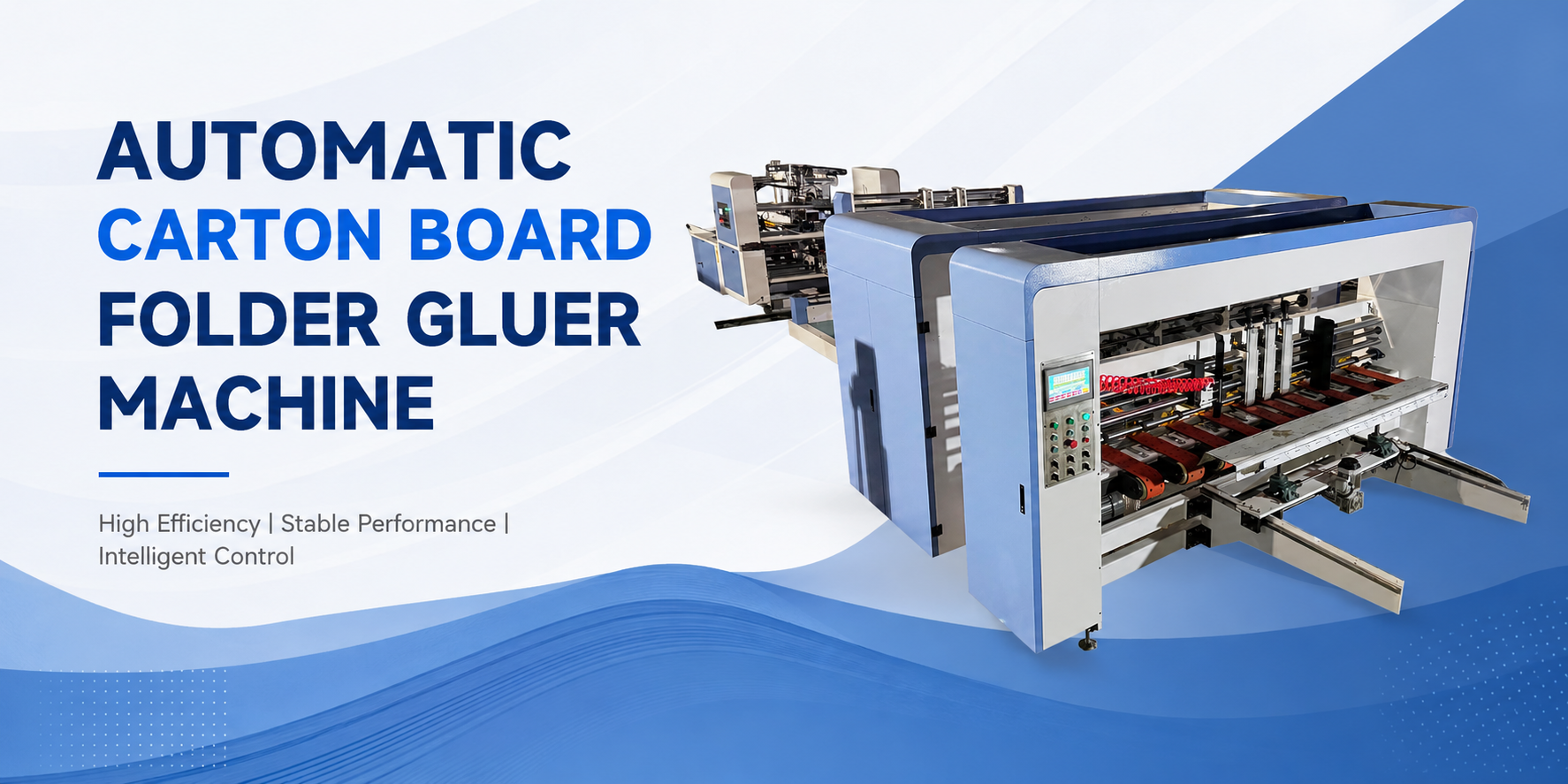
Evaluating an automatic carton board folder gluer machine manufacturer starts with the squaring mechanism, not the top-line speed number. First, confirm independent belt-speed regulation — the machine has to correct blank alignment by varying outer-to-inner belt speed through the PLC, not rely on a single fixed-speed pass. Second, confirm the folding section is rated for 3-ply and 5-ply board specifically, since heavy corrugated structures “spring back” mid-fold in ways thin single-wall stock never does. Third, get documented starch-consumption and wear-component data for a 15-to-20-year duty cycle, not a demo-floor speed run. A manufacturer that can’t produce all three is selling a straight-line gluer with a heavier-sounding name.

https://gzsmartmachinery.com/product/eco-automatic-folder-gluer-and-stitcher-machine/
Engineering Benchmark: Three Tiers of Carton Board Manufacturer Capability
Most listings for an “automatic carton board folder gluer machine” describe top speed and stop there, skipping the squaring mechanism and board-thickness rating that actually determine whether a heavy-duty carton comes out square. The gap shows up in three places: how the machine corrects alignment on thick board, what ply range it’s rated for, and whether starch/wear data is documented past the warranty period.
| Engineering Criterion | Entry-Level / Straight-Line Gluer | Semi-Integrated Regional Fabricator | Guangzhou Smart Machinery (Direct-Factory Platform) |
|---|---|---|---|
| Squaring Correction | Fixed single-speed belt pass, no correction | Manual side-guide adjustment | Independent belt-speed regulation — PLC-adjusted outer/inner belt differential |
| Board-Ply Rating | Single-wall thin board only | 3-ply rated, struggles above | 3-ply and 5-ply (Single Wall and Double Wall) rated |
| Fold-Section Design | Standard-length fold plow | Extended section, no reinforced belts | Extended folding section with side-guide rollers and high-torque pressure belts |
| Glue System | Single fixed glue type | Cold glue only | Water-based cold glue or hot-melt, high-precision nozzles |
| Starch Efficiency | Undocumented, industry-average consumption | Estimated, not measured | Under 18 kg/t (≈40 lb/ton), against a >22 kg/t (≈48 lb/ton) industry average |
| Wear-Component Data | Not published | Published at launch only | Documented across a 15–20 year duty cycle |
What Separates an Automatic Carton Board Folder Gluer Machine from a Basic Straight-Line Gluer
An automatic carton board folder gluer machine, by engineering definition, is built to fold and seal pre-die-cut corrugated blanks across a range of board structures — not just thin single-wall stock running in a straight line. The distinction matters because 3-ply (Single Wall) and 5-ply (Double Wall) board behaves differently under a fold bar: thicker flute structures resist bending and “spring back” toward their original flat shape immediately after the fold plow releases them.
A basic straight-line gluer built for single-wall board has no answer for that spring-back. Guangzhou Smart Machinery’s platforms address it with an extended folding section, specialized side-guide rollers, and high-torque pressure belts that hold the panel flat long enough for the board’s fibers to set in the folded position — what the engineering team calls “gradual fold” technology, as opposed to a single quick crease-and-release pass.
Inside the Squaring System: Independent Belt-Speed Regulation and Dual-Side Correction
The core correction mechanism on an automatic carton board folder gluer machine from Guangzhou Smart Machinery is independent belt-speed regulation, not a fixed mechanical guide. The PLC interface adjusts the speed of the outer folding belts relative to the inner belts in real time, correcting blank alignment before the panel reaches the final pressure section.
That differential-speed correction, combined with dual-side squaring devices, is what holds a perfectly square fold at sustained speeds up to 180 m/min / 591 FPM — a spec that only means something if the squaring system is actively correcting drift, since a fixed-timing machine loses squareness first on heavy or slightly warped board. Secondary correction technology layered on top of this catches residual “fishtailing” — the geometric skew that jams automated case packers at the receiving end — before the box reaches the counting and stacking stage.
Handling 3-Ply and 5-Ply Board Without “Spring-Back”: Fold-Section and Glue Data
Thick, heavy-duty board doesn’t just resist folding — it resists staying folded, which is why the fold section geometry matters as much as the squaring system. Guangzhou Smart Machinery’s extended folding section is built specifically to hold 3-ply and 5-ply blanks through the full “gradual fold” cycle rather than crimping and releasing them in one motion. The same platform runs an integrated stitching section adjustable across 30–120 mm / 1.18–4.72 in, needed on heavy-duty transit cartons where glue alone doesn’t hold under drop-test loads.
Adhesive application supports both water-based cold glue and hot-melt through high-precision nozzles, a real specification difference — hot-melt sets fast enough to keep pace with heavy board on a continuous line, where cold glue can lag on thicker, more absorbent flute structures. Guangzhou Smart Machinery’s servo-driven folder-gluer platforms are built to the same ±0.5 mm (±0.02 in) fold-registration class used across the company’s product line, verified per configuration rather than assumed from a brochure number.
Request a Factory FAT (Factory Acceptance Test) Protocol Sheet confirming squaring accuracy and fold registration on your specific board-ply combination before specifying a model.
Wear-Component Metallurgy That Keeps Registration Tight Over a 15–20 Year Life
Squaring accuracy on day one means nothing if it decays by year three. The components that determine whether registration holds over a 15-to-20-year duty cycle are the fold belts, the feed friction plates, and the glue valves — not the frame, which rarely fails first.
Guangzhou Smart Machinery specifies high-grip, tensile-reinforced folding belts to keep heavy 3-ply and 5-ply panels flat against the fold bar without slipping mid-cycle, and tungsten-carbide-coated feed friction plates to resist the abrasive dust that heavier, denser board sheds at high throughput. Glue metering runs through high-frequency electronic glue valves, which hold a consistent bead on thick board far longer than a mechanical cam-timed nozzle before requiring recalibration.
Ask any manufacturer selling an automatic carton board folder gluer machine to name the wear-component materials directly, not describe them as “industrial-grade” or “heavy-duty” without a specification. A friction plate that isn’t tungsten-carbide-coated will visibly degrade faster on abrasive recycled board, and that failure shows up as drifting registration long before the frame shows any wear at all.
Starch and Adhesive Economics: The Running Cost Line Manufacturers Don’t Publish
Purchase price and top speed dominate the sales conversation; starch consumption dominates the actual multi-year invoice. Guangzhou Smart Machinery’s platforms are engineered to run under 18 kg of starch per metric ton of board (≈40 lb/ton), against an industry average above 22 kg/t (≈48 lb/ton) — a gap that compounds daily on a continuously running line.
That difference is worth calculating against your own volume before comparing machine prices side by side. A plant running board at industrial volume for a full year absorbs that starch-consumption gap as a recurring cost line that a lower sticker price on a competing machine rarely offsets within the first 12 months.
Vetting an Automatic Carton Board Folder Gluer Machine Manufacturer: Closing Checklist
Return to the three benchmarks this audit opened with — independent belt-speed regulation for squaring, a fold section rated for 3-ply and 5-ply board, and documented starch/wear data across a full duty cycle — and require evidence of each before signing.
A practical due-diligence checklist before you commit capital:
- Request a live demonstration of belt-speed regulation correcting a warped or heavy blank, not just a straight-line speed run
- Confirm the fold section’s board-ply rating in writing — 3-ply and 5-ply performance, not just single-wall specs
- Ask for the named wear-component materials (fold belts, friction plates, glue valves), not generic “heavy-duty” language
- Request measured starch-consumption data, in kg per ton, rather than accepting a percentage-savings marketing claim
- Confirm fold-registration tolerance is verified per configuration via a documented FAT, not assumed from a brochure figure
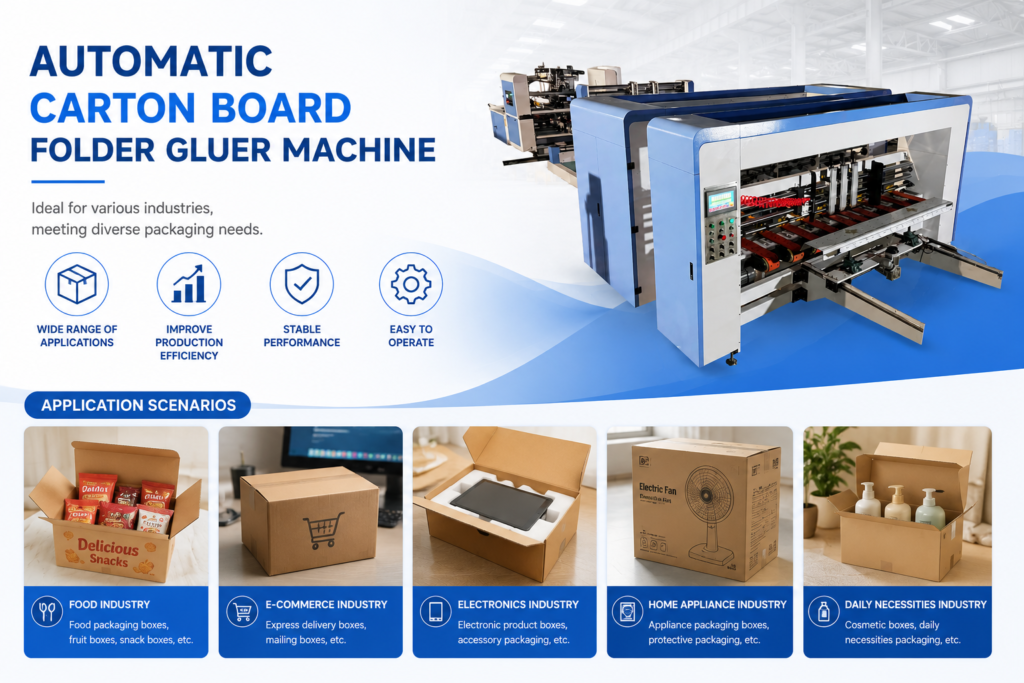
Guangzhou Smart Machinery’s Eco Automatic Folder Gluer and Stitcher Machine is the direct-factory platform this audit was built around — the automatic carton board folder gluer machine capability it delivers runs 180 m/min / 591 FPM with independent belt-speed squaring, 30–120 mm / 1.18–4.72 in adjustable stitching, and starch consumption under 18 kg/t (≈40 lb/ton).
Frequently Asked Questions
Q: What makes a folder gluer machine rated for “carton board” rather than just standard paperboard? A: An extended folding section with side-guide rollers and high-torque pressure belts, built to hold 3-ply and 5-ply corrugated structures through a “gradual fold” cycle without spring-back — standard single-wall gluers aren’t built to control that.
Q: How does the machine keep a fold square on heavy or slightly warped board? A: Independent belt-speed regulation, where the PLC varies outer-to-inner belt speed in real time to correct alignment before the final pressure section, combined with dual-side squaring devices and secondary correction technology.
Q: What starch consumption should I expect from a modern automatic carton board folder gluer machine? A: Guangzhou Smart Machinery’s platforms run under 18 kg/t (≈40 lb/ton) of board, against an industry average above 22 kg/t (≈48 lb/ton) — a recurring cost line worth calculating against your own production volume.
Q: What should I request before signing a purchase order? A: A Factory FAT Protocol Sheet confirming squaring accuracy and fold registration on your specific board-ply combination, named wear-component materials, and measured starch-consumption data in kg per ton.
Ready to Specify a Carton Board Folder Gluer Line for Heavy-Duty Production?
A top-speed number tells you nothing about whether a machine can hold a square fold on 5-ply board at that speed — belt-speed regulation, fold-section design, and starch data are what decide that. Request a Factory FAT Protocol Sheet documenting squaring accuracy and wear-component specifications for your board mix before you commit capital.
For plants ready to move on pricing and lead times, inquire for Direct-Factory Wholesale B2B Pricing & Lead Times and speak directly with Guangzhou Smart Machinery’s engineering team about your board-ply range, order volume, and site requirements.