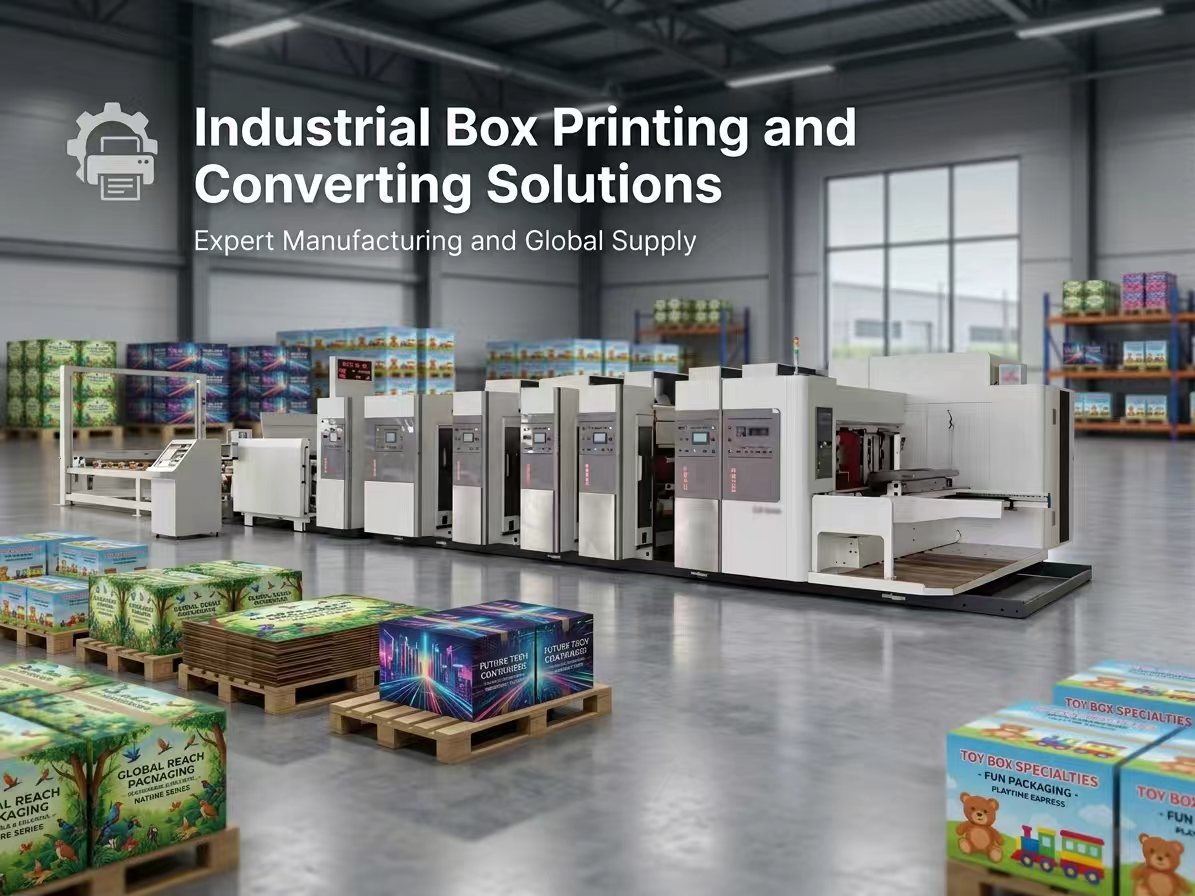
Print registration on corrugated board is a mechanical synchronization problem before it is a color problem, and industrial box printer machine manufacturers who lead with ink chemistry before drivetrain architecture are showing you their real priorities. Three benchmarks separate a first-tier OEM from a gear-train assembler: independent servo motors on every rotational axis — feed roll, print cylinder, anilox roll, slotting shaft, die-cutting anvil — rather than a shared line shaft; documented tolerance data across a full model range, not one flagship number; and verifiable sourcing on the wear components that determine print consistency at year three. Skip any of these and registration drift shows up as smeared barcodes and rejected pallets.
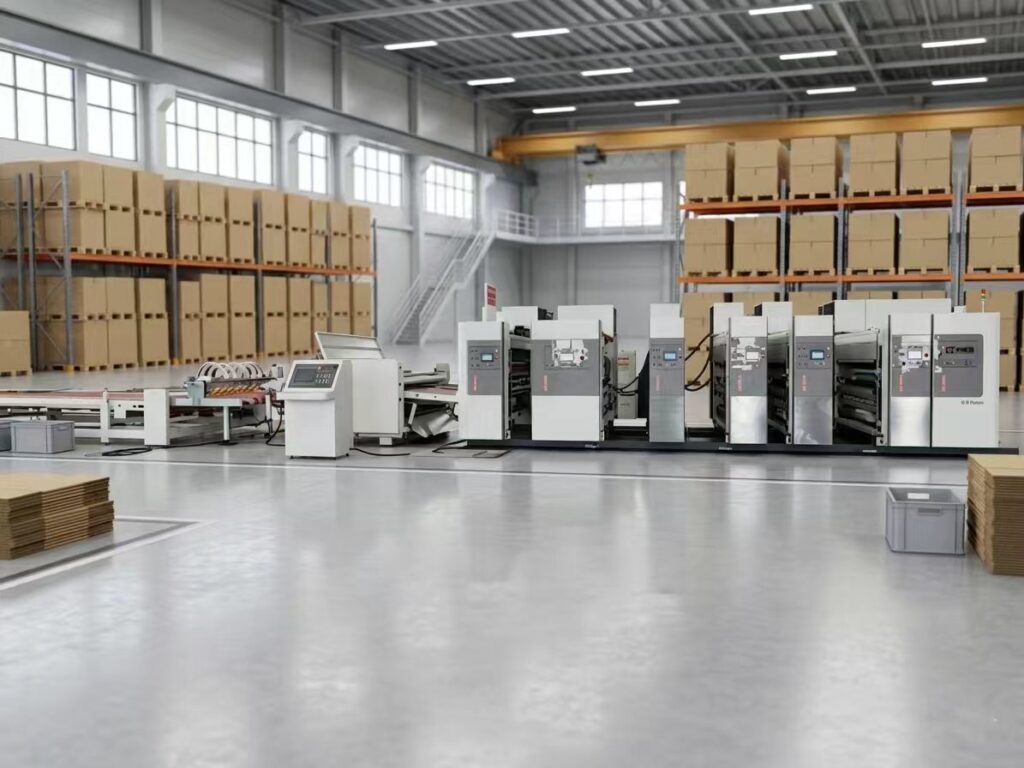
https://gzsmartmachinery.com/product/corrugated-box-printing-machine/
Supplier Tier Comparison: Gear-Train vs. Servo-Synchronized
| Engineering Criterion | Trading Company / Reseller | Mechanical Gear-Train Assembler | Guangzhou Smart Machinery (Servo-Synchronized OEM) |
|---|---|---|---|
| Drive Architecture | Rebadged, source unverified | Shared mechanical line shaft | Independent servo motor per axis |
| Backlash Behavior | Undocumented | Compounds at high speed | Closed-loop feedback eliminates cumulative backlash |
| Print Registration | Quoted, rarely load-tested | ±1.5–2 mm (±0.06–0.08 in) typical | ±0.5 mm (±0.02 in) topping accuracy |
| Feeding Accuracy | Undocumented | Kick-feeder, crushes flutes | ±1 mm (±0.04 in), suction-assisted lead-edge |
| Job Recall | Manual re-setup | Partial digital memory | Motorized phase/position input, zero-return memory |
| Anilox Roller | Unspecified grade | Chrome-etched, wears fast | Laser-engraved ceramic, extended service life |
| Model Range Documentation | Single generic spec sheet | Limited size options | 9-model range (920–1632), full spec table published |
A reseller can quote one impressive registration number pulled from a flagship unit. What a real factory publishes is the full spread across its size range, because a 920 model and a 1632 model do not behave identically at speed — and if a supplier only has one number to show you, ask why the rest of the range isn’t documented.
Inside the Line: Feed, Print, Slot, Die-Cut
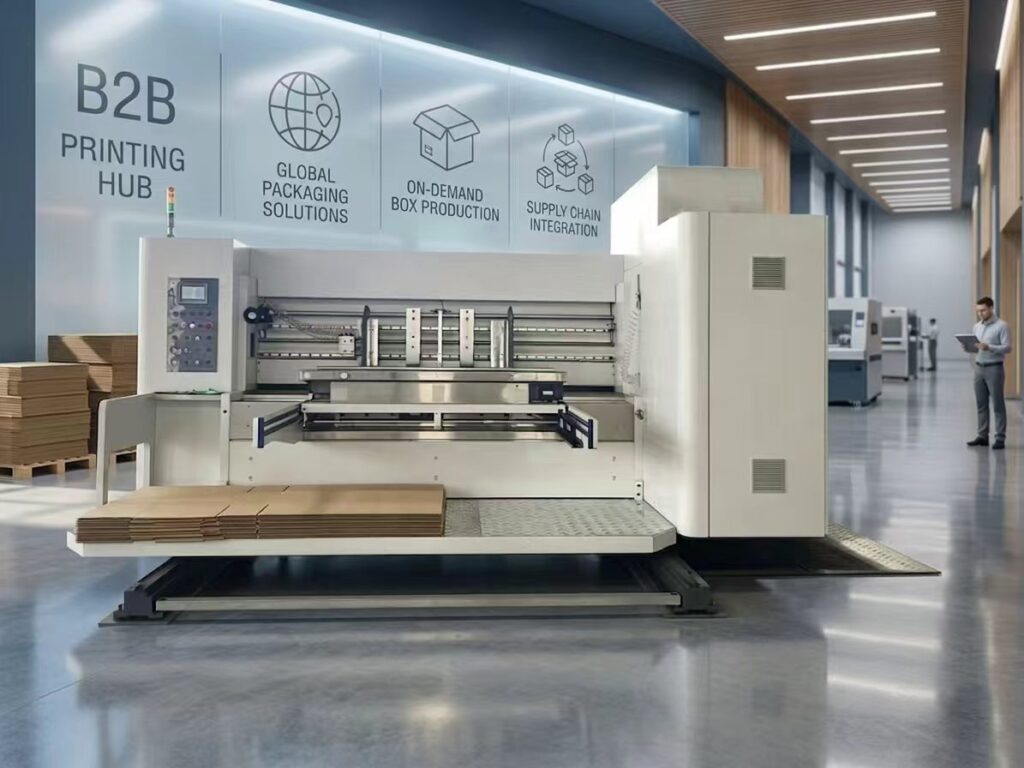
A suction-assisted lead-edge feeder draws the bottom sheet from the stack using high-friction wheels rather than a mechanical kick-feeder, keeping the sheet parallel and un-crushed on entry. The feed system is adjustable across 3-ply, 5-ply, and 7-ply board without re-tooling, and holds ±1 mm (±0.04 in) feeding accuracy — the foundation every downstream station depends on, since a skewed sheet at the feeder cannot be corrected by the print unit that follows it.
Printing runs through laser-engraved ceramic anilox rollers with motorized, PLC-controlled phase adjustment, holding ±0.5 mm (±0.02 in) print registration — what the spec sheet calls “topping accuracy.” Standard printing plate thickness is 7.2 mm (0.28 in) across the full model range, and an “Automatic Zero-Return” memory function recalls prior job settings so a repeat order does not require re-calibrating registration from zero.
The linkage slotting unit runs synchronized blade movement to hold ±1.5 mm (±0.06 in) slotter accuracy, with slot depth capacity scaling from 230 mm (9.06 in) on the compact 920/924 models up to 410 mm (16.14 in) on the 1424–1632 range. Final die-cutting uses imported polyurethane rubber pads against a standardized 25.4 mm (1.00 in) knife height, holding ±1 mm (±0.04 in) die-cutting accuracy with ±20 mm (±0.79 in) lateral anvil-pad adjustment for fine positioning.
Precision Registration: Why ±0.5mm Isn’t a Marketing Number
A mechanical gear train accumulates backlash — the microscopic play between gear teeth — and that play compounds every time the line speeds up, which is exactly when registration failures start showing up as smeared barcodes or misaligned print. Independent servo motors on the print cylinder and anilox roll close that gap with continuous feedback correction instead of relying on a rigid shaft to hold position across the whole line. Printing roll position adjustment of ±6 mm (±0.24 in) gives fine registration control on press, on top of the baseline ±0.5 mm topping accuracy the drivetrain is built to hold.
Before specifying any industrial box printer machine manufacturer on a brochure claim alone, request a Factory FAT (Factory Acceptance Test) Protocol Sheet documenting registration accuracy at rated speed across the actual model you’re buying — not a flagship demo unit. A manufacturer that can only produce one number for one model is not documenting their real range.
Wear Components and Material Science
Laser-engraved ceramic anilox rollers hold their microscopic ink-metering cells far longer than chrome-etched alternatives, which is what keeps ink volume — and therefore color consistency — stable across a long production run instead of drifting cell-by-cell as the surface wears. Drive gears machined from high-quality alloy steel go through heat treatment and precision grinding before assembly, which is what keeps noise and vibration low and holds tolerance under continuous 24/7 operation rather than just at commissioning.
Imported polyurethane rubber pads back the die-cutting anvil and absorb impact cycle after cycle without losing the flatness that keeps cut depth consistent; a pad that compresses unevenly is a slow, hard-to-diagnose source of ragged box edges. Ask any competing manufacturer for the anilox roller’s cell count and expected service life, and the die-cutting pad’s replacement interval, in writing — a real factory answers in numbers, not “premium materials.”
Total Cost of Ownership: Changeover, Waste, and Model Fit
Changeover time is the lever most TCO comparisons miss. Motorized digital input for phase and position adjustments, paired with the zero-return memory function, means a repeat job recalls its registration settings instead of restarting calibration from a blank slate — the difference compounds fast on short, mixed-SKU runs. Linear velocity compensation keeps die-cutting and printing aligned as mechanical wear accumulates over the machine’s life, which protects registration accuracy without requiring a full recalibration cycle every few months.
Model selection is the second lever, and it is where oversizing quietly erodes ROI. Line speed scales inversely with format size across the range — 260 sheets/min on the compact 920 model down to 120 sheets/min on the flagship 1632 — because larger cylinders and larger sheet formats trade cycle rate for print area. Buying a 1632-class machine to run 920-class sheet sizes wastes both floor space and achievable throughput; matching model to your actual box format is a TCO decision, not a specifications afterthought.
Model Range and Regional Fit
The platform spans nine models from 920 to 1632, with minimum feeding size starting at 260 × 560 mm (10.24 × 22.05 in) on the 920 and maximum continuous feeding size reaching 1,540 × 3,350 mm (60.63 × 131.89 in) on the 1632. Maximum printing size scales from 860 × 1,960 mm (33.86 × 77.17 in) on the smallest model to 1,580 × 3,160 mm (62.20 × 124.41 in) on the largest, with suitable cardboard thickness rated at 2–11 mm (0.08–0.43 in) across the 1224-and-above range.
Confirm which model in that nine-unit range actually matches your box format and daily volume before comparing price quotes across manufacturers — a headline speed number from a 920 model and a 1632 model are not interchangeable claims. A tier-one industrial box printer machine manufacturer will walk you through model selection against your actual sheet sizes, not just hand you a single spec sheet for the largest unit in the catalog.
Vetting Checklist: What to Request Before You Sign
Return to the benchmarks that opened this audit — servo-per-axis drive architecture, full-range tolerance documentation, and verifiable wear-component sourcing — and require evidence for each. A quick due-diligence list before committing capital:
- Request registration and feeding accuracy data for the specific model you’re buying, not the flagship unit
- Confirm anilox roller type (ceramic vs. chrome) and expected service life in writing
- Verify die-cutting knife height and anvil-pad adjustment range match your box styles
- Ask for the full model-range spec table, not a single-unit brochure
- Confirm slot depth and printing size capacity against your actual sheet dimensions
Frequently Asked Questions
Q: What is the real difference between a gear-train printer-slotter and a servo-synchronized one? A: A gear-train machine relies on a shared mechanical line shaft that accumulates backlash as speed increases, degrading registration. A servo-synchronized machine drives feed roll, print cylinder, anilox roll, slotting shaft, and die-cutting anvil independently with closed-loop feedback, holding tolerance regardless of speed.
Q: What print registration accuracy should I expect from a tier-one manufacturer? A: ±0.5 mm (±0.02 in) topping accuracy is the documented standard across this platform’s full model range, paired with ±1 mm (±0.04 in) feeding accuracy and ±1.5 mm (±0.06 in) slotter accuracy.
Q: How many model sizes should a real manufacturer offer? A: This platform spans nine models (920 through 1632) with distinct feeding, printing, and die-cutting capacities. A manufacturer offering only one or two sizes is not giving you room to match the machine to your actual sheet format.
Q: What should I request before signing a purchase order? A: A Factory FAT Protocol Sheet documenting registration and feeding accuracy at rated speed for your specific model, anilox roller specification, and die-cutting pad replacement interval.
Ready to Audit Your Next Supplier?
Brochure specifications are a starting point, not a purchase decision. Request a Factory FAT Protocol Sheet documenting registration accuracy, wear-component grade, and model-specific tolerance data before you commit capital.
For plants ready to move on pricing and lead times, inquire for Direct-Factory Wholesale B2B Pricing & Lead Times and speak directly with Guangzhou Smart Machinery’s engineering team about your sheet size, box format, and site voltage.