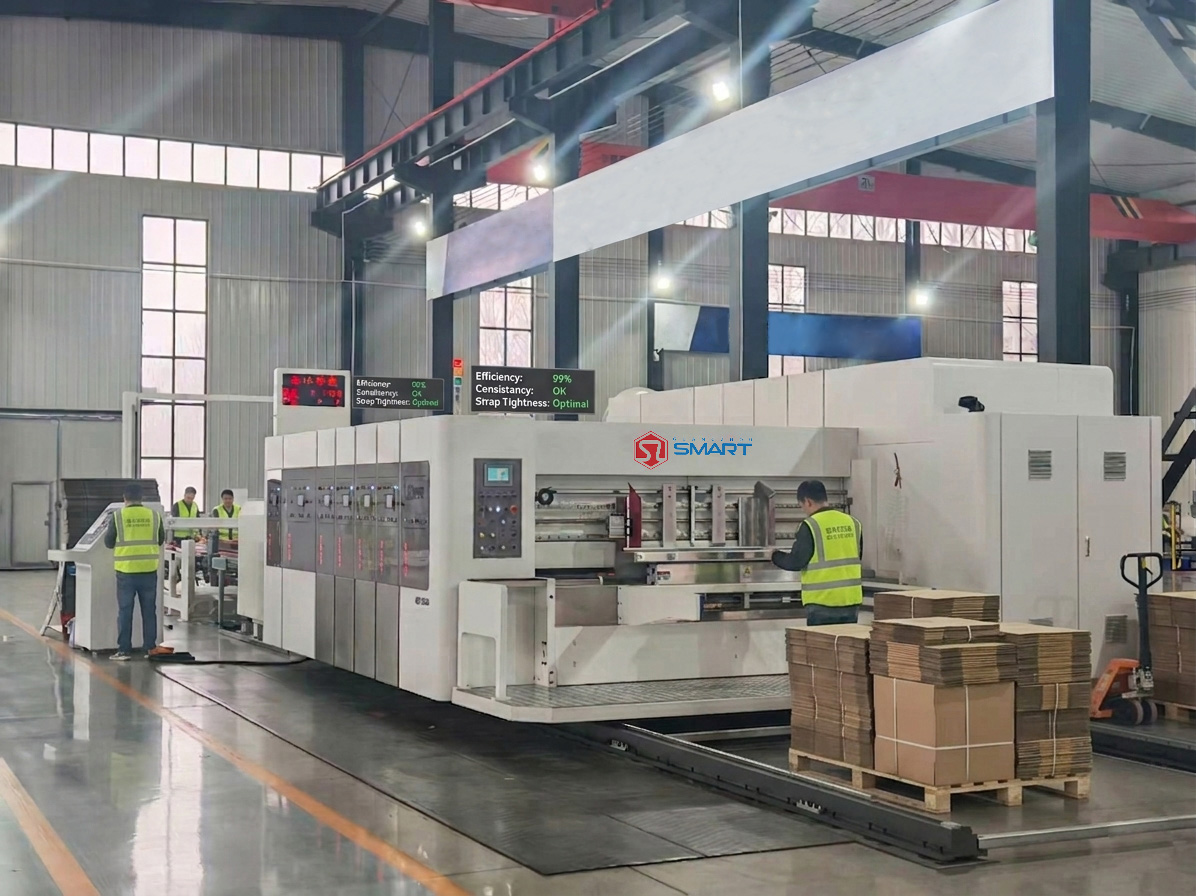
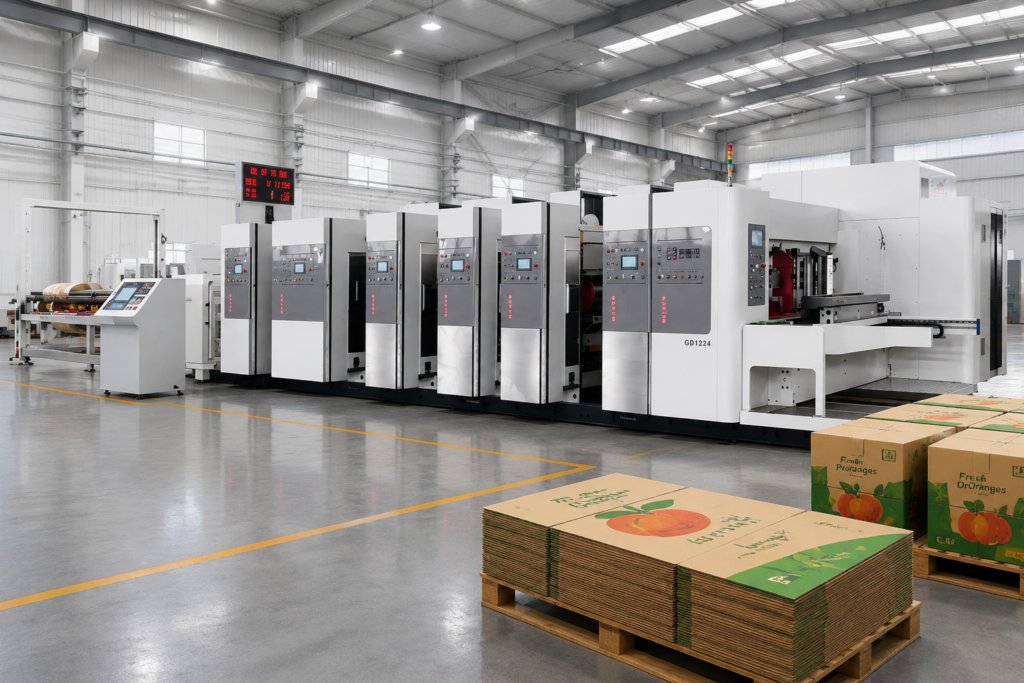
Screening a wholesale corrugated printing machine supplier starts with three non-negotiable benchmarks. First, frame metallurgy — the main structure must use heat-treated alloy steel, not standard iron castings that flex under sustained load. Second, motion control protocol — production-grade servo drives with closed-loop encoder feedback, not open-loop mechanical or chain-driven timing. Third, component sourcing — PLCs, servo drives, and bearings from internationally recognized brands (Delta, NSK, or equivalent), not unbranded substitutes that void warranty claims and stall spare-parts logistics. A supplier failing any one of these three benchmarks is a Tier-2 assembler, not a factory-direct manufacturer, regardless of the quoted price.
https://gzsmartmachinery.com/product/corrugated-box-printing-machine/
Tier-1 Factory vs. Trading Company: Verifying a True Wholesale Corrugated Printing Machine Manufacturer
Most inquiries for a wholesale corrugated printing machine are answered by a trading company, not the factory floor. The distinction matters: trading companies add a margin layer, cannot commit to a Factory Acceptance Test (FAT) date, and rarely disclose the actual OEM behind the machine.
Classify every quote against the criteria below before it reaches your CFO’s desk:
| Engineering Criterion | Tier-1 Factory-Direct | Tier-2 Regional Assembler | Trading Company / Broker |
|---|---|---|---|
| Motion Control | Closed-loop multi-axis servo, synchronized print-to-cut registration | Servo on main shaft only; sub-stations mechanically linked | Undisclosed — varies by whatever the broker sources |
| Frame Material | Heat-treated Alloy Steel, stress-relieved | Standard structural steel, no heat treatment | Not disclosed in quotation |
| Core Components | Branded PLC/servo (Delta), NSK-class bearings | Mixed branded and generic components | Cannot confirm sub-assembly origin |
| Spare Parts Lead Time | Ex-factory stock, 7–15 days globally | 30–45 days, dependent on the actual OEM | 45–90+ days through multiple intermediaries |
| FAT Availability | Full protocol, live video or on-site | Informal video call only | Rarely offered |
| Pricing Structure | Direct factory quote, zero markup layer | Regional distributor markup added | 15–35% broker margin, typically undisclosed |
A machine scoring “Tier-1” across this entire matrix is the only category that should receive a wire transfer without a factory visit or a verified video audit first.
Motion Control Synchronization: The Servo Logic Behind Print Registration
Print registration failure — colors misaligned by even 0.3 mm — is almost always a motion control problem, not an ink problem. On a wholesale corrugated printing machine, each print station’s cylinder runs on an independent servo motor referenced to a common electronic line shaft, not a mechanical gear train.
High-resolution rotary encoders (typically 2,500–5,000 pulses per revolution) feed position data back to the servo controller at intervals under 1 millisecond. This closed-loop correction is what holds registration tolerance at ±0.5 mm (±0.02 inches) across a 1,200 mm (47.2-inch) working width, even at production speeds of 350 m/min (1,148 FPM).
Mechanically-timed machines cannot replicate this, because backlash in the gear train accumulates with every cycle. A gear train carrying even 0.05 degrees of backlash produces measurable registration drift after a few thousand print cycles — the exact failure mode closed-loop servo correction is designed to eliminate at the encoder level, not the gearbox. Ask any supplier for the encoder resolution and correction-loop frequency in writing; one who cannot answer in mechanical terms is quoting a spec sheet they did not engineer.
Wear-Part Metallurgy: What Actually Determines Component Lifespan
Three wear components determine whether a wholesale corrugated printing machine stays in production or sits in maintenance:
- Anilox rollers — ceramic-coated, laser-engraved cell structure for metered ink transfer. A quality anilox roll holds its cell volume for 15,000+ operating hours before re-engraving is needed.
- Slotting and die-cutting blades — Tungsten Carbide inserts on every cutting edge hold a working edge roughly 10 times longer than standard tool steel, directly cutting blade-change downtime.
- Vacuum-transfer belts — high-tensile, abrasion-resistant belting with adjustable suction zoning to move boards from micro-flute to double-wall without crushing the flute profile.
- Doctor blade assemblies — precision-ground chamber seals that control ink film thickness on the anilox roller. A worn or improperly torqued doctor blade is the single most common cause of streaking on long print runs.
Frame rigidity matters as much as the wear parts riding on it. A heat-treated Alloy Steel frame, stress-relieved before final machining, holds cylinder-to-cylinder alignment across 45,000 kg (99,200 lbs) of engineered mass without twisting under vibration over a 10-year service life.
Spare Parts Supply Chain: Why Lead-Time Transparency Separates Manufacturers from Resellers
A machine is only as productive as its worst spare-parts delay. Ask any wholesale corrugated printing machine supplier one direct question: if an anilox roller fails on a Tuesday, what is the airfreight-ready lead time from ex-factory stock?
Factory-direct manufacturers hold critical wear parts — anilox rollers, tungsten carbide blade sets, servo drive cards — in ex-factory inventory, typically shipping within 7–15 days to any global port. Resellers and regional assemblers must first place their own order with the actual OEM, which routinely stretches that same request to 45–90 days.
Inquire for Direct-Factory Wholesale B2B Pricing & Lead Times — Guangzhou Smart Machinery ships critical spares from ex-factory stock, with lead times confirmed in writing before any deposit is placed.
This single question, asked before the deposit rather than after the machine jams, is the fastest way to separate a 20-year factory from a one-year trading account.
Factory Acceptance Testing: The Audit Step Most Buyers Skip
A Factory Acceptance Test (FAT) runs the actual unit you are purchasing — not a showroom demo — under load, at your specified board caliper and target speed, before it is crated. Skipping this step is the single most common reason a wholesale corrugated printing machine underperforms after installation.
A complete FAT protocol should verify, on camera or in person:
- Registration accuracy at full 350 m/min (1,148 FPM) production speed, not idle speed
- Folding/slotting tolerance held at ±0.5 mm (±0.02 inches) across a minimum 30-minute continuous run
- PLC fault-log review, confirming zero unexplained servo faults during the test window
- Full safety interlock function (CE/OSHA-aligned emergency stops and gate sensors)
Any supplier unwilling to schedule a FAT — or unwilling to send raw, unedited video of one — is asking you to underwrite the commissioning risk yourself.
Total Cost of Ownership: Why the Lowest Quote Rarely Wins
The purchase price of a wholesale corrugated printing machine typically represents only 55–65% of its 10-year operating cost; labor, downtime, and spare parts absorb the rest. A machine priced 15% below a Tier-1 factory quote, sourced through a broker with no FAT and a 60-day parts cycle, is rarely cheaper once one unplanned stoppage is factored in.
| Cost Driver (10-Year Horizon) | Tier-1 Factory-Direct | Broker-Sourced / Tier-2 |
|---|---|---|
| Unplanned downtime (parts delay) | Low — 7–15 day ex-factory stock | High — 45–90 day OEM reorder cycle |
| Warranty enforcement | Direct factory accountability | Diluted across intermediaries |
| Blade/roller replacement cycle | Extended via Tungsten Carbide wear parts | Standard tool steel, more frequent changes |
| Registration-related material waste | Minimized at ±0.5 mm tolerance | Higher reject rate on tight-tolerance jobs |
For a plant running three shifts, the downtime differential alone typically closes an 18–24 month payback gap in favor of the factory-direct machine, even at a higher sticker price.
FAQ: Supplier Vetting Questions Procurement Teams Ask
Q: Should I request a factory visit before wiring a deposit on a wholesale corrugated printing machine? A: Yes, or at minimum a live video walkthrough of the production floor and the specific unit’s serial number. A supplier unwilling to show the assembly line in real time is very likely a trading intermediary, not the manufacturer.
Q: What spare-parts lead time should I write into the purchase contract? A: For a Tier-1 factory-direct supplier, 7–15 days ex-factory for critical wear parts (anilox rollers, blade sets, servo cards) is a reasonable contractual commitment. Anything beyond 30 days signals the seller does not hold factory-level inventory.
Q: How long does a proper Factory Acceptance Test take? A: Budget a minimum 4–6 hours for a full-load FAT covering registration accuracy, tolerance verification, and PLC fault-log review across multiple board calipers — not a 10-minute idle-speed demonstration.
Q: Does a lower quote always mean a lower-tier supplier? A: Not necessarily, but any quote below the Tier-1 factory-direct range should come with full disclosure of the actual manufacturing source, FAT availability, and spare-parts lead time before it is treated as a comparable offer.
Q: How do I confirm CE or UL compliance isn’t just a certificate on paper? A: Request the specific EN or UL standard numbers cited on the declaration of conformity, and cross-check that the safety PLC and interlock wiring diagram match the exact unit you are buying — not a generic model-line certificate issued for a different configuration.
Request Your Factory Audit Documentation
Guangzhou Smart Machinery manufactures and ships every wholesale corrugated printing machine directly from our Panyu, Guangzhou facility — no trading intermediary, no undisclosed OEM behind the nameplate.
Request a Factory FAT Protocol Sheet to see exactly how your unit will be tested before it ships, or inquire for direct-factory wholesale B2B pricing and confirmed lead times on the current production slot. Every quote includes the servo drive specification, frame metallurgy certificate, and a written spare-parts lead-time commitment — before any deposit is requested.