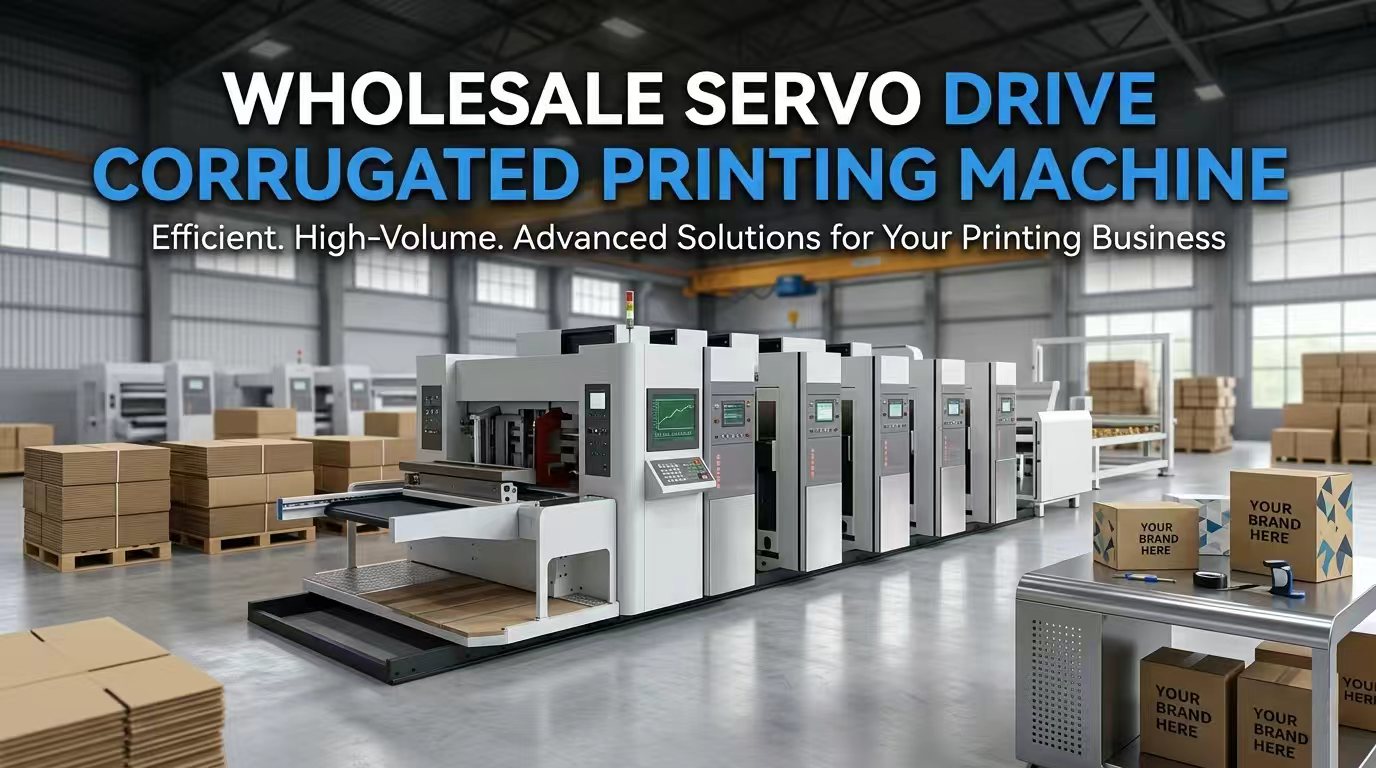
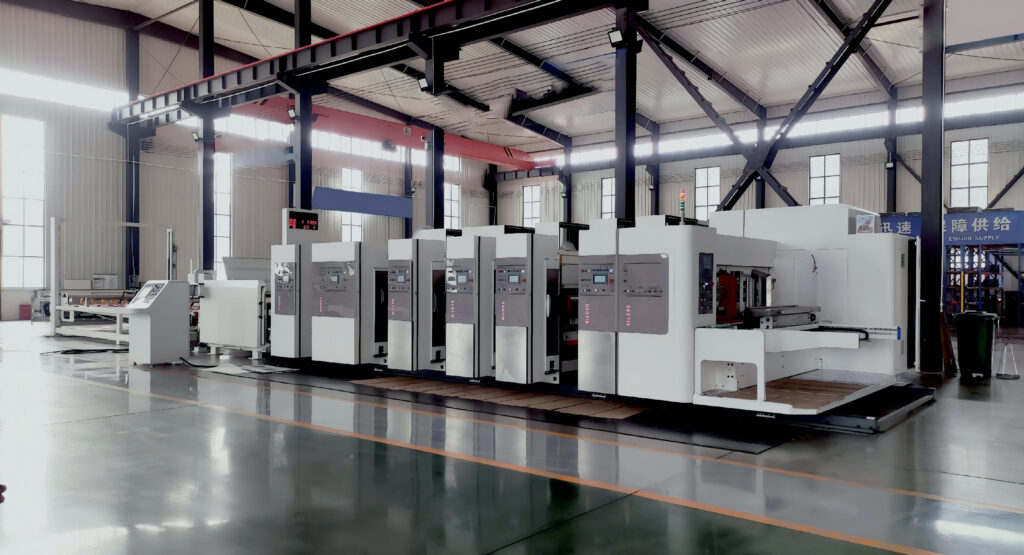
A procurement team searching for a wholesale servo drive corrugated printing machine is really vetting a factory, not a spec sheet. Three benchmarks separate a tier-1 OEM from a trading-company reseller: independently driven print/slot/die-cut stations rather than one motor and a gear train, registration tolerance published on an actual technical parameter table — not a marketing claim — and globally sourced electrical components so a failed part doesn’t strand your line for six weeks. Machines missing any of the three will drift out of tolerance, jam under continuous load, or leave you waiting on a proprietary part with no local substitute.
https://gzsmartmachinery.com/product/corrugated-box-printing-machine/
Engineering Tier Comparison: What “Servo Drive” Actually Buys You
| Criterion | Entry Gear-Driven Line | Mid-Tier Single-Servo | Guangzhou Smart Machinery (Multi-Axis Servo) |
|---|---|---|---|
| Drive architecture | One motor, mechanical gear train | One servo motor, mechanical linkage to sub-stations | Independent AC servo per print cylinder, slotter, and die-cutter |
| Registration tolerance | Not published / field-variable | ±1.0–1.5 mm (0.04–0.06 in), degrades with wear | ±0.5 mm (0.02 in) topping accuracy, fixed spec across the model range |
| Feeding accuracy | Mechanical stop, operator-dependent | Sensor-assisted, ±2 mm (0.08 in) typical | ±1 mm (0.04 in), vacuum lead-edge feed |
| Changeover | Manual mechanical reset | Partial digital recall | Motorized digital phase/position input |
| Control platform | Relay logic or basic HMI | Single-loop PLC | Touchscreen PLC with linear velocity compensation |
| Spare parts | Often proprietary | Mixed proprietary/standard | Standard knife series (spiral, slotting, tungsten steel) |
Why Sourcing Direct From the Factory Floor Matters More Than the Spec Sheet
Before going deeper into the mechanics, it’s worth stating plainly: sourcing a wholesale servo drive corrugated printing machine direct from a manufacturing floor — rather than through a trading intermediary — is what makes the tolerance and spare-parts commitments above enforceable in a contract instead of a brochure. A trading company can quote you any number it likes; only the factory that machines the gears and writes the PLC logic can stand behind it in a Factory Acceptance Test.
Independent Servo Synchronization Replaces the Backlash Problem
A single-motor gear-driven press connects the print cylinders, slotter, and die-cutter through a shared mechanical train. Every gear tooth wears a fraction of a micron per rotation cycle; over months of continuous running, that wear becomes backlash — play between teeth that lets the cylinders drift out of phase. The visible result is blurred graphics and slot-to-print misalignment that gets worse, not better, over the machine’s life.
Independent servo drive removes the shared mechanical path entirely. Each station — feeder, print unit, slotter, die-cutter — runs its own AC servo motor, synchronized over an industrial Ethernet protocol in real time. There is no gear train to wear, so tolerance doesn’t decay with hours logged.
This is the mechanical reason a servo-driven press holds its published spec at year five the same way it did on day one.
Reading the Real Spec Sheet: Sheets/Min vs. Line Speed
Here’s a distinction most competitor content glosses over, and it costs buyers real money at RFQ stage. A corrugated cardboard production line (the corrugator) runs continuous board at m/min. A printing, slotting, and die-cutting machine is a sheet-fed rotary press — it indexes one sheet at a time, so its throughput is properly rated in sheets/min, not m/min.
Suppliers who quote 300+ m/min on a sheet-fed printer-slotter are usually citing a different machine’s spec sheet or rounding aggressively. Demand the sheets/min figure, tied to a specific model number, before you compare quotes.
Guangzhou Smart Machinery’s platform ships in nine working-width configurations, from the compact 920 to the large-format 1632:
- 920 model: up to 260 sheets/min, max continuous feeding 860 × 2150 mm (33.9 × 84.6 in), board thickness 2–10 mm (0.08–0.39 in), max slot depth 230 mm (9.06 in)
- 1632 model: up to 120 sheets/min, max continuous feeding 1540 × 3350 mm (60.6 × 131.9 in), board thickness 2–11 mm (0.08–0.43 in), max slot depth 410 mm (16.14 in)
Across the full range, three specs hold constant regardless of format size: standard printing plate thickness of 7.2 mm (0.28 in), die-cutter knife height of 25.4 mm (1.0 in) — the industry-standard rule height — and printing roll position adjustment of ±6 mm (0.24 in) with ±20 mm (0.79 in) lateral anvil-pad displacement for fine registration correction. A genuine wholesale supplier publishes this per-model, not as a single blended number that quietly describes only their smallest unit.
Wear-Component Material Science: What to Specify Before You Order
Request a Factory FAT (Factory Acceptance Test) Protocol Sheet before wiring any deposit — it’s the fastest way to confirm the following specs against the physical machine rather than a datasheet PDF.
The parts that fail first on an underspecified press are rarely the servo motors — they’re the consumables and wear surfaces around them. A wholesale servo drive corrugated printing machine built for continuous duty should specify:
- Heat-treated, precision-ground alloy steel drive gears — standard carbon steel gears flex under repetitive high-speed loading, generating vibration that degrades registration long before the servo motors themselves fail.
- Laser-engraved ceramic anilox rollers with PLC-controlled motorized phase adjustment — ceramic holds its micro-cell ink-metering geometry far longer than chrome-plated steel under continuous washdown cycles.
- Tungsten carbide-tipped slotting and die-cutting knives — sourced as a standard spare-parts line (not a proprietary cut), so a dulled blade is a same-day swap, not a six-week import wait.
- Imported polyurethane rubber die-cutting pads — the anvil surface a factory chooses here directly determines die-cut edge cleanliness and how many production cycles pass before a pad swap is due.
Ask any prospective supplier to itemize wear-part replacement intervals and confirm whether the knife series is standard stock or model-specific tooling. That single question filters out most trading-company resellers immediately.
Configuration Questions Regional Deployment Should Force You to Ask
A multi-ton converting asset is not a universal commodity, and the honest answer to “what does it weigh, what voltage does it run” is: it depends on your configuration — which is exactly what a Factory Acceptance Test protocol is designed to confirm in writing before shipment, not after.
- North America: confirm dual-channel emergency-stop wiring, light-curtain guarding, and OSHA-aligned interlocks are factory-installed, not retrofitted on arrival.
- Europe: confirm CE documentation, and ask specifically whether regenerative braking on the servo bus is standard or optional — it affects your energy compliance filing.
- Southeast Asia / humid climates: confirm vacuum-assist blower capacity is rated for high-moisture board, since soft, warped sheet is the leading cause of feed jams in this climate band.
- Middle East / dusty environments: confirm the electrical cabinet IP rating (ask for the number, not “sealed”) and whether cooling is closed-loop or draws in ambient air.
Vetting Checklist Before You Commit to a Supplier
Tie every claim on a supplier’s page back to a document you can hold them to:
- Tolerance data under load — ±0.5 mm (0.02 in) topping accuracy, ±1 mm (0.04 in) feeding accuracy, ±1.5 mm (0.06 in) slotter accuracy, confirmed at full production speed, not idle.
- Model-specific throughput in sheets/min, tied to the exact working-width model you’re ordering — the 920 and the 1632 are not interchangeable numbers.
- PLC sourcing and spare-parts lead time in writing, plus confirmation of standard vs. proprietary knife series.
- Cabinet IP rating and voltage/frequency configuration matched to your plant’s climate and grid before the machine leaves the factory floor.
- Category and taxonomy on the supplier’s own site — a manufacturer who can’t organize their own technical content is a signal worth noting.
A wholesale servo drive corrugated printing machine that passes all five checks is a machine you can put a purchase order behind with confidence, not a brochure you’re hoping holds up on the factory floor.
Frequently Asked Questions
Q: Why do some suppliers quote m/min and others quote sheets/min for the same class of machine? A: They’re describing different equipment. A continuous corrugator (production line) runs board at m/min; a sheet-fed printer-slotter-die-cutter indexes discrete sheets, so sheets/min is the correct and comparable unit. If a supplier quotes m/min for a sheet-fed press, ask them to convert it to sheets/min at your specific board length.
Q: What board thickness range does the platform handle? A: Depending on the model, suitable cardboard thickness runs 2–10 mm (0.08–0.39 in) on the compact 920/924 configurations up to 2–11 mm (0.08–0.43 in) on the 1224 model and larger.
Q: Can I get model-specific weight and shipping dimensions before I order? A: Yes — exact shipping weight varies by working-width configuration and options selected, which is precisely what’s documented on the Factory FAT protocol sheet issued per order.
Q: What’s actually included in a Factory Acceptance Test? A: You or your technical team run your own board stock and ink formulation on the machine at full production speed before it ships, verifying registration tolerance, feed reliability, and changeover time against the numbers on your quote — not a demo reel.
Request Your Factory FAT Protocol Sheet
Skip the trading-company markup and the unverifiable brochure claims. Guangzhou Smart Machinery publishes model-specific tolerances, feeding envelopes, and wear-part specifications you can check against the machine on the factory floor before it ships. Request a Factory FAT Protocol Sheet or inquire for direct-factory wholesale B2B pricing and lead times on the full nine-model range, from the compact 920 to the large-format 1632.