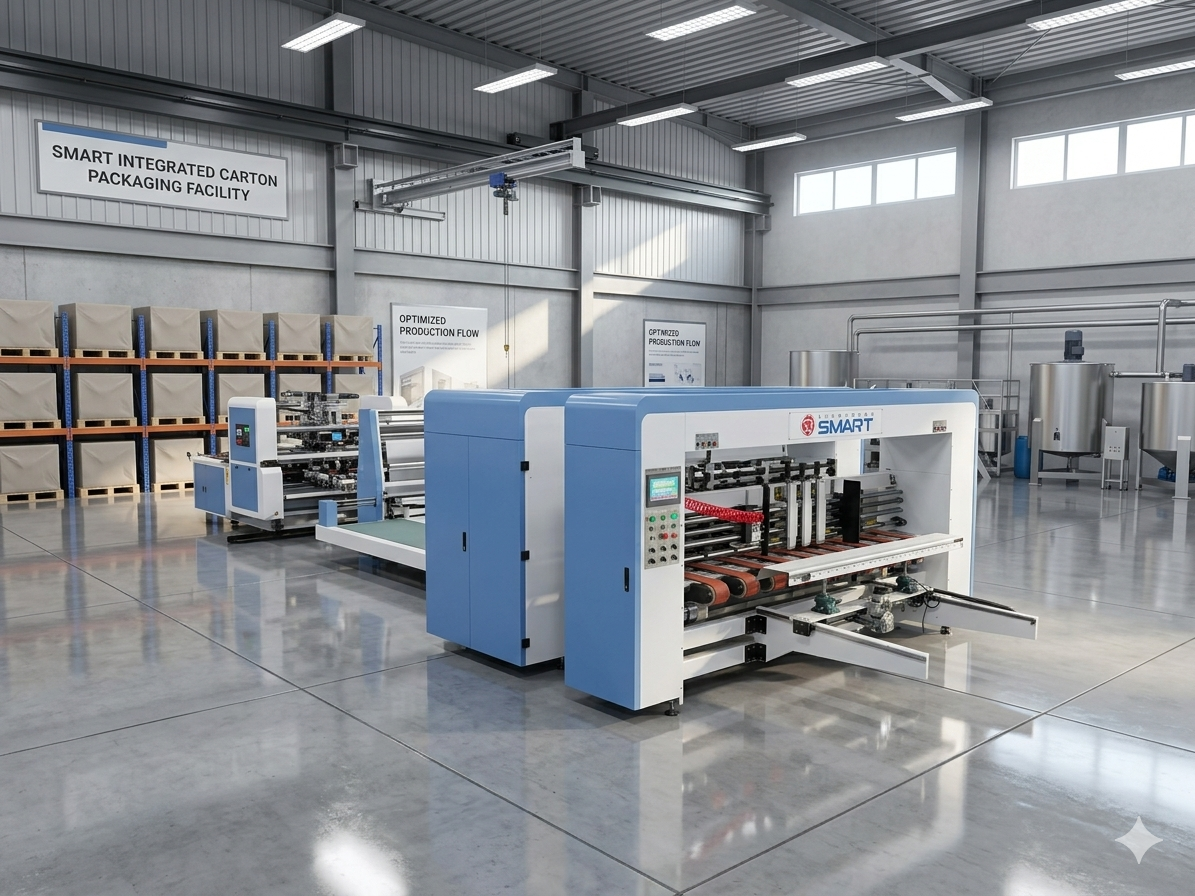
Specifying an eco automatic folder gluer and stitcher machine demands three non-negotiable operating benchmarks: fold registration stability under sustained-speed load (not just at ramp-up), stitching pitch consistency across wire gauge changes, and glue-bead volume repeatability when ambient temperature swings ±10°C. Any supplier that leads with raw speed figures without disclosing servo-loop response latency, wire-feed encoder resolution, or glue-gun actuation frequency is giving you marketing data, not machine data. At Guangzhou Smart Machinery, every production release ships with a closed-loop calibration log validated at ≥ 95% of rated line speed.
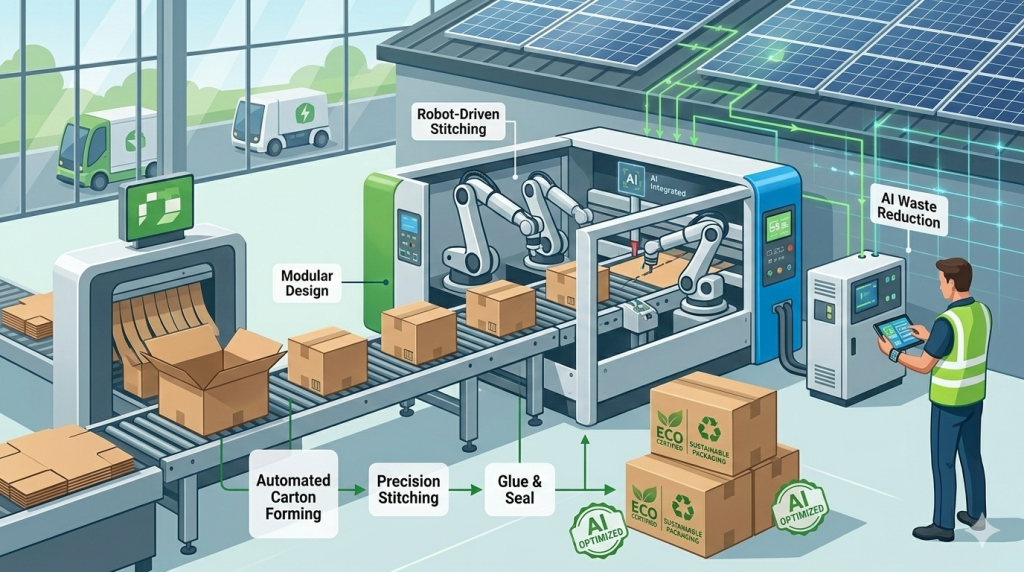
Guangzhou Smart Machinery The eco automatic folder gluer and stitcher machine is an advanced, high-speed finishing solution that integrates folding, gluing, and wire-stitching (nailing) functions into a single automated line. Engineered for modern sustainability and efficiency, the “Eco” aspect typically utilizes regenerative servo drives and precision cold-glue atomization to reduce power consumption by up to 25% compared to traditional mechanical systems.
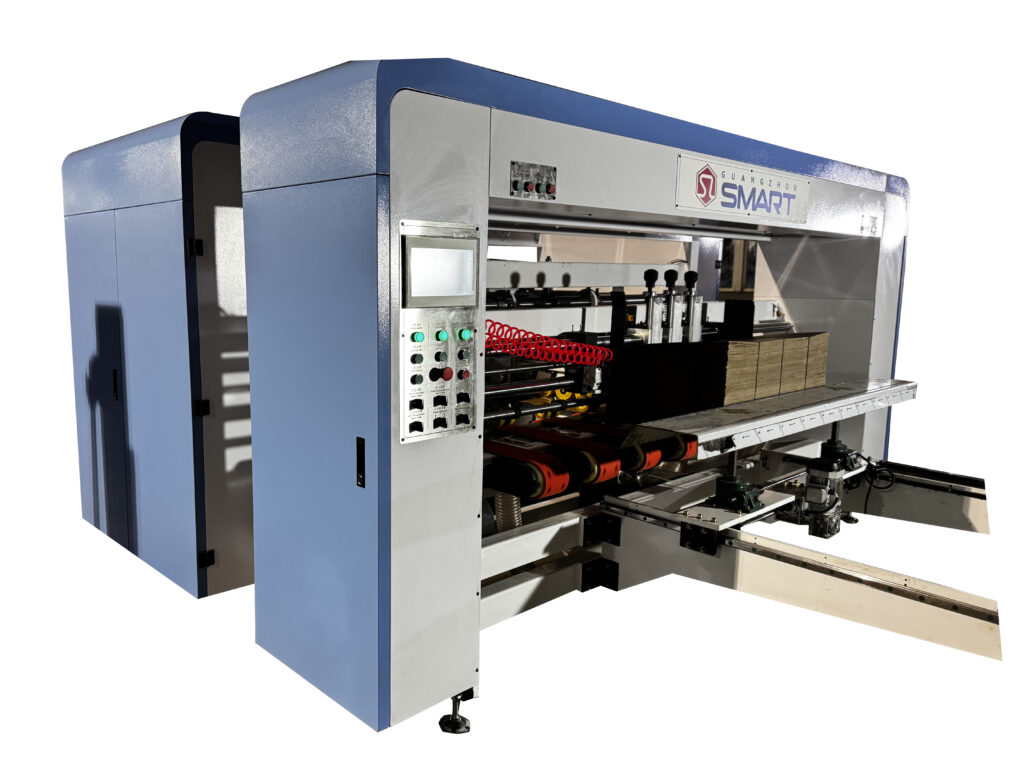
This machine is essential for processing high-strength corrugated containers (3-ply, 5-ply, and even 7-ply) where standard gluing is insufficient for heavy-duty structural integrity. Key features found in high-ranking SERP results include:
Dual-Function Integration: Seamlessly toggles between glue-only, stitch-only, or combined (glue + stitch) modes for maximum box strength.
Precision Control: Utilizing EtherCAT or similar high-speed bus communication to maintain folding accuracy of ±0.5 mm (0.02 in) even at speeds exceeding 150 m/min.
Sustainability Features: Integrated dust extraction and noise reduction (<80dB) modules, alongside automated “order memory” to reduce setup waste—a critical factor for Tier-1 suppliers like Amazon or Nestlé.
In summary: An eco automatic folder gluer and stitcher machine represents the pinnacle of post-print versatility, offering a low-carbon footprint while providing the robust mechanical fastening required for global export-grade corrugated packaging.
Fast Check Product :https://gzsmartmachinery.com/product/eco-automatic-folder-gluer-and-stitcher-machine/
Tier-by-Tier Operating Performance Benchmarks
| Parameter | Tier 3 Supplier | Tier 2 Supplier | Tier 1: GZ Smart Machinery |
|---|---|---|---|
| Fold Registration Accuracy | ±1.5 mm | ±0.8 mm | ±0.5 mm / ±0.019″ |
| Stitching Pitch Consistency | ±2.0 mm | ±1.0 mm | ±0.5 mm / ±0.019″ |
| Glue Bead Placement Accuracy | ±0.8 mm | ±0.5 mm | ±0.2 mm / ±0.008″ |
| Max Sustained Speed | 90 m/min / 295 FPM | 120 m/min / 390 FPM | 180 m/min / 590 FPM |
| Format Changeover Time | 45–60 min | 20–30 min | < 12 min |
| Energy vs. Legacy Induction Drive | Baseline | −12% | −28% (IE4 PMSM) |
| Closed-Loop Servo Axes | 4 | 8 | 12 |
| Wire Feed Encoder Resolution | Fixed cam | 500 PPR | 2,048 PPR |
| PLC Scan Interval | 1 ms | 500 μs | 250 μs |
Sheet Feeding & Dynamic Skew Correction
An eco folder gluer’s throughput ceiling is set not at the glue unit, but at the moment the lead-edge feeder’s vacuum suction plenum picks the blank from the stack. Our plenum segments into three independently regulated pressure zones, each governed by a proportional valve that responds within < 8 ms to board density variance measured by load-cell feedback under the feed table. This eliminates the double-feed failure mode that plagues single-zone vacuum designs at speeds above 150 m/min (492 FPM).
Skew correction is where mid-tier machines expose their mechanical weakness. A warped board entering at even a 0.3° angular offset translates into a fold deviation of 4–6 mm across a 1,200 mm (47.2″) blank — a defect that survives undetected until the finished carton collapses under compressive load. Our dynamic side-guide system applies lateral correction via a servo-actuated gate that reads leading-edge position via encoder feedback in real time, not via static mechanical stops that require manual reset per job.
The correction stroke completes within one sheet-pitch interval, meaning the board is geometrically aligned before contacting the first fold rail. Pre-fold guide rails then apply a progressive-wrap angle profile across 1,800 mm (70.9″) of rail travel — spreading mechanical stress over time and preventing crease fracture on 3-ply B-flute profiles running at 180 m/min (590 FPM).
Glue Application Dynamics & Fold Registration Closed-Loop Logic
Hot-melt glue application in a folder gluer is not a static bead-on-command event — it is a timed pneumatic pulse synchronized to instantaneous sheet velocity. Our glue guns actuate via a solenoid valve with 6 ms electrical response time, triggered by a rotary encoder on the fold conveyor shaft — not a software timer. This encoder-referenced triggering compensates for belt slip and mechanical hysteresis, delivering glue bead placement at ±0.2 mm / ±0.008″ accuracy across the full speed range of 60–180 m/min (197–590 FPM).
Glue bead volume is regulated by a gear-pump metering unit whose output speed scales proportionally with encoder pulse rate. As line speed increases, glue flow rate increases in exact ratio — maintaining a consistent 4.0–4.5 g/m bead density without operator intervention. Conventional fixed-flow pumps require 30–40 minutes of manual calibration at every speed change; the closed-loop gear pump eliminates this entirely.
Fold registration across the belt section is maintained by a 12-axis servo architecture where each fold belt drive is independently phase-tuned via a Mitsubishi iQ-R master PLC. Encoder feedback loops close at 250 μs scan intervals, compensating for belt elongation and thermal expansion before any fold deviation reaches 0.1 mm / 0.004″ — well below the print-register tolerance of most corrugated plants.
Wire Stitching Head Synchronization & Pitch Consistency
The stitcher-folder integration is where combination machines most often fail under production load. A wire-feed system running asynchronously with the folder conveyor generates pitch drift — the inter-staple gap begins to vary, and at sustained high speed this creates structural weak points that compromise carton compressive strength by 15–22% in standard BCT testing. Our stitching heads are phase-locked to the main PLC via 2,048 PPR incremental encoders on the wire-feed shaft — the same clock domain that governs the folder conveyor — eliminating the independent drive motor approach where phase error accumulates over time.
Wire cutting force is governed by a cam-actuated knife with hydraulic back-pressure compensation. As wire hardness varies between spools — a documented manufacturing reality with galvanized wire — the hydraulic circuit absorbs the resistance differential, maintaining consistent cut energy without spiking dynamic load on the stitching head shaft. Stitching pitch holds at ±0.5 mm / ±0.019″ across all wire gauges from 0.9 mm to 1.2 mm (20–18 AWG) at speeds up to 180 m/min (590 FPM).
Synchronization is validated during FAT via a strobe-phase test at 100%, 90%, and 75% of rated speed — not only at low-speed run-in. Any phase deviation exceeding 0.4 ms triggers an automatic speed-hold command from the PLC, preventing out-of-spec cartons from reaching the counter-ejector.
Eco Drive Architecture & Verified Energy Reduction
The “eco” designation is not marketing language — it is a measurable specification verified against IEC 60034-30-1 Class IE4 motor standards. All 12 servo axes use permanent magnet synchronous motors (PMSM), replacing the induction motors and mechanical gearboxes common in legacy folder-gluer drivetrains. PMSMs deliver 28% lower energy consumption per 100,000 produced cartons versus equivalent induction-motor platforms, measured at 180 m/min (590 FPM) sustained speed under standard plant ambient conditions of 35°C / 95°F.
Regenerative braking energy from deceleration events — emergency stops, controlled ramp-downs during short-run format changes — is fed back to the DC bus and consumed by adjacent servo drives rather than dissipated as heat through braking resistors. At a plant running two format changes per shift, this regenerative recovery reduces peak demand on the electrical supply by approximately 8–12 kW per stop-start cycle. In markets with demand-charge electricity pricing — standard across North American industrial tariffs — this directly reduces per-shift operating cost without affecting throughput.
Quick-release mechanical changeover on the glue system, fold rails, and stitching head guide channels reduces format-change downtime from an industry-average 45 minutes to under 12 minutes. At five format changes per day across a two-shift operation, this recovers 2.75 machine-hours daily — equivalent to an additional production block at zero incremental capital cost.
Inline Phase Synchronization & Counter-Ejector Output Logic
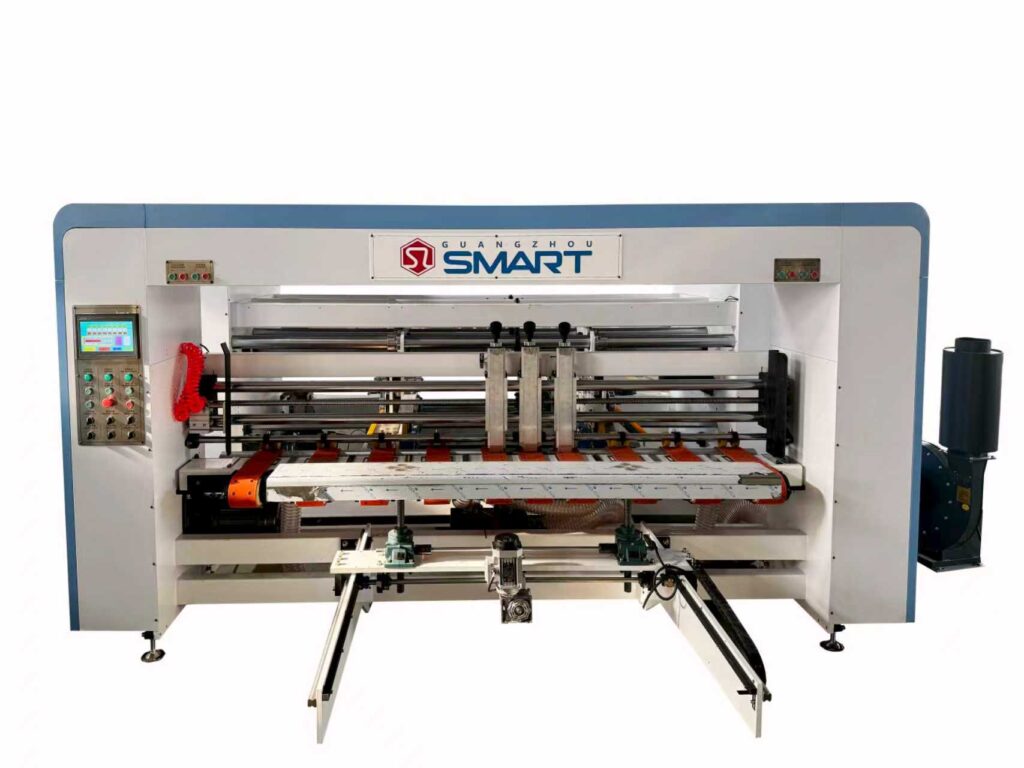
The counter-ejector is where output quality becomes visible and where poor synchronization produces the most expensive defects. Our inline counter uses a photo-electric sheet-detection array with 0.1 ms trigger latency, feeding real-time box-count data to the main PLC. Ejector gate timing is synchronized to the folder-conveyor encoder, ensuring the ejection stroke completes within the sheet-gap interval — never during passage of the next sheet.
Stack formation uses servo-actuated side-tamping plates that compress each completed bundle within ±1 mm / ±0.039″ of the programmed stack width. This dimensional control is critical for automated downstream handling: a stack out of tolerance by 3 mm (0.12″) causes misalignment in a robotic gripper, triggering cascade failure across the entire post-press line. For plants integrating with a eco automatic folder gluer and stitcher machine upstream, the folder-gluer-stitcher PLC accepts a machine-ready handshake signal via Profibus-DP or EtherCAT, creating a line-speed-matched buffer that eliminates manual operator pacing between stations.
FAQ
Q: What is the minimum and maximum blank size this machine processes? The machine handles blanks from 250 × 200 mm (9.8″ × 7.9″) up to 2,800 × 1,500 mm (110.2″ × 59.1″), covering RSC, HSC, and standard slotted containers across most corrugated plant portfolios.
Q: Can the stitcher and glue unit operate simultaneously on the same carton? Yes. Both heads are independently phase-controlled, allowing stitch pitch and glue bead position to be configured separately without mechanical conflict — supporting multi-wall and reinforced flap carton constructions.
Q: Which wire gauges does the stitching head accept? The heads accept 0.9 mm to 1.2 mm (20–18 AWG) galvanized flat wire, covering board thicknesses from 3-ply B-flute through 5-ply BC-flute combined board.
Q: How does the PMSM servo architecture affect long-term maintenance intervals? Elimination of mechanical gearboxes removes the highest-failure-rate components in conventional folder-gluer drivetrains. Mean time between maintenance interventions extends from a typical 1,200 hours to > 4,500 hours, reducing unscheduled downtime and spare-parts inventory requirements.
Q: What certifications does the machine carry? CE (Machinery Directive 2006/42/EC), ISO 9001:2015 process certification, and IEC 60034-30-1 IE4 motor efficiency classification. UL and CSA certification available on request for North American installations.
Q: What does the Factory Acceptance Test (FAT) documentation include? Sustained-speed run tests at 100%, 90%, and 75% of rated speed; glue-placement deviation histograms; fold-registration data logs; stitching pitch measurement reports captured across all three wire gauges. The full FAT package is available for review prior to purchase commitment.