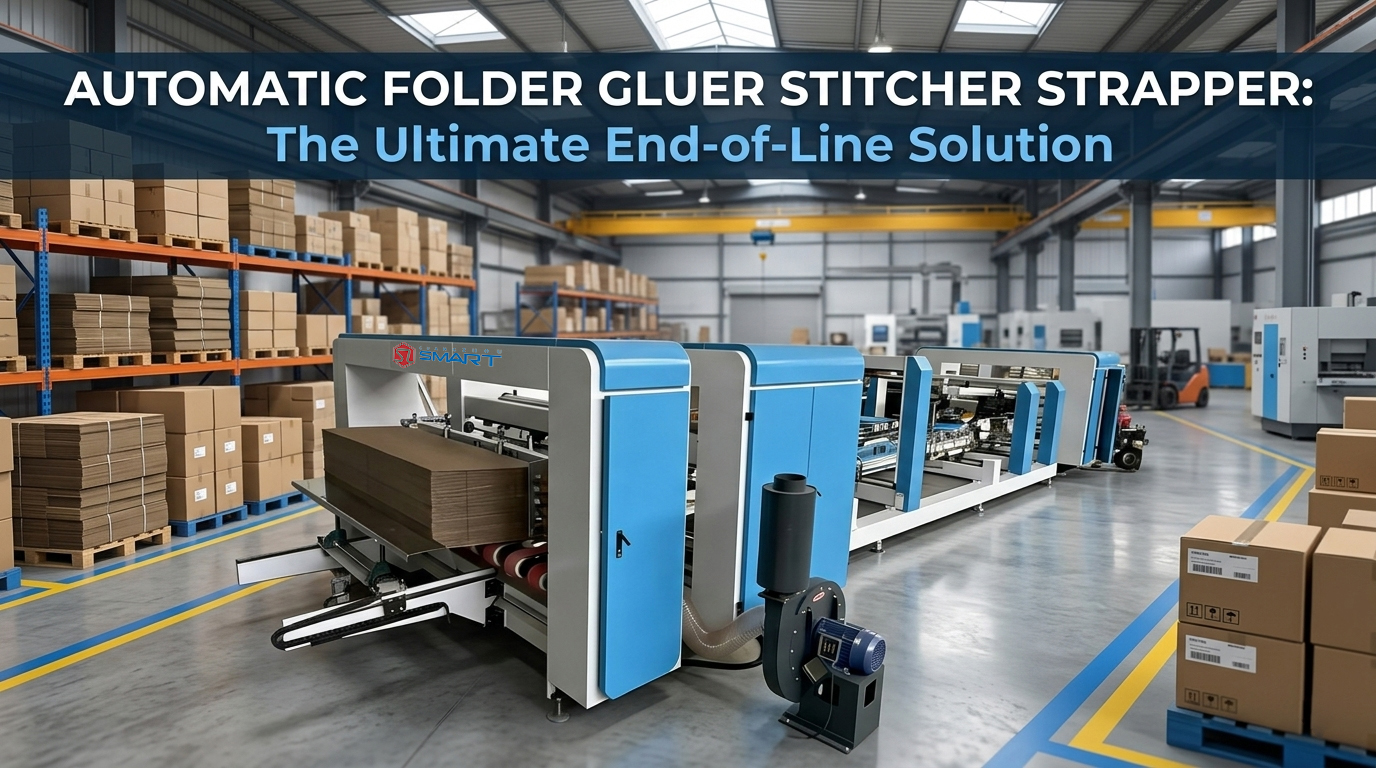
Vetting an automatic folder gluer stitcher strapper machine supplier requires three non-negotiable benchmarks before the purchase order is raised: phase-locked motion control shared across all three machine sections under sustained production load — not just at commissioning speed — documented wear-part lead times under 72 hours for high-cycle consumables including fold belts, stitch wire guides, and strapper arch liners, and a structured Factory Acceptance Test (FAT) protocol that validates inter-section synchronization at ≥ 90% of rated line speed for a minimum 60-minute continuous run. At Guangzhou Smart Machinery, the integrated automatic folder gluer stitcher strapper machine ships as a single Delta PLC-governed line with a shared encoder reference bus across all three drive sections.
An automatic folder gluer stitcher strapper is an integrated packaging solution that converts corrugated sheets into finished boxes. It performs three primary functions: Folding the pre-creased blanks, applying Adhesive (Gluing), and reinforced Wire Stitching (Stapling). This hybrid capability allows manufacturers to choose the best closure method based on the weight and durability requirements of the carton.
The primary advantages include reduced floor space, lower labor costs (single operator), and increased structural integrity. Heavy-duty export boxes often require both glue and stitches to meet international shipping standards for burst strength.
Accuracy: Ensuring a ±0.5mm folding precision.
Versatility: Handling 3-ply, 5-ply, and E/B/C/A flute corrugated boards.
Setup Time: Mention “Digital PLC Control” for rapid order changeover
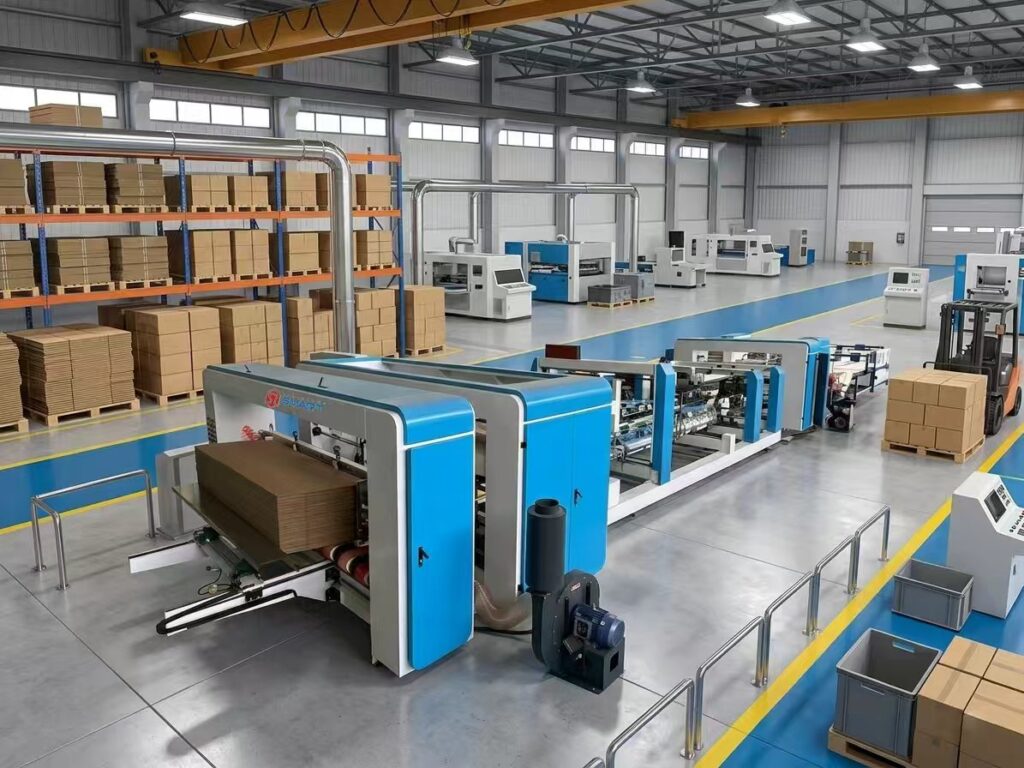
Fast Check Product:https://gzsmartmachinery.com/product/automatic-folder-gluer-stitching-machine/
| Benchmark | Tier 3 Supplier | Tier 2 Supplier | Tier 1: GZ Smart Machinery |
|---|---|---|---|
| Motion Control Architecture | Mechanical cam, no handshake | Separate PLCs per section | Unified Delta PLC, shared encoder bus |
| Fold Accuracy at Max Speed | ±2.0 mm / ±0.079″ | ±1.0 mm / ±0.039″ | ±0.5 mm / ±0.019″ |
| Max Line Speed | 120 m/min / 394 FPM | 150 m/min / 492 FPM | 180 m/min / 591 FPM |
| Stitch Pitch Range | Fixed setting | 50–100 mm / 1.97″–3.94″ | 30–120 mm / 1.18″–4.72″ |
| Glue System | Hot-melt only | Hot-melt only | Cold glue + hot-melt, switchable |
| Strapper Integration | Manual transfer required | Semi-auto bridge conveyor | Inline, servo-synchronized |
| Secondary Skew Correction | None | Side guide only | Active correction, eliminates fishtail |
| FAT Documentation | None | Run-speed sheet only | Phase deviation log + stitch histogram |
The Labor Math Behind Three-Section Inline Integration
A conventional post-press layout runs the folder, stitcher, and strapper as three standalone stations connected by manual transfer and intermediate stacking. At 180 m/min / 591 FPM throughput across three separate machines, the staffing requirement is typically 4–5 operators per shift: one managing the folder feeder, one supervising stitcher wire tension, one feeding the strapper infeed, and one clearing inter-machine stack accumulation points. Over a two-shift operation, that is 8–10 headcount dedicated exclusively to box finishing, before maintenance or quality control personnel are included.
An integrated folder-gluer-stitcher-strapper eliminates inter-machine stacking entirely. The folder conveyor feeds directly into the stitching section; the stitcher output transfers inline to the strapper arch — all three sections synchronized by the same Delta PLC encoder reference. The realistic operator requirement for the integrated line is two per shift: one at the feed stack, one at the output bundle conveyor. For plants running two shifts, this represents a sustained reduction of 4–6 operator positions on the box finishing line.
The material cost reduction is equally calculable. Our folder-gluer section’s enclosed cold-glue recirculation system brings starch consumption from an industry-average > 22 kg per metric ton of board processed to < 18 kg per metric ton — a reduction of approximately 20%. At a corrugated plant processing 800–1,200 metric tons of board per month, this is a measurable monthly consumable cost reduction that compounds across the machine’s full service life.
Supplier Audit: Drive Architecture & Inter-Section Phase Control
The most reliable predictor of long-term integrated line performance is not the spec sheet’s peak speed figure — it is whether the three machine sections share a unified motion reference signal or operate on independent drive controllers. Three sections running separate PLCs without a defined handshake protocol are three machines on a shared frame, not an integrated line. Under real production conditions — board density variation between jobs, wire spool changes in the stitching section, strap coil transitions at the strapper — independent controllers accumulate phase offset errors that manifest as stitch-pitch drift, missed strap cycles, and bundle miscount at the output.
Our integrated line uses the Delta PLC as the master motion controller for all three sections simultaneously. All folder belt drives, stitching head servo motors, and strapper arch drives reference the same encoder pulse train. When line speed transitions from 60 m/min to 180 m/min / 197 FPM to 591 FPM during ramp-up, all three sections execute the same velocity profile with no inter-section slip or timing offset. Fold register is maintained at ±0.5 mm / ±0.019″ through the speed transition — not just at steady-state rated speed.
Demand the following from any supplier’s engineering team before issuing a purchase order:
- The exact PLC model and motion control module governing inter-section synchronization
- Encoder placement and resolution (PPR) on the stitching head shaft and strapper arch servo
- The documented acceleration ramp time (0 to rated speed, in seconds) — this reveals whether phase control is genuine or approximated by a fixed-time delay relay
Wear Parts Metallurgy & Supply Chain Transparency
A folder-gluer-stitcher-strapper running two shifts per day at 150 m/min / 492 FPM will drive its fold belts, wire guides, glue valve seals, and strapper arch liners through > 250,000 operational cycles per week. At this cycle intensity, consumable wear is a scheduled production event — not a contingency. Any supplier that cannot provide material specifications and documented ex-stock lead times for these components is presenting an ROI model that excludes its largest variable.
Fold Belts: Our conveyor fold belts use a high-grip, aramid fiber-reinforced polyurethane compound — not standard rubber-ply construction. The design keeps elongation under sustained lateral tension below the threshold that requires re-tensioning, extending maintenance intervals without belt replacement frequency increasing. Standard rubber-ply belts require re-tensioning every 300–400 operational hours; our belts are rated to substantially longer intervals at equivalent load.
Feed Friction Plates & Wire Guides: The feed table friction surfaces that grip individual board sheets are coated with tungsten carbide (WC) via thermal spray process, achieving Vickers hardness in the HV 1,400–1,600 range. Mild steel friction plates at HV 200–250 develop groove wear within 60–90 days under continuous board throughput. WC-coated plates extend service intervals by a factor of 4–6× on this component. Stitch wire guide channels are manufactured from hardened tool steel with precision-ground wire contact surfaces to maintain ±0.5 mm / ±0.019″ stitch pitch consistency across wire gauge transitions.
High-Frequency Electronic Glue Valves: Cold-glue application is actuated by high-frequency solenoid glue valves synchronized to the folder conveyor encoder — not to a software timer. Encoder-referenced triggering compensates for mechanical hysteresis and belt speed variation, maintaining bead placement accuracy independent of line speed changes. Valve body seals are rated for continuous duty on water-based starch adhesives at operating temperatures up to 60°C / 140°F, with a documented service interval of [VERIFY: glue valve seal replacement interval] hours under standard production conditions.
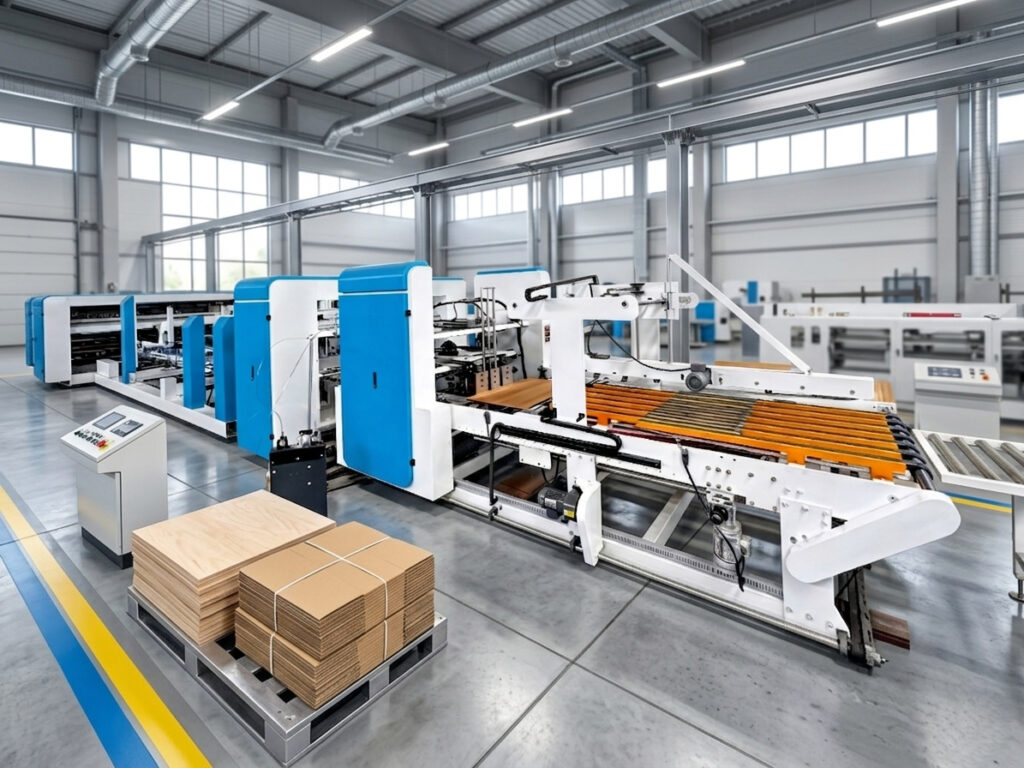
Stitcher-to-Strapper Handoff: Where Phase Problems Actually Appear
The folder-to-stitcher transition is the section most suppliers test during FAT because it is the most visible. The stitcher-to-strapper handoff is where phase problems emerge in production and are rarely caught during factory validation at reduced speed. The strapper arch requires a defined inter-stack gap to complete its strap cycle — if the stitcher output conveyor speed is not matched to the strapper arch cycle time within a tight tolerance, the strapper either jams on a double-feed or misses a strap cycle, producing unstrapped bundles that must be manually re-processed.
Our strapper’s servo-driven infeed conveyor receives a real-time trigger from the stitcher section’s output encoder — not from a fixed-time delay. This encoder-referenced triggering maintains gap timing across all speed conditions including ramp-up, ramp-down, and speed-hold events during short-run format changes. Intelligent tension control adjusts strap tension to match the board grade stored in the job recipe: 5-ply double-wall corrugated requires significantly higher strap tension than 3-ply B-flute product, and a fixed-tension strapper set for the former will crush scored flap edges on the latter.
Strap tension range, arch height range, and compatible strap widths are model-dependent — the correct specification for your board grade portfolio and bundle dimensions should be confirmed with our technical sales team at the quoting stage.
FAT Checklist for a Three-Section Integrated Line
A FAT protocol for a standalone folder gluer covers fold accuracy and output count. A FAT for an integrated three-section line must cover inter-section synchronization under three distinct production conditions: (1) a 60-minute minimum sustained run at 180 m/min / 591 FPM with no operator intervention, (2) two complete format changes executed from full speed with documented ramp-down and ramp-up phase logs, and (3) one wire spool change at 80% of rated speed with no strapper jam or missed strap cycle recorded.
The minimum FAT documentation set that should ship with the machine:
- Fold registration deviation log recorded at 60%, 80%, and 100% of rated speed
- Stitch-pitch measurement report: 50-sample histogram at each of three speed points
- Strapper arch cycle timing log: recorded at 10-minute intervals over the 60-minute sustained run
- Inter-section phase error log: delta between stitcher output encoder and strapper infeed encoder at 1-second sample intervals
- Bundle dimension verification: [VERIFY: target tolerances] across 10 consecutive bundles
A supplier that cannot produce this documentation at FAT is operating three machines with a shared conveyor frame. Your production team will identify the difference within the first 90 days of commissioning.
For full technical specifications and model configuration options, see our automatic folder gluer stitcher strapper — the core section of the integrated three-section line.
FAQ
Q: Can the strapper section be retrofitted to an existing GZ Smart Machinery folder-gluer-stitcher? A: Retrofit integration is possible on machines where the existing Delta PLC generation supports the encoder handshake protocol required for inter-section synchronization. A site inspection is required to confirm compatibility before retrofit engineering is scoped. New-line orders are configured as a unified system from the outset and do not carry retrofit compatibility risk.
Q: What strap materials and widths does the strapper accept? A: The strapper processes both PP (polypropylene) and PET (polyester) strap. Compatible strap width and thickness ranges are model-dependent. [VERIFY and insert specific width/thickness range.] Strap specification is stored per job recipe in the Delta PLC and recalled automatically at job changeover.
Q: How does board grade variation affect strap tension settings? A: Strap tension is not a fixed machine parameter — it is a job recipe variable stored in the Delta PLC and recalled automatically at format change. The system adjusts tension to match board grade ECT (Edge Crush Test) rating, preventing edge damage on lighter board grades while maintaining bundle security on double-wall corrugated.
Q: What is the format changeover time for the complete integrated line? A: A standard format change — fold dimension, stitch pitch reset, and strapper arch adjustment — completes in under [VERIFY] minutes when job recipes are pre-stored in the Delta PLC. First-time job setup without a stored recipe requires a short calibration run in addition.
Q: Does the integrated line support remote diagnostic access? A: Yes. The Delta PLC is configured for remote access via a secured industrial VPN connection. Real-time fault logs, encoder calibration data, and PLC parameter adjustments can be executed remotely without an on-site service visit for diagnostic tasks.
Q: What certifications does the machine carry? A: CE (Machinery Directive 2006/42/EC) and ISO 9001:2015 manufacturing process certification are standard.