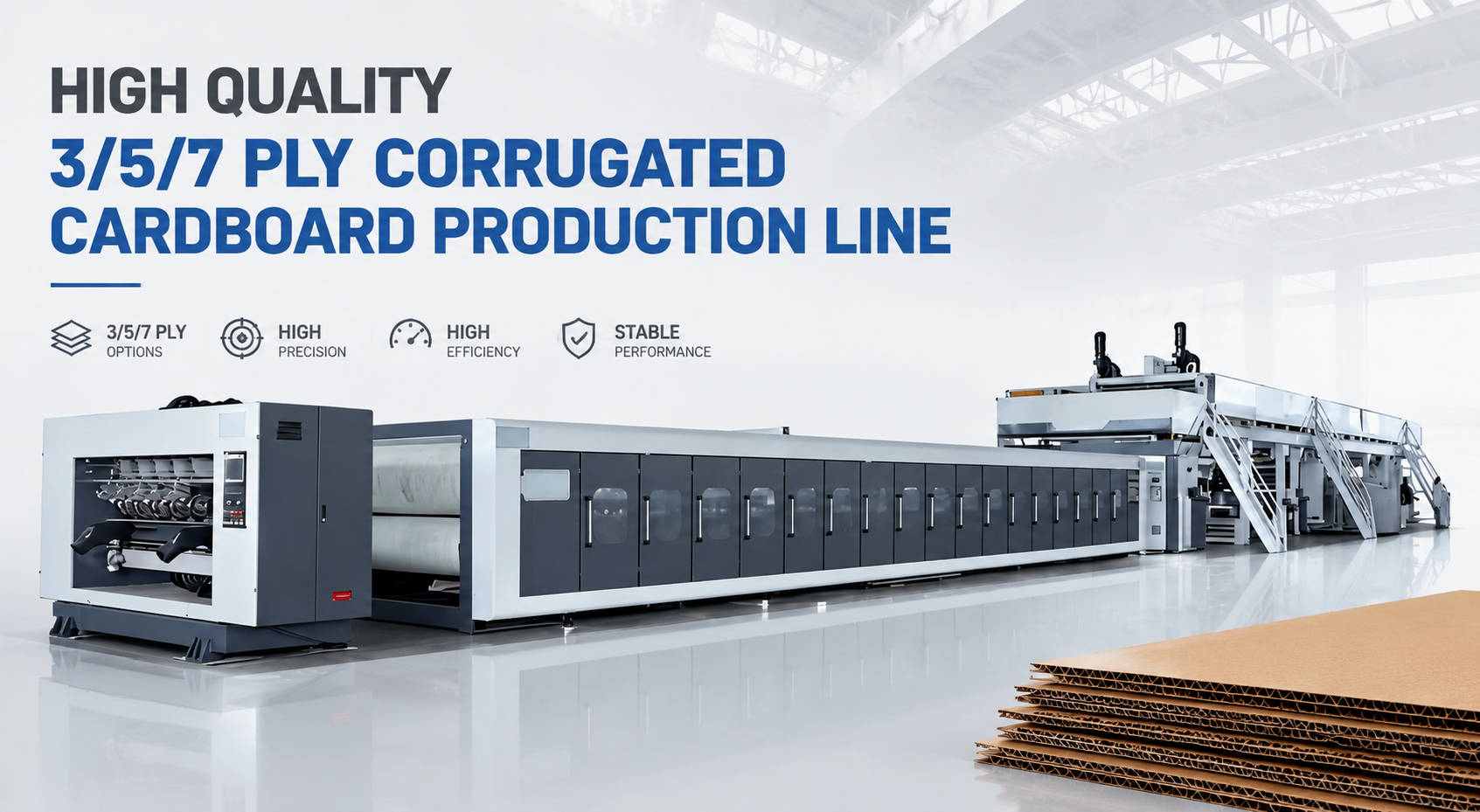
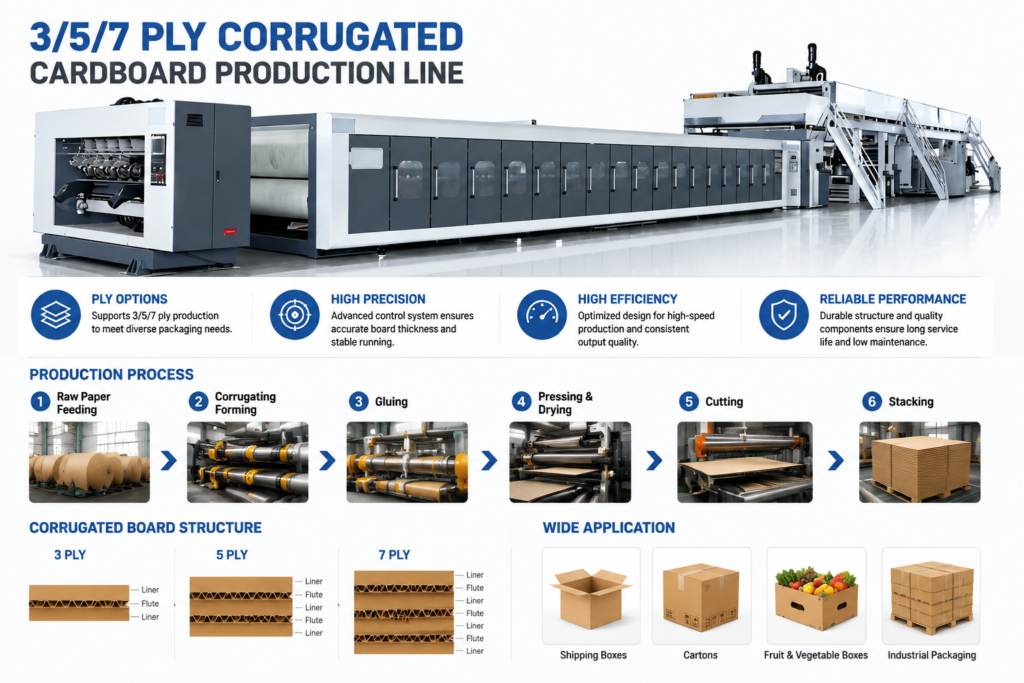
Three parameters separate a first-tier high quality 3 5 7 ply corrugated cardboard production line supplier from the field: corrugating roll surface geometry tolerance — specifically whether flute pitch deviation is held below ±0.05 mm / ±0.002″ across the full roll face width, which determines board caliper consistency and downstream box compression strength; double facer hot plate temperature uniformity — whether temperature variation across the board width is controlled within ±3°C / ±5.4°F, because thermal non-uniformity causes differential starch gelatinization that manifests as delamination under compressive load; and steam system condensate recovery rate — a supplier that cannot document this figure is handing you an open-ended energy cost that will compound across the production line’s 15–20 year service life. At Guangzhou Smart Machinery, our corrugated board production lines are configured for 3-ply, 5-ply, and 7-ply output from a single integrated line, with section-by-section thermal and tension control governed by a unified PLC architecture.
Guangzhou Smart Machinery stands globally recognized as a premier authority in this industrial paradigm shift, engineering advanced heavy-duty solutions that seamlessly bridge the gap between uncompromising mechanical reliability and state-of-the-art digital control. For packaging conglomerates aiming to dominate local markets and secure lucrative, long-term contracts with multinational retail giants, upgrading to a high quality 3 5 7 ply corrugated cardboard production line is no longer merely a capital expenditure option; it is a critical operational necessity.
Fast Check Product:https://gzsmartmachinery.com/product/corrugated-cardboard-production-line/
Production Line Tier Comparison: Engineering Specification Matrix
| Technical Benchmark | Tier 3 Supplier | Tier 2 Supplier | Tier 1: GZ Smart Machinery |
|---|---|---|---|
| Corrugating Roll Material | Cast iron, chrome-plated | Forged steel, chrome-plated | Alloy steel, precision-ground, chrome-plated |
| Flute Pitch Deviation | ±0.15 mm / ±0.006″ | ±0.08 mm / ±0.003″ | ±0.05 mm / ±0.002″ |
| Double Facer Plate Temp. Uniformity | ±8°C / ±14.4°F | ±5°C / ±9°F | ±3°C / ±5.4°F |
| Steam Condensate Recovery | < 60% | 70–80% | > 85% |
| Bridge Tension Control | Fixed mechanical | Manual adjustment | Auto-tension PLC with load cell feedback |
| Glue System | Fixed-flow pump | Fixed-flow with manual trim | Encoder-referenced high-frequency valve |
| Slitter-Scorer Accuracy | ±2.0 mm / ±0.079″ | ±1.0 mm / ±0.039″ | ±0.5 mm / ±0.019″ |
| PLC Architecture | Standalone per section | Partially integrated | Unified PLC, all sections |
| Ply Configuration | Fixed (3-ply or 5-ply) | Fixed at order | 3-ply / 5-ply / 7-ply switchable |
Single Facer Section: Corrugating Roll Geometry & Flute Formation Mechanics
The single facer is where corrugated board’s structural identity is established — the corrugating roll pair forms the flute profile by running the medium paper through intermeshing fluted rolls under a combination of heat and pressure. Roll surface temperature is maintained in the 160–180°C / 320–356°F range to plasticize the paper fibers sufficiently for flute formation without thermal degradation of cellulose structure. The critical variable is not the average roll temperature but the temperature uniformity across the full roll face width — a roll that is 10°C hotter at the center than at the edges produces a corrugated medium with inconsistent flute height across the board width, which reduces the finished board’s flat crush resistance (FCT) in a pattern that correlates directly with the roll thermal gradient.
Corrugating roll flute geometry is a precision-machined specification: A-flute runs at 4.7 mm / 0.185″ pitch and 4.7 mm / 0.185″ height, B-flute at 2.7 mm / 0.106″ pitch and 2.7 mm / 0.106″ height, C-flute at 3.6 mm / 0.142″ pitch and 3.5 mm / 0.138″ height, and E-flute at 1.2 mm / 0.047″ pitch. Pitch deviation beyond ±0.05 mm / ±0.002″ causes flute tip misalignment at the glue station — flute tips that miss the glue application zone produce unbonded flute nodes that fail catastrophically under vertical compressive load. Our corrugating rolls are manufactured from alloy steel and finish-ground to profile tolerances that maintain flute geometry across the roll’s full service life, with chrome-plating applied to the flute surfaces for corrosion and wear resistance.
The starch glue application to the corrugated medium’s flute tips is executed by a high-frequency electronic solenoid glue valve system — encoder-referenced to the single facer roll speed so that glue volume scales proportionally with production rate. A fixed-flow glue pump running at constant output will over-apply adhesive at low speed and under-apply at high speed; both conditions produce bond-strength failures in the finished board, with over-application additionally increasing board weight and steam consumption in the double facer required to gelatinize the excess starch.
Bridge Section: Web Tension Management & Warp Prevention
The bridge — the overhead loop conveyor that carries the single-face web from the single facer to the double facer — is the section of the corrugated production line that most directly determines finished board flatness, and it is the section that receives the least attention in supplier comparisons. The single-face web exits the single facer at a moisture content significantly higher on the fluted medium side than on the liner side; as this differential moisture equalizes during bridge transit, the web develops a curl tendency proportional to the moisture gradient. A board moisture differential exceeding 2% between top and bottom liner produces warp that cannot be corrected downstream by the double facer’s heating plates — the caliper set point of the board at exit will vary and the finished sheet will not lie flat on the stacker.
Our bridge section uses PLC-controlled auto-tension with load-cell feedback at the web entry and exit points. The load-cell system measures web tension in real time and adjusts the bridge drive speed to maintain tension within ±5% of the target set point across speed transitions — ramp-up, ramp-down, and speed-hold during paper roll splices. Uncontrolled tension during a paper splice event is the primary cause of web breaks; a web break at 200 m/min / 656 FPM generates approximately 8–12 minutes of production downtime per event including re-threading, making tension control during splices the most impactful availability factor on the entire production line.
The bridge length is configured at the line design stage based on the production speed and the target dwell time for moisture equalization — a line designed for 200 m/min / 656 FPM requires a longer bridge than a line designed for 120 m/min / 394 FPM to achieve the same equalization dwell time. This is not a detail that appears in a one-page technical sheet; it is a design parameter that separates a production line built for a specific speed rating from one that happens to run at that speed under ideal conditions.
Double Facer: Heating Architecture & Glue Gelatinization Control
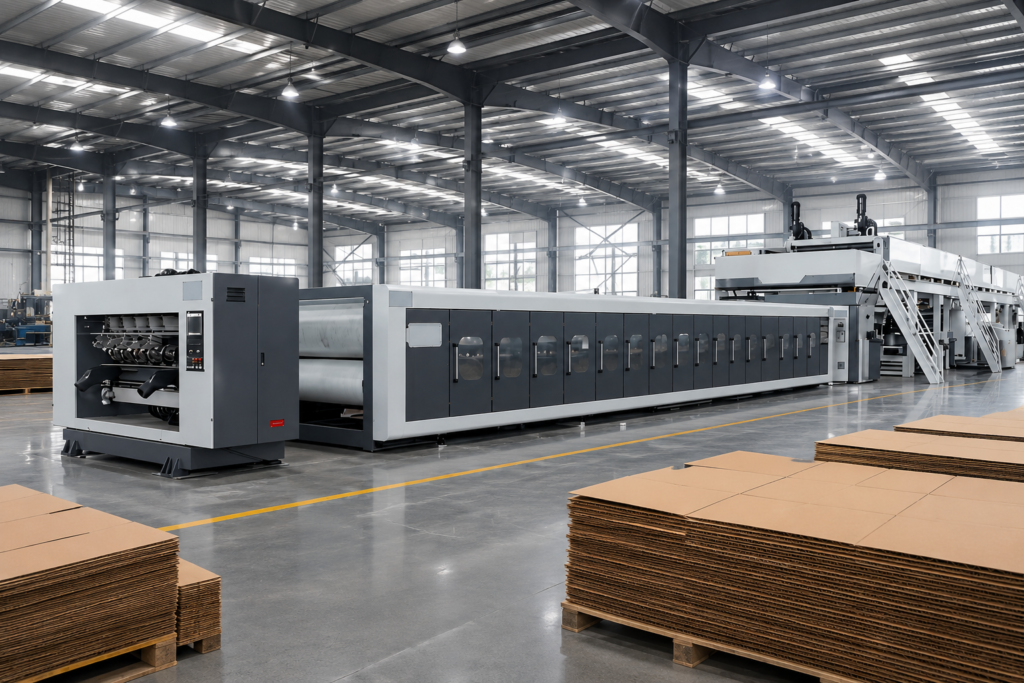
The double facer bonds the single-face web and the bottom liner under simultaneous heat and pressure, completing the board laminate. Heat is applied through a series of steam-heated flat plates over which the board travels under the compression force of woven polyester pressure belts — the belt material specification determines how consistently the compression force is distributed across the full board width, and belt wear directly affects bond-strength uniformity as the line ages. Our double facer uses high-tensile polyester-cotton blend pressure belts with a documented elongation-at-load specification that maintains even pressure distribution across the full board width throughout the belt’s service life.
The critical process parameter in the double facer is starch gelatinization temperature — corn starch adhesive used in corrugated board production gelatinizes (converts from liquid suspension to structural adhesive) at 58–68°C / 136–154°F. The hot plates must bring the board surface to this temperature range in the time the board spends traversing the double facer length. At higher production speeds, the dwell time under each plate is shorter, requiring higher plate temperatures to achieve equivalent gelatinization — and this is where temperature uniformity becomes the binding constraint. A plate running ±8°C / ±14.4°F variation may achieve adequate bond at the plate center while leaving under-gelatinized zones at the edges, producing boards with consistent center bond strength but delaminating edges under peel test.
Our hot plate temperature uniformity specification of ±3°C / ±5.4°F across the full board width is achieved through a zoned steam distribution design — each plate section is independently controlled rather than fed from a common steam manifold. Zones adjacent to the board edge, which experience higher convective heat loss to the ambient environment, receive independently regulated steam supply to compensate for the heat loss. This is the engineering reason why edge-zone temperature control requires individual zone regulators rather than a single manifold: a manifold supplies the same steam enthalpy to center and edge zones that have different heat loss rates, making uniform plate temperature physically impossible.
Slitter-Scorer Precision & Its Impact on Downstream Post-Press Performance
The slitter-scorer cuts the finished board to width and applies crease lines — and its accuracy specification propagates directly into the performance of every downstream machine that processes the finished sheet. A corrugated sheet produced at ±0.5 mm / ±0.019″ slitter accuracy enters a folder-gluer or flexo printing machine with a consistent dimensional baseline; a sheet produced at ±2.0 mm / ±0.079″ introduces a dimensional variability that the downstream machine’s feed table must absorb, consuming part of its registration tolerance budget before any processing error is introduced. For corrugated plants that operate both a board production line and downstream post-press equipment, slitter accuracy is the mechanical link between upstream and downstream quality performance.
Our slitter-scorer achieves ±0.5 mm / ±0.019″ cutting accuracy through servo-driven knife positioning with encoder feedback — each knife carrier is independently positioned by a servo actuator rather than by mechanical stop adjustment. This architecture allows width changes to be executed from the PLC operator panel without physical knife repositioning by an operator, reducing format-change time and eliminating the measurement error introduced by manual adjustment. The score bar geometry is configured at the design stage for the paper weight range and board caliper — score depth that is correctly set for 150 gsm liner will crack 300 gsm liner if not reconfigured, which is a common quality failure on non-servo slitter-scorers with fixed score depth settings.
The slitter knife specification uses tungsten carbide (WC)-coated cutting edges applied to the knife disc substrate via thermal spray. Corrugated board is an abrasive substrate — the kraft liner surface and the starch adhesive layer accelerate edge wear on unhardened steel knives. WC-coated slitter knives maintain their cutting edge geometry across a service life 4–6× longer than unhardened tool steel alternatives, reducing the frequency of knife changes and the associated production stoppages and re-calibration events.
Steam System Design, Thermal Efficiency & Energy Cost Per Metric Ton
Steam is the largest operating cost variable on a corrugated board production line — not labor, not starch adhesive, not paper. Saturated steam at 1.2–1.5 MPa / 174–217 PSI supplies heat to the single facer rolls, the glue preheaters, and the double facer hot plates. At a production speed of 180 m/min / 591 FPM on a 1,800 mm / 70.9″ wide line producing 5-ply board, steam consumption runs in the range of 250–350 kg per metric ton of board produced — and the delivered cost of that steam, whether from a natural gas boiler, biomass system, or purchased steam supply, represents a cost that accumulates continuously across every production hour for the line’s 15–20 year life.
Condensate recovery is the primary lever for reducing steam system operating cost. When steam gives up its latent heat in the hot plates and corrugating rolls, it condenses to water — still at elevated temperature and pressure. A condensate recovery system captures this water, returns it to the boiler as pre-heated feedwater, and recovers the thermal energy content that would otherwise be lost to drain. Our production lines achieve > 85% condensate recovery through a flash tank and condensate return pump configuration with insulated return lines. The energy recovered in the returned condensate reduces the boiler’s fuel input per ton of steam generated — compounding into a measurable annual fuel cost reduction that is documented in the line’s energy performance specification.
The steam distribution design also affects production line speed capability. Steam flow rate to the double facer plates must match the thermal demand at the production speed — a steam system designed for 150 m/min / 492 FPM will not supply adequate heat at 200 m/min / 656 FPM, causing the control system to either reduce line speed or accept under-gelatinized board. Our steam system is sized with a 20% thermal margin above rated production speed, ensuring that the line’s mechanical speed capability is not thermally constrained during peak production periods or when processing heavier paper weights than the nominal specification.
For full technical specifications on our 3-ply, 5-ply, and 7-ply corrugated cardboard production line configurations, including board width options, paper weight range, and production speed ratings, see our high quality 3 5 7 ply corrugated cardboard production line product page.
FAQ
Q: What is the difference between a 3-ply, 5-ply, and 7-ply corrugated production line? A: The ply count refers to the number of paper layers in the finished board. 3-ply (single face) consists of one corrugated medium bonded to one flat liner — it is used primarily for wrapping and light-duty inner packaging. 5-ply (single wall) adds a second flat liner on the opposite side, producing the standard corrugated board used in most shipping cartons. 7-ply (double wall) bonds two corrugated medium layers with three flat liners, producing heavy-duty board for industrial and export packaging. Our production lines are configurable for all three outputs from a single line by adjusting the single facer count and bridge configuration.
Q: What paper weight range does the production line handle? A: The line processes liner and medium papers from 80 gsm to 450 gsm / 49 lbs to 275 lbs across the full ply configuration range. Paper weight change requires impression gap adjustment at the single facer and score depth reconfiguration at the slitter-scorer — both are PLC-controlled on our machines and do not require manual tooling change.
Q: What flute profiles can the production line produce? A: Standard flute profiles available include A-flute (4.7 mm pitch), B-flute (2.7 mm pitch), C-flute (3.6 mm pitch), E-flute (1.2 mm pitch), and BC-combination (double wall). Flute profile is determined by the corrugating roll set installed in the single facer — roll sets are interchangeable and changing flute profile requires a roll set replacement, which is a scheduled maintenance event rather than a per-job format change.
Q: How long does a corrugating roll set last before requiring replacement or re-grinding? A: Corrugating roll service life depends on paper type, production speed, and lubrication protocol. Chrome-plated alloy steel corrugating rolls in our specification typically run 8,000–12,000 production hours before profile wear reaches the re-grind threshold. Re-grinding restores the flute geometry to specification and extends the roll’s service life; a roll set typically supports 2–3 re-grind cycles before the substrate is consumed to the minimum wall thickness.
Q: What is the installation footprint for a complete 5-ply production line? A: A complete 5-ply production line from roll stands through stacker requires a building length of 80–120 m / 262–394 ft depending on bridge configuration and board width, with a minimum building height clearance of 8 m / 26.2 ft for the bridge overhead section. Specific footprint drawings are provided at the pre-order engineering review stage based on the customer’s confirmed building dimensions and column spacing.
Q: Does GZ Smart Machinery provide installation and commissioning support for overseas customers? A: Yes. Complete installation supervision, commissioning, and operator training are included in the supply scope for production line orders. Commissioning protocol includes a minimum 72-hour continuous production run at rated speed before handover acceptance, with board quality documentation — caliper, FCT, ECT, and bond strength — captured at the start, midpoint, and end of the commissioning run.