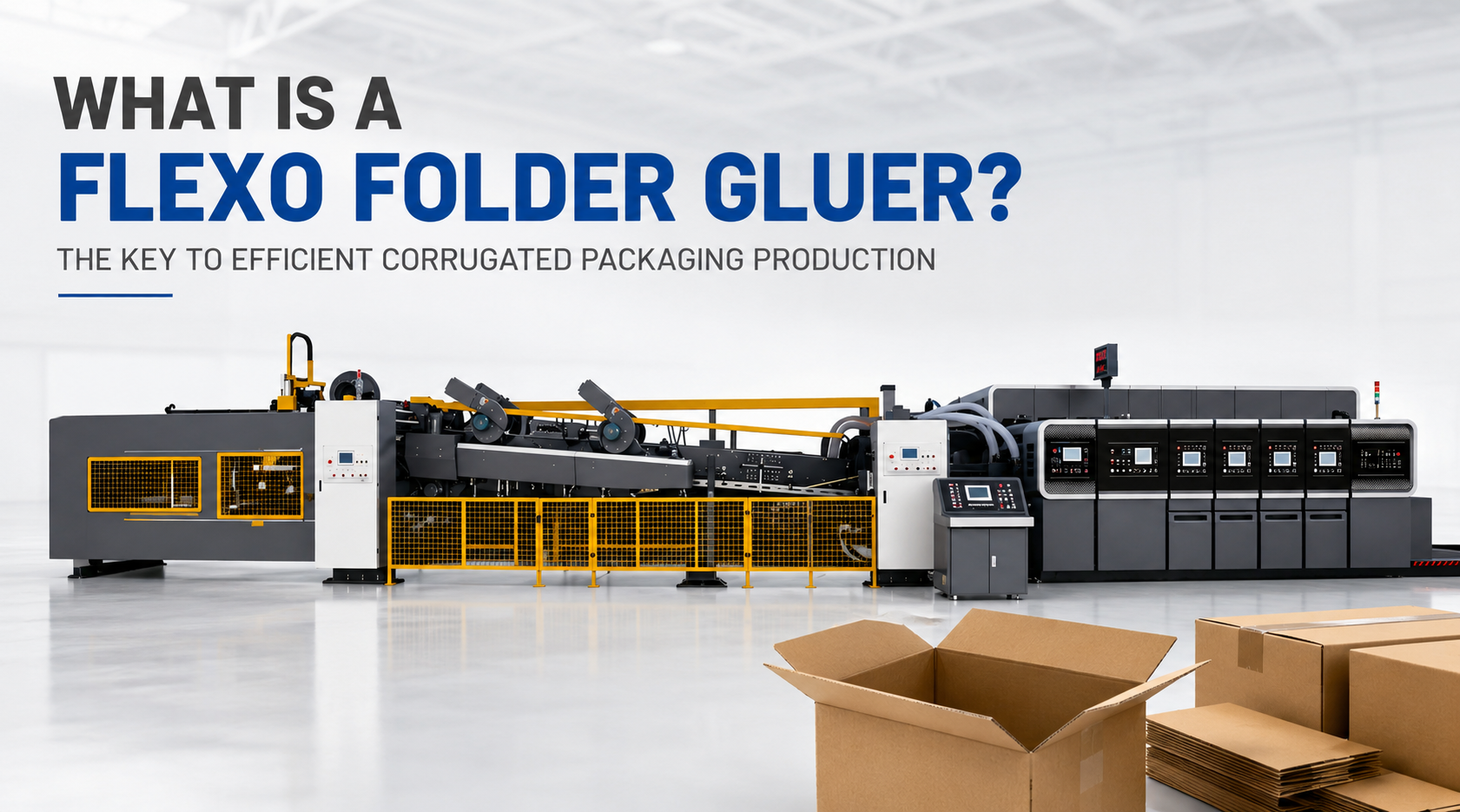
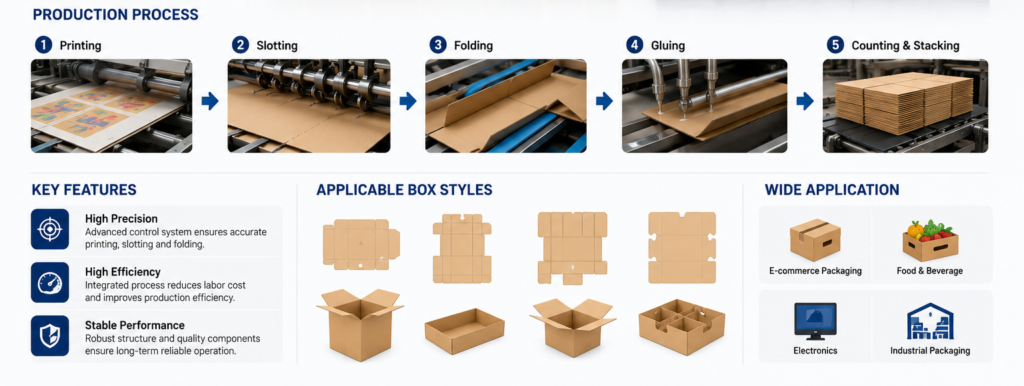
A flexo folder gluer (FFG) is a high-speed inline converting line that takes flat corrugated blanks and outputs finished, glued, squared cartons in a single pass — integrating flexographic printing, slotting, die-cutting, folding, and gluing without intermediate handling. At Guangzhou Smart Machinery, we commission these lines across North America, Europe, Southeast Asia, and the Middle East. This article gives you the engineering breakdown that most supplier websites won’t publish.
Fast Check Product: https://gzsmartmachinery.com/product/flexo-folder-gluer-inline-printing-machine/
FFG Supplier Capability Matrix: How to Read the Tiers Before You Buy
| Evaluation Criterion | Tier 3 (Entry-Level OEM) | Tier 2 (Mid-Range) | Tier 1 (Smart Machinery Class) |
|---|---|---|---|
| Frame Steel | Q235 mild steel, ≤12 mm | 45# carbon steel, 14 mm | Cold-heat-treated alloy steel, 16 mm / 0.63 in |
| Drive Architecture | Chain & gear mechanical | Partial servo | Full independent servo per unit |
| Folding Precision | ±2.5 mm / ±0.098 in | ±1.2 mm / ±0.047 in | ±0.5 mm / ±0.019 in |
| Registration Accuracy | ±2 mm | ±1 mm | ±0.5 mm / ±0.019 in |
| Max Speed | 120 pcs/min / 394 FPM | 180 pcs/min / 591 FPM | 260 pcs/min / 853 FPM (920 model) |
| Anilox Roller | Chrome-plated steel | Ceramic, manual adjust | Laser-engraved ceramic, motorized phase |
| Control System | Relay-based | Basic PLC | Delta PLC + WECON HMI, memory recall |
| Wear Plate Material | Mild steel | Surface-hardened | Tungsten carbide (WC) thermal spray |
| Certifications | None documented | CE partial | CE full, ISO-documented FAT protocol |
| Parts Lead Time | 4–8 weeks, no stock | 2–4 weeks | Warehouse stock, 24-hr dispatch |
The Six Sequential Modules: What Actually Happens Inside an FFG Line
1. Lead-Edge Feeder
The feeding section separates one blank at a time from the stack using tungsten-carbide-coated friction pads and localized vacuum suction — not kick-wheels. This distinction matters: a kick-feeder compresses the flute at entry, directly degrading the board’s Edge Crush Test (ECT) value before it reaches the printing unit. A vacuum lead-edge system preserves structural integrity across board thicknesses from 2 mm / 0.08 in up to 11 mm / 0.43 in — covering 3-ply through 7-ply configurations.
The feeder synchronizes with downstream units via the master PLC. Any feed gap deviation triggers an automatic jam-clear sequence without manual intervention, maintaining line continuity at full rated speed.
2. Flexographic Printing Units (1–4 Colors)
Each color station uses a laser-engraved ceramic anilox roller — the same precision-engraved architecture used on Tier 1 converting lines globally. The motorized phase adjustment system corrects registration in real-time: operators input a shift value on the WECON HMI touchscreen, and the servo repositions the print cylinder to within ±0.5 mm / ±0.019 in without stopping the line.
The “Zero-Return” and job memory functions store servo encoder positions for every SKU. Calling up a repeat job takes under 90 seconds, versus 25–40 minutes of manual re-setup on a mechanical-drive machine. This single feature drives the majority of changeover ROI in high-mix, short-run environments.
3. Slotting & Die-Cutting Unit
The slotting unit uses synchronized dual-shaft architecture: both the positive knife and reverse knife holders move laterally via motorized actuators, adjusted digitally from the touchscreen — no manual cranks. Slot-to-slot dimensional accuracy holds at ±1.5 mm / ±0.059 in across the full board width, up to 1,540 mm / 60.6 in on the 1628 model.
The die-cutting station incorporates imported polyurethane rubber pads with linear velocity compensation. As the rubber pad wears over its service life, the system maintains clean cut lines — a feature absent on Tier 2 machines, which require manual shim adjustments every few hundred thousand impressions. Die-cutting accuracy on our machines: ±1 mm / ±0.039 in.
4. Folder-Gluer Unit
Fishtailing — the asymmetrical skew of the folded blank — is caused by unequal belt tension between left and right folding rails. On a well-engineered FFG, each folding belt is driven by its own servo motor. The PLC monitors and adjusts belt speed differentially in real-time, keeping the box squared to ±0.5 mm / ±0.019 in at full production speed.
The gluing system uses a high-frequency electronic solenoid glue valve that delivers precise cold-glue beads (water-based adhesive) at programmable positions along the glue tab. Bead placement holds consistent regardless of line speed changes during acceleration or deceleration ramps. Hot-melt integration is available for crash-lock bottom and multi-corner styles.
5. Squaring & Counter-Ejector
The counter-ejector uses optical through-beam sensors — not mechanical trip switches — to count blanks and signal the kicker to eject bundles at preset counts. The squaring section uses pneumatically actuated side tampers that align the stack before ejection, so strapping is applied to a perfectly squared bundle rather than a fanned stack. Topping accuracy: ±0.5 mm / ±0.019 in.
6. Inline Strapping (Optional Integration)
When paired with an inline automatic strapping machine — 5 mm PP strap, bottom heat-seal bonding, ≥20 bundles/min — the complete output cycle runs without manual touch points from blank to strapped pallet. Labor headcount for the entire FFG line: typically 2 operators versus 6–8 on a standalone sequential setup.
Motion Control Sync Logic: The Engineering That Separates FFG Classes
The central Delta PLC functions as a master pulse generator. Every servo axis — feeder, print units, slotter, folder belts, glue valve trigger, counter-ejector — receives its timing reference from this master. When line speed ramps from 150 pcs/min to 220 pcs/min during production warm-up, the PLC recalculates the phase relationships of all axes simultaneously and issues correction commands within one control cycle.
The result: no ink smear, no slot drift, no fold shift during acceleration. This synchronized ramp behavior is what separates modern servo-driven FFG lines from mechanical-gear-train predecessors — where cumulative backlash in the gear train produced dimensional drift that compounded with every speed change.
All drive gears on our machines are manufactured from high-quality alloy steel, heat-treated and precision-ground — delivering low-noise operation and a significantly extended machine lifespan under 24/7 heavy-duty production conditions.
Calibrate your servo phase offsets at commissioning and document them in the HMI memory bank. This 30-minute setup procedure eliminates 90% of the registration callbacks we see in the field on improperly commissioned equipment.
Wear Part Metallurgy: What Your Supplier Won’t Tell You
The operating cost gap between Tier 1 and Tier 3 FFG lines is driven primarily by consumable wear part intervals, not the initial capital price.
Slotting Knives:
- Tier 3 (high-carbon steel, uncoated): replacement intervals are short and frequent, driving high annual consumable spend
- Tier 1 (tungsten carbide thermal-spray coating): industry experience puts WC-coated knives at 4–6× the service life of uncoated equivalents on recycled kraft board
- On a 3-shift plant running at rated speed, this difference translates to tens of thousands of dollars annually in avoided downtime and knife replacement costs
Folding Belts:
High-grip, anti-stretch folding belts — the type used on production-grade FFG lines — maintain consistent tension across their full service life. Inferior rubber belts stretch progressively from the third month onward, causing fold drift that operators compensate for manually, introducing defect variation and increasing labor load.
Anilox Rollers:
Laser-engraved ceramic anilox rollers maintain cell geometry and ink transfer volume far longer than chrome-plated alternatives. On abrasive water-based ink systems, chrome rolls lose cell definition within 18–24 months. Ceramic rolls with laser-engraved cells retain transfer accuracy for a decade-plus of continuous production — keeping color consistency tight across multi-year brand supply contracts.
TCO Calculation: Inline FFG vs. Standalone Sequential Setup
For a plant running 3 shifts, 22 operating days/month, 200 pcs/min target throughput:
| Cost Driver | Standalone Sequential | Inline FFG |
|---|---|---|
| Direct Labor | 6–8 operators/shift | 2 operators/shift |
| Annual Labor Cost (@ $18/hr) | ~$777,600 | ~$259,200 |
| Floor Space (WIP staging) | +600–900 m² / 6,460–9,690 ft² | Eliminated |
| Defect Rate | 2.5–4.0% | <0.5% |
| Order Changeover Time | 45–90 min (multi-machine) | 3–8 min (memory recall) |
| Annual Consumable Cost | Higher (short-life knives, belts) | Lower (WC tools, long-life belts) |
Labor savings alone — approximately $518,400/year — typically return the capital investment on a mid-range FFG line within 24–36 months, before factoring in defect reduction and throughput gains.
Regional Deployment: Engineering Adjustments by Market
North America: OSHA-compliant full-perimeter guarding, polycarbonate access panels, Category 3 safety relays on all pinch zones. Servo memory recall is the primary ROI driver against $22–28/hr average packaging labor costs. Emergency stop arrays and light curtains are standard on all export configurations.
Europe: Full CE marking (Machinery Directive 2006/42/EC), regenerative braking on main drives reducing energy consumption 12–18%, acoustic dampening panels targeting ≤78 dB(A) at operator stations. Our machines carry full CE documentation with technical file available for customs clearance.
Southeast Asia / Tropics: Vacuum pressure on transport belts is adjustable to handle humidity-warped board in environments with ambient humidity consistently above 80% RH. Pre-crease wheel geometry is modified with a gentle pre-crush profile before hard-crease application — preventing liner cracking on moisture-softened corrugated board. This is a field-proven adjustment on our Southeast Asia installations.
Middle East / Arid Regions: IP54-rated positive-pressure electrical cabinets with intake filtration, sealed bearings in all rotating assemblies, servo drives and Delta PLC components rated for high-ambient-temperature environments. Dust ingress protection is mandatory in facilities operating near desert conditions.
Supplier Audit: 5 Questions to Ask Before You Sign a PO
If your target FFG supplier cannot answer all five with documented evidence, re-evaluate:
- “Show me the FAT (Factory Acceptance Test) protocol and the signed run-off results for a machine of my spec.” Legitimate manufacturers run a full-speed production test before shipment. No FAT protocol means unknown risk.
- “What alloy grade are your transmission gears, and what is the heat treatment specification?” The answer should be high-grade alloy steel, heat-treated and precision-ground. Confirm this is documented in the machine’s technical file.
- “What is the control system brand, and do you have a local authorized service partner in my country?” Delta PLC and WECON HMI — with documented regional distributor support — is what we supply. No-name controls mean 8–16 week lead times on replacement components.
- “What is the documented service interval for folding belts, and can you provide the replacement part number from your BOM?” A supplier that cannot provide a BOM part number has no real aftersales infrastructure.
- “Can you provide a live video run-off at rated speed before shipment, with dimensional verification of box squareness?” This is standard practice for Tier 1 manufacturers. Resistance to this request is a red flag.
What Is a Flexo Folder Gluer — The Operational Summary
A correctly specified and commissioned flexo folder gluer machine does the following in one uninterrupted pass:
- Feeds corrugated blanks at up to 260 pcs/min / 853 FPM (model 920)
- Handles board from 2 mm / 0.08 in to 11 mm / 0.43 in thickness
- Prints up to 4 colors at ±0.5 mm / ±0.019 in registration accuracy
- Slots and scores to ±1.5 mm / ±0.059 in across full board width
- Die-cuts to ±1 mm / ±0.039 in accuracy
- Folds and glues to ±0.5 mm / ±0.019 in squareness
- Counts, squares, and ejects bundles at operator-set counts
- Runs with 2 operators on a full 3-shift production schedule
It is not a printing machine. It is not a folder gluer. It is the single capital asset that determines whether your plant wins or loses Tier 1 brand supply contracts.
FAQ
Q: What board grades and flute types can an FFG run?
A: Our FFG models handle board thicknesses from 2 mm to 11 mm / 0.08 in to 0.43 in, covering 3-ply through 7-ply configurations with A, B, C, E, F flutes and combinations including BC and AB double-wall. Maximum board width ranges from 860 mm / 33.9 in (model 920) to 1,540 mm / 60.6 in (model 1628).
Q: How long does an order changeover take on your machines?
A: With Delta PLC servo memory recall and WECON HMI job storage, a full changeover — box dimensions, print phase, slot position — takes 3–8 minutes. Mechanical machines without HMI memory require 25–45 minutes of manual adjustment per order change.
Q: What is the minimum production volume where an FFG delivers positive ROI vs. semi-auto equipment?
A: At 3-shift operation, break-even typically occurs at ≥150,000 boxes/month. Below that threshold, a semi-auto line may offer better capital efficiency for your specific run mix.
Q: Do FFG lines require temperature-controlled factory environments?
A: Delta PLC and servo drives operate within standard industrial ambient ranges. For Middle East and high-temperature deployments, we configure positive-pressure climate-controlled electrical cabinets as standard. Consult our engineering team for your specific site conditions.
Q: What certifications do your FFG machines carry?
A: Full CE marking under Machinery Directive 2006/42/EC, ISO 9001 manufacturing certification, and a documented FAT run-off protocol signed before shipment. For food-adjacent packaging applications, ask about FDA-compliant adhesive system materials.
Q: Can your FFG integrate with our existing MES or ERP system?
A: Yes. Our Delta PLC architecture supports standard industrial data output protocols for MES integration, including real-time speed, counter data, and alarm logs. Confirm your integration requirements with our engineering team at inquiry stage.
Ready to Verify the Engineering Before You Commit?
Guangzhou Smart Machinery manufactures direct — no trading company markup, no third-party quality risk. Our engineering team provides full FAT protocol documentation, BOM part numbers, and control system specifications for any machine configuration you are evaluating.
Every inquiry receives a response within 24 hours.
→ Inquire for Direct-Factory B2B Pricing, Lead Times & FAT Protocol Documentation