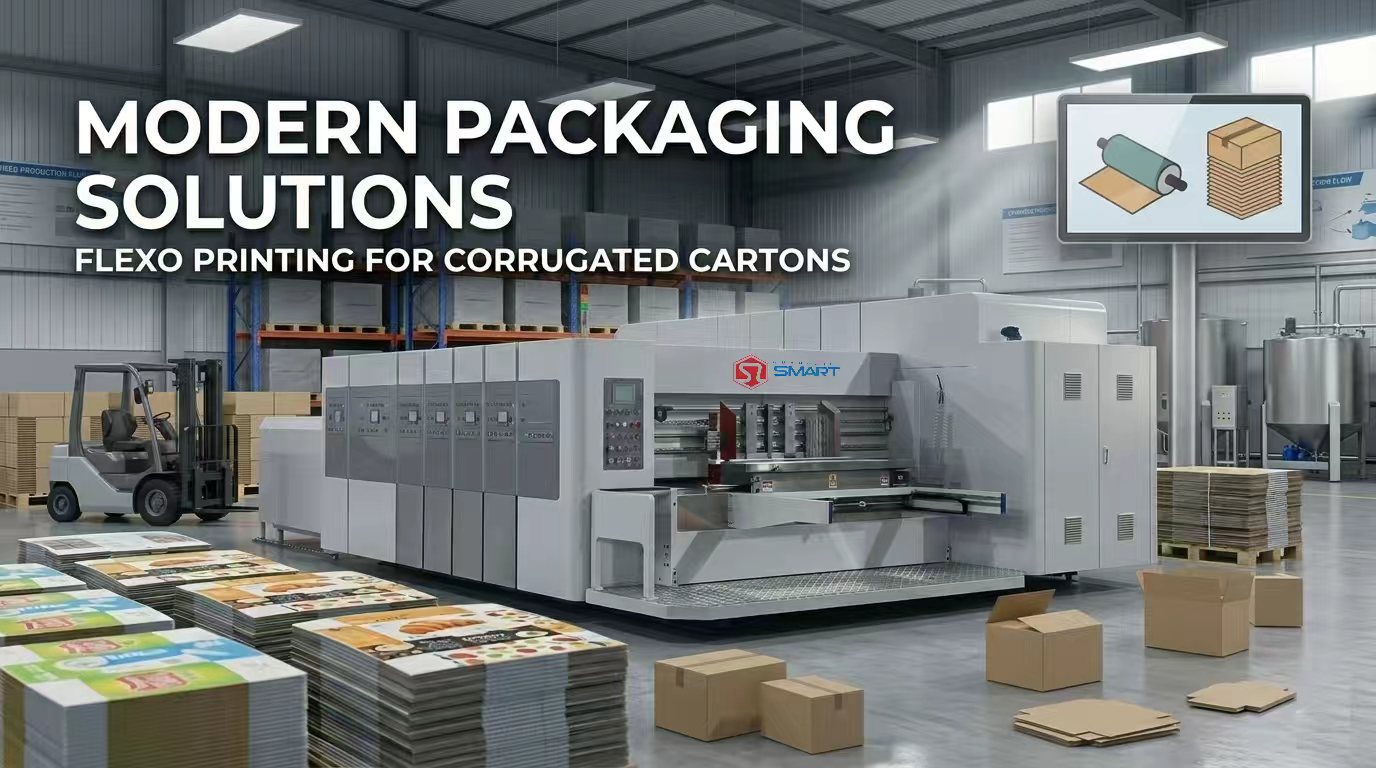
Sourcing a flexo printing machine for corrugated carton means auditing three non-negotiable benchmarks before comparing quotes. First, phase-locked registration across printing, slotting, and die-cutting — held at running speed, not measured once on an idle bench. Second, non-crush lead-edge feeding that keeps 3/5/7-ply board flat and flute-intact through every station.
Third, a working-width model whose real throughput — not a single peak-speed marketing number — actually matches your board size and daily order volume. A supplier who can’t produce per-model registration data captured under load isn’t ready for a serious RFQ.
https://gzsmartmachinery.com/product/corrugated-box-printing-machine/
Engineering Benchmark: Standalone Printer-Slotter-Die-Cutter Tiers
Most listings for a “flexo printing machine for corrugated carton” blur the line between a synchronized inline system and a set of mechanically linked stations fighting their own drift. That distinction shows up in registration tolerance, changeover time, and wear-component grade — the line items procurement teams most often underweight against sticker price.
| Engineering Criterion | Decoupled Analog Press | Semi-Integrated Setup | Guangzhou Smart Machinery Corrugated Box Printing Machine |
|---|---|---|---|
| Print-to-Slot-to-Crease Registration | Manual reset between passes; drift of ±3–5 mm (±0.12–0.20 in) is common | Fixed mechanical link, no phase compensation | PLC-controlled phase adjustment + “Zero-Return” memory: ±0.5 mm (±0.02 in) topping/creasing accuracy |
| Feed System | Kick-feeders strike the board’s trailing edge; flute-crush risk | Basic friction rollers | Suction-assisted lead-edge feeder, adjustable for 3/5/7-ply board without crushing flutes |
| Motion Control | Independent motors, no shared timing signal | Single shared motor across stations | Synchronized servo/PLC control across printing, slotting, and die-cutting |
| Order Changeover | Full manual re-registration, often hours | Faster, but still multi-step | Motorized digital phase/position input + memory recall |
| Wear-Component Grade | Unspecified or generic carbon steel | Mixed grade, undocumented | Tungsten-carbide-brazed cutting edges + imported polyurethane die-cutting pads |
| Working-Width Range | Fixed to whatever standalone units are on hand | Limited configurations | 9 models, 920–1632 series: max continuous feeding up to 1,540×3,350 mm (60.6×131.9 in) |
Inside the Flexo Printing Machine for Corrugated Carton: Feed, Print, Slot, Crease
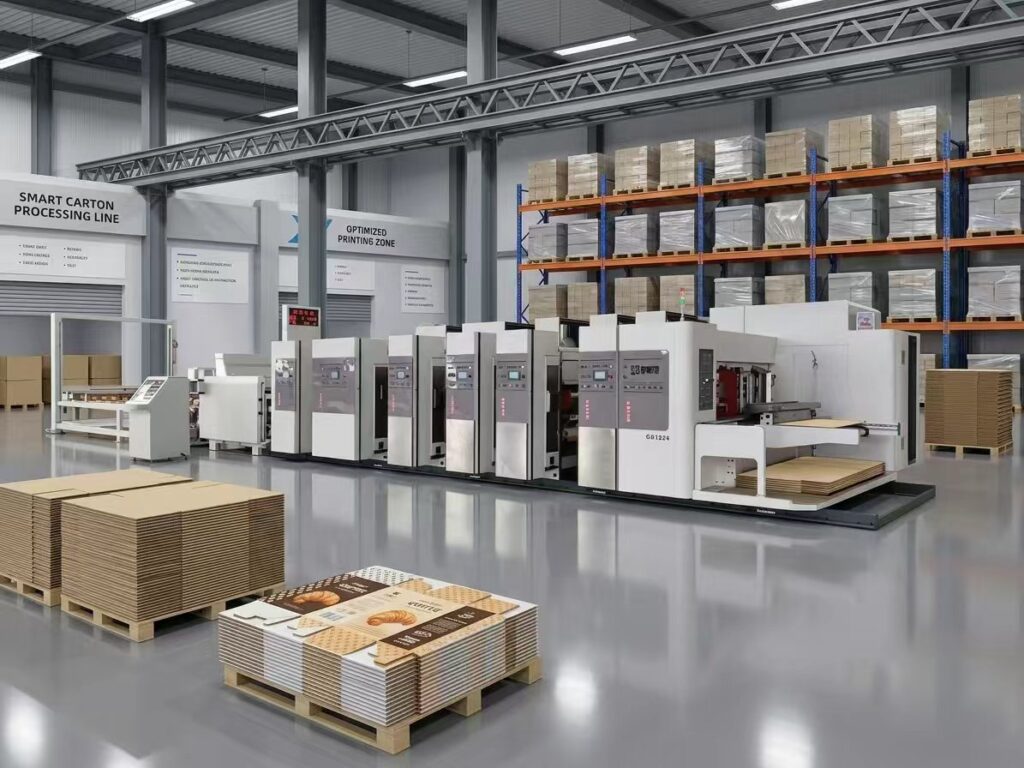
A flexo printing machine for corrugated carton earns its accuracy from four synchronized stations, not raw horsepower. Board enters through a suction-assisted lead-edge feeder, adjustable for 3/5/7-ply stock, which holds the sheet flat and pulls it in without the flute-crushing impact of an outdated kick-feeder.
At the printing station, laser-engraved ceramic anilox rollers meter ink onto the photopolymer plate while a motorized, PLC-controlled phase adjustment system holds position across the run. The “Automatic Zero-Return” and “Memory” functions store the previous job’s registration settings, so a repeat order recalls its exact print position in seconds instead of restarting alignment from zero.
Next, a linkage slotting unit synchronizes blade-holder movement to cut box height, length, and width, while creasing lines are scored to guide the fold that happens downstream. The die-cutting unit pairs imported polyurethane rubber pads with linear velocity compensation, holding a clean cut as the pad wears over thousands of operating hours — a detail that matters far more at hour 5,000 than on a demo run.
One scope note worth stating plainly: this machine prints, slots, creases, and die-cuts — it does not fold or glue. Finished, printed, and creased blanks exit ready for a separate folder-gluer station, whether that’s an existing line in your plant or a paired inline FFG system if you’re consolidating stages.
Registration and Cut Accuracy Under Running Speed
Tolerance data only matters when it’s captured at production speed, not on an idle bench. Across the full model range, the machine holds feeding accuracy of ±1 mm (±0.04 in), topping/creasing accuracy of ±0.5 mm (±0.02 in), slotting accuracy of ±1.5 mm (±0.06 in), and die-cutting accuracy of ±1 mm (±0.04 in) — figures that apply consistently from the compact 920 to the large-format 1632.
That ±0.5 mm creasing tolerance is what lets a scored blank fold cleanly downstream without cracking the inner liner. Printing roll position adjusts within ±6 mm (±0.24 in), and the anvil pad shifts laterally within ±20 mm (±0.79 in) for fine registration tuning without a full re-tool; the die-cutter knife height is a standard 25.4 mm (1.00 in).
Most spec sheets quote one peak speed and stop there. Real throughput here is model-specific — 260 pieces per minute on the compact 920, down to 120 pieces per minute on the large-format 1632 — because a wider sheet needs more dwell time at each station to hold the same registration tolerance.
Ask any supplier for tolerance data broken out by model and captured under running load, not a single idle-bench figure. Request a Factory FAT (Factory Acceptance Test) Protocol Sheet documenting registration accuracy, wear-component grade, and run-in hours for the specific working width you need before committing capital.
Material Science: Why Wear Components Set the Real Lifespan
Machine lifespan is decided by wear components, not the frame. Tungsten-carbide-brazed cutting edges on the slotter and rotary die-cutter resist the abrasive wear of recycled-fiber dust far longer than untreated steel, which is why replacement-blade intervals belong in the purchase contract rather than a footnote.
Imported polyurethane die-cutting pads work with the linear velocity compensation mechanism, adjusting cutting pressure as the pad surface wears so cuts stay clean instead of ragged as hours accumulate. Primary drive gears are heat-treated, precision-ground alloy steel, specified for low-noise, low-vibration operation under continuous 24-hour runs.
The ceramic anilox roller is the printing station’s own wear item: its laser-engraved cell structure sets ink volume consistency, and a worn surface shows up first as color drift — long before it shows up as a mechanical fault. Request the anilox cell specification and expected replacement interval alongside the rest of the FAT documentation.
Matching a Model to Your Board Size and Order Volume
The line ships in nine working-width models — 920, 924, 1224, 1228, 1424, 1428, 1624, 1628, and 1632 — and picking the wrong one costs more in wasted capacity than any other sourcing decision on this machine. The compact 920 outputs up to 260 pieces/min on a max continuous feeding size of 860×2,150 mm (33.9×84.6 in), suited to smaller RSC boxes run at high count.
A mid-range 1224 steps up to a max continuous feeding size of 1,160×2,550 mm (45.7×100.4 in) at 220 pieces/min, with a max printing size of 1,170×2,360 mm (46.1×92.9 in) — the working point most Tier 2 box plants run day to day. At the top of the range, the 1632 handles a max continuous feeding size of 1,540×3,350 mm (60.6×131.9 in) and a max printing size of 1,580×3,160 mm (62.2×124.4 in), with throughput scaling down to 120 pieces/min to preserve the same ±0.5 mm creasing tolerance on a much larger sheet.
Cardboard thickness capacity runs 2–10 mm (0.08–0.39 in) on the 920/924 and 2–11 mm (0.08–0.43 in) on every wider model, with a 7.2 mm (0.28 in) standard printing plate thickness across the full range. Ordering by nameplate speed alone, without checking your actual board width against this table, is the most common reason plants end up running a machine well under its rated output.
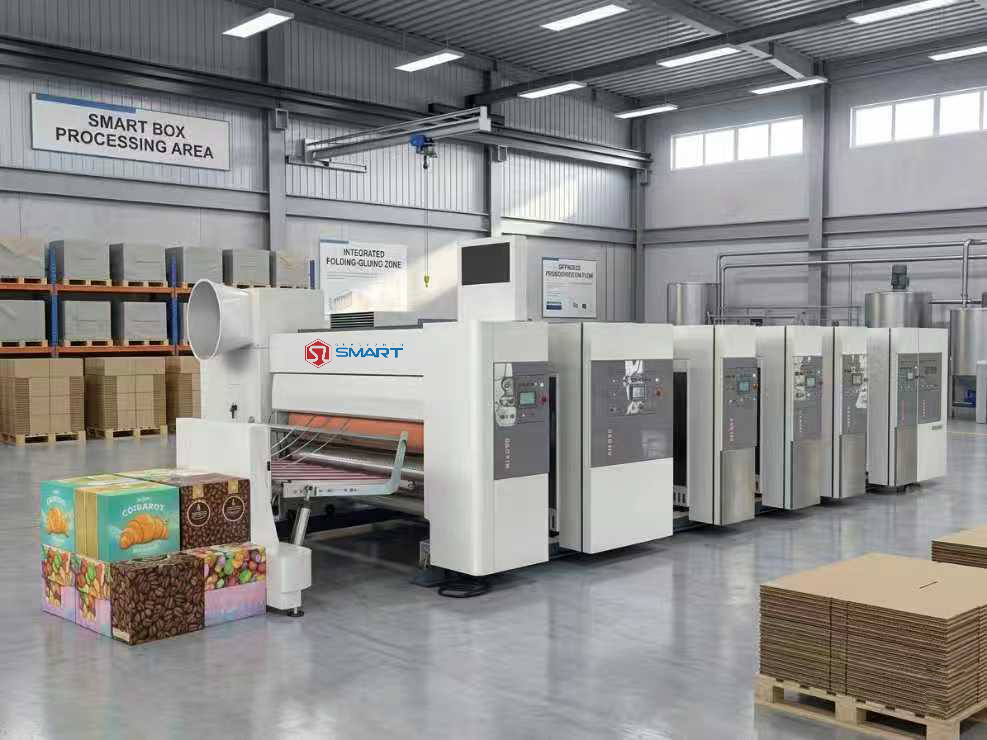
For the complete nine-model comparison sheet — every width, speed, and tolerance figure side by side — inquire for Direct-Factory Wholesale B2B Pricing & Lead Times and specify your board dimensions and target daily volume.
Where This Machine Fits Your Line: A First-Tier Supplier Checklist
Return to the three benchmarks that opened this audit — phase-locked registration through printing, slotting, and creasing; non-crush lead-edge feeding across 3/5/7-ply stock; and a working-width model that actually fits your board — and require documentation for each, not a brochure claim. A supplier who won’t share per-model registration data or wear-component specification isn’t operating at first-tier standard.
A practical due-diligence checklist before you sign:
- Request registration and creasing-tolerance data by model, captured at running speed
- Confirm cardboard thickness range and printing plate thickness against your actual board stock
- Ask for tungsten-carbide, polyurethane-pad, and anilox-roller replacement intervals and spare-parts lead time in writing
- Clarify whether the quoted line prints, slots, and creases only, or includes downstream folding-gluing — and price accordingly
- Verify voltage/frequency and control-interface compatibility with your site before signing
Guangzhou Smart Machinery’s flexo printing machine for corrugated carton — offered across all nine widths from the compact 920 to the large-format 1632 — is the machine this audit was built around: PLC-controlled phase-locked registration, ±0.5 mm (±0.02 in) creasing accuracy, and motorized changeover built for both long runs and small-batch orders.
Frequently Asked Questions
Q: What’s the real difference between this machine and a full FFG inline system? A: This Corrugated Box Printing Machine handles feeding, printing, slotting, and die-cutting/creasing — finished blanks exit ready for folding-gluing on a separate line. An FFG inline system adds the folding-gluing stage in the same continuous pass, useful for plants consolidating every conversion step into one machine footprint.
Q: Why does throughput vary so much between models — 260 pieces/min down to 120? A: Wider working widths need more dwell time at each station to hold the same ±0.5 mm (±0.02 in) creasing tolerance on a larger sheet. Nameplate speed only means something when it’s read against your actual board width, not compared across models in isolation.
Q: What cardboard thickness and printing plate specifications does this line support? A: Cardboard thickness runs 2–10 mm (0.08–0.39 in) on the compact 920/924 models and 2–11 mm (0.08–0.43 in) on every wider model, with a standard printing plate thickness of 7.2 mm (0.28 in) across the full nine-model range.
Q: What should I request before signing a purchase order? A: A Factory FAT (Factory Acceptance Test) Protocol Sheet documenting registration and creasing-tolerance data for your specific model width, wear-component grade for the anilox roller and die-cutting pads, and confirmed cardboard thickness range against your board stock.
Ready to Specify Your Print-Slot-Crease Line?
A brochure speed rating is a starting point, not a purchase decision — registration tolerance, wear-component grade, and the right working width for your board are what actually determine daily output. Request a Factory FAT Protocol Sheet documenting tolerance data for the model width that matches your production line before you commit capital.
For plants ready to move on pricing and lead times, inquire for Direct-Factory Wholesale B2B Pricing & Lead Times and speak directly with Guangzhou Smart Machinery’s engineering team about your board mix, order volume, and site voltage.