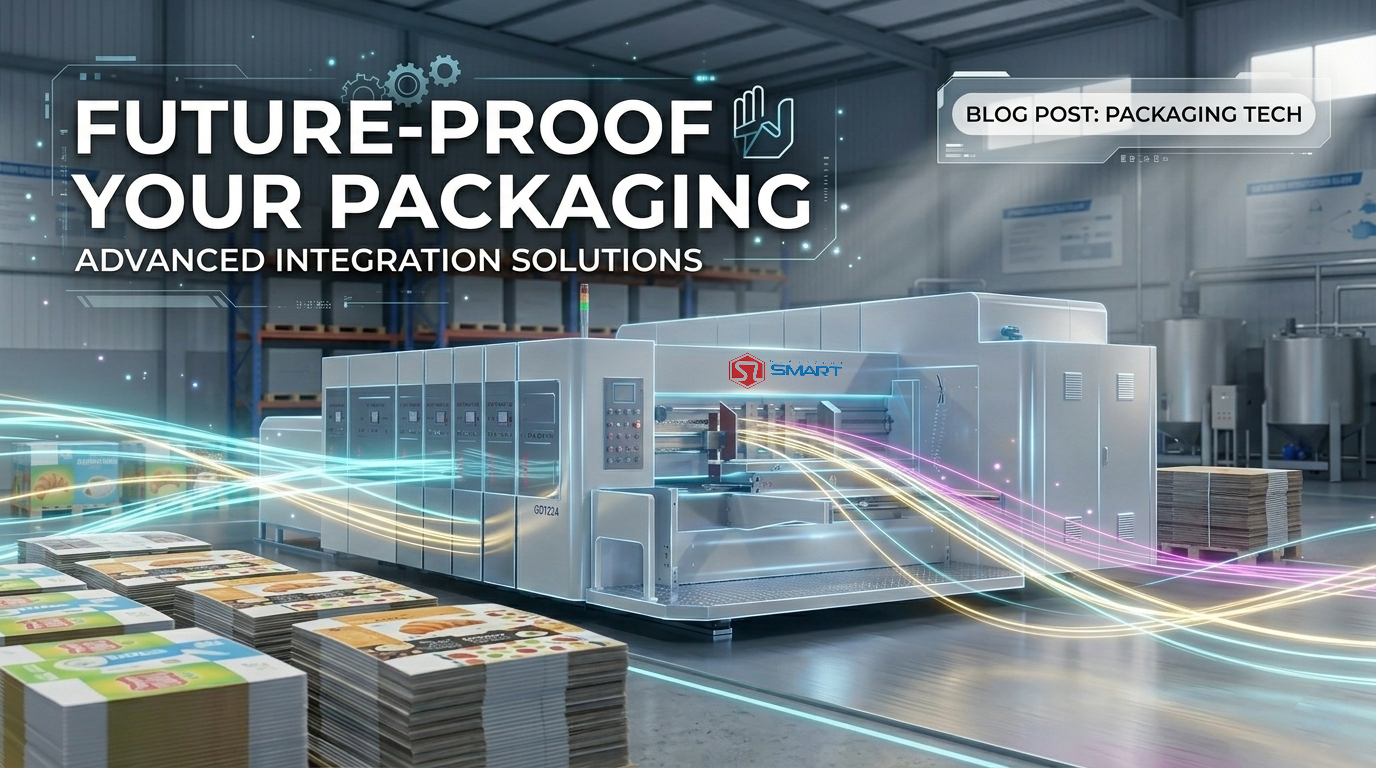
A carton box printing machine is only as good as its weakest synchronized axis. Three benchmarks separate a direct-factory build from an assembled trading-house unit: rigid, heavy-plate wall panels that hold zero deflection under load, independent servo motion control on every print, slot, and die-cut station instead of a shared mechanical shaft, and non-proprietary, internationally sourced components — bearings, PLCs, drives — that keep spare-parts lead time in days, not months. Skip any one of these and registration drift, not raw speed, becomes your bottleneck.
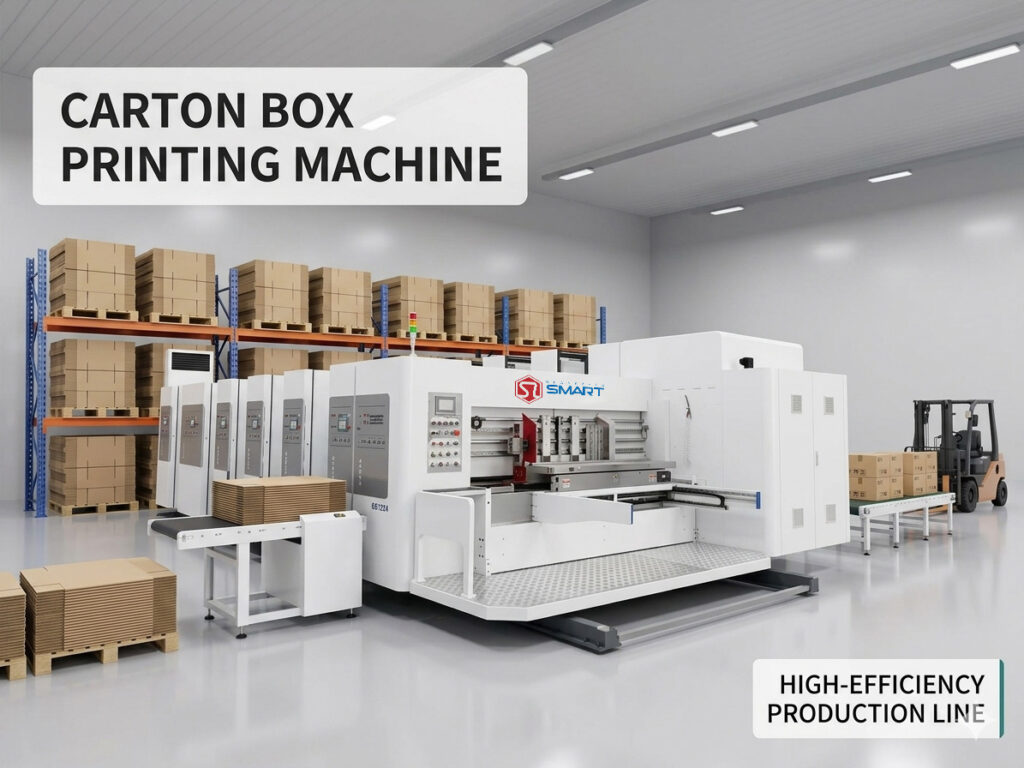
https://gzsmartmachinery.com/product/corrugated-box-printing-machine/
Direct-Factory Build vs. Trading-House Assembly: The Engineering Matrix
Most sourcing decisions get reduced to a single number: top speed in sheets per minute. That number is meaningless if the motion control architecture behind it can’t hold registration past the first production shift. Below is the comparison matrix we use internally when auditing a competitor’s spec sheet against our own printer-slotter-die-cutter platforms.
| Engineering Criterion | Direct-Factory OEM Build | Trading-House Assembled Unit | Legacy Mechanical Line |
|---|---|---|---|
| Motion control | Independent AC servo per print/slot/die-cut station, PLC-synchronized | Single servo on main shaft, mechanical linkage to sub-stations | Full mechanical gear train, no servo axis |
| Print registration | ±0.5 mm (±0.02 in) via motorized phase adjustment with Zero-Return and Memory recall | ±1.0–1.5 mm (±0.04–0.06 in), manual dial reset per job | Operator-dependent, drifts after 2–3 changeovers |
| Anilox roller | Laser-engraved ceramic, fixed cell volume | Chrome-plated or unverified ceramic sourcing | Worn chrome or rubber, inconsistent ink lay |
| Slot/die-cut sync | Linear velocity compensation holds alignment as blades wear | Fixed mechanical linkage, drifts with blade wear | Manual re-timing required every shift |
| Wear-part sourcing | Non-proprietary tungsten-steel knives and polyurethane pads stocked at the factory | Mixed proprietary and generic parts, unclear lead time | Often obsolete, custom-machined replacements only |
Vendors that can’t answer where their anilox rollers, printing plate cylinders, or slotting knives are actually manufactured are trading houses, not factories. Ask for the metallurgy spec on the wall panel steel and the servo brand list before you ask about price.
Motion Control Architecture: Why a Shared Main Shaft Kills Registration Over Time
A mechanical line-shaft design routes power from one motor through gear trains to every printing, slotting, and die-cutting station. Backlash accumulates in every gear mesh, and that backlash compounds as the shaft ages. On a machine running three shifts, this shows up as registration drift that gets worse month over month, not job over job.
Independent servo synchronization removes the shared shaft entirely. Each printing unit, the slotting head, and the die-cutter run on its own AC servo motor, cross-referenced through the PLC in real time. Our 920 through 1632 platforms hold ±0.5 mm (±0.02 in) topping accuracy across the full working-width range specifically because there is no mechanical linkage left to wear.
The practical test on a factory floor: ask the vendor to run the same job twice, 30 minutes apart, without touching the controls. A servo-synchronized carton box printing machine reproduces registration within spec both times. A line-shaft machine usually doesn’t.
Feed, Anilox & Registration Engineering: Where the ±0.5 mm Actually Comes From
Registration accuracy starts before the board reaches the print units. A suction-assisted lead-edge feeder pulls the bottom sheet off the stack with vacuum assist rather than a mechanical kick-feeder, which keeps board entry parallel across 3/5/7-ply stock from 2 mm to 11 mm (0.08 in to 0.43 in) thick without crushing the flute tips.
Ink transfer is governed by a laser-engraved ceramic anilox roller, which meters a fixed ink volume onto the photopolymer plate through millions of micro-cells cut into a hardened ceramic surface. Phase adjustment between print units is motorized and PLC-controlled, with Automatic Zero-Return and Memory functions that recall the exact roll position from the last time that job ran — this is what lets a changeover start from spec instead of from a blank dial.
Across the full model range, feeding accuracy holds at ±1 mm (±0.04 in), topping (print registration) accuracy at ±0.5 mm (±0.02 in), slotter accuracy at ±1.5 mm (±0.06 in), and die-cutter accuracy at ±1 mm (±0.04 in) — the same tolerance band on the smallest 920 model and the largest 1632 model. That consistency across the size range is the detail worth checking on a competitor’s data sheet, because plenty of vendors quote their tightest tolerance only on the smallest frame.
Wear-Part Metallurgy: What Actually Fails First After 18 Months of 3-Shift Running
Drive gears on the printing cylinders are cut from alloy steel, heat-treated and precision-ground — this is what keeps backlash low enough to hold registration after two years of continuous running, not just on commissioning day. The die-cutting anvil runs imported polyurethane rubber pads, which resist compression set far longer than the phenolic or rubber-composite pads used on lower-tier lines.
Slotting knives take the most abrasive wear in the entire system, since they’re cutting through glue-laminated board thousands of times per shift. These are stocked as separate tungsten-steel knife, spiral knife, and standard slotting knife series spare parts, specifically because a dull or chipped knife — not the machine’s motion control — is the single most common cause of a slot-width complaint on the finished carton.
Request a Factory FAT (Factory Acceptance Test) Protocol Sheet before you sign a PO. A proper FAT runs your actual board stock and ink formulation at full continuous speed on the factory floor, with your technical team present, so registration and slot accuracy are verified before the machine ever enters a container.
Model Selection & TCO: Matching Working Width and Speed to Your Order Mix
The working width you need is dictated by your largest recurring box blank, not your average one — undersizing here forces a second machine purchase within 24 months. The table below shows three representative points across the 920 to 1632 platform range.
| Spec | Model 920 (entry) | Model 1224 (mid) | Model 1632 (max width) |
|---|---|---|---|
| Speed | up to 260 sheets/min | up to 220 sheets/min | up to 120 sheets/min |
| Max printing size | 860 × 1,960 mm (33.9 × 77.2 in) | 1,170 × 2,360 mm (46.1 × 92.9 in) | 1,580 × 3,160 mm (62.2 × 124.4 in) |
| Max continuous feeding size | 860 × 2,150 mm (33.9 × 84.6 in) | 1,160 × 2,550 mm (45.7 × 100.4 in) | 1,540 × 3,350 mm (60.6 × 131.9 in) |
| Cardboard thickness range | 2–10 mm (0.08–0.39 in) | 2–11 mm (0.08–0.43 in) | 2–11 mm (0.08–0.43 in) |
| Max slot depth | 230 mm (9.1 in) | 310 mm (12.2 in) | 410 mm (16.1 in) |
Speed drops as working width climbs because both sheet mass and print-unit travel increase — a 1632 running at 120 sheets/min still processes more total board area per hour than a 920 at 260 sheets/min on a large-format order. Size the machine to your blank, then evaluate throughput in square meters per hour, not the raw sheets-per-minute figure alone.
Total Cost of Ownership on this equipment class is decided less by the invoice price and more by spare-parts lock-in. A direct-factory relationship keeps servo drives, PLC modules, and slotting knives on non-proprietary specifications, so a failed component doesn’t strand your line waiting on an exclusive import license from a single distributor. Inquire for Direct-Factory Wholesale B2B Pricing & Lead Times to get model-specific throughput numbers against your actual order mix.
Confirm two deployment details before finalizing a container date. Electrical configuration needs to match your grid — 380V/50Hz covers Europe, the Middle East, and most of Southeast Asia, while 480V/60Hz is the North American standard — and a suction-fed board path handles humidity-warped stock more reliably than mechanical pull rolls if your plant runs without climate control.
inquire for Direct-Factory Wholesale B2B Pricing & Lead Times
FAQ: Carton Box Printing Machine Sourcing
What print registration accuracy should I expect from a mid-size model? On the 1224 platform, topping (print registration) accuracy holds at ±0.5 mm (±0.02 in) — the same tolerance band as the smaller 920 and larger 1632 models. It shouldn’t tighten or loosen with frame size on a properly engineered line.
Can one machine run both 3-ply and 5-ply board without retooling? Yes, provided the feeder and print units are rated for the full 2–11 mm (0.08–0.43 in) thickness range and the anvil pressure is servo-adjustable rather than fixed by shim plates.
How long does a Factory Acceptance Test actually take? Plan for your technical team to be on-site running your own board and ink stock at full continuous speed. It’s the only way to verify registration and slot accuracy before the machine ships, and it’s worth building into your project timeline rather than skipping to save a week.
Are slotting knives and anilox rollers available as standalone spare parts? Yes — tungsten-steel knife, spiral knife, and slotting knife series are stocked separately from the machine order, which matters when budgeting consumable replacement cost into year-two and year-three operating expense.
What voltage configurations does this equipment support? Industrial corrugated converting lines in this class are typically configured for either 380V/50Hz or 480V/60Hz to match regional grid standards. Confirm your plant’s specification with the factory engineering team before finalizing the order.
Ready to Move Forward
A carton box printing machine is a 15-to-20-year capital asset sitting at the center of your production floor — the sourcing decision deserves the same scrutiny you’d apply to a corrugator. Request a Factory FAT Protocol Sheet or Inquire for Direct-Factory Wholesale B2B Pricing & Lead Times, and our engineering team will size a carton box printing machine — 920 through 1632 — against your actual board specification and order mix.
inquire for Direct-Factory Wholesale B2B Pricing & Lead Times