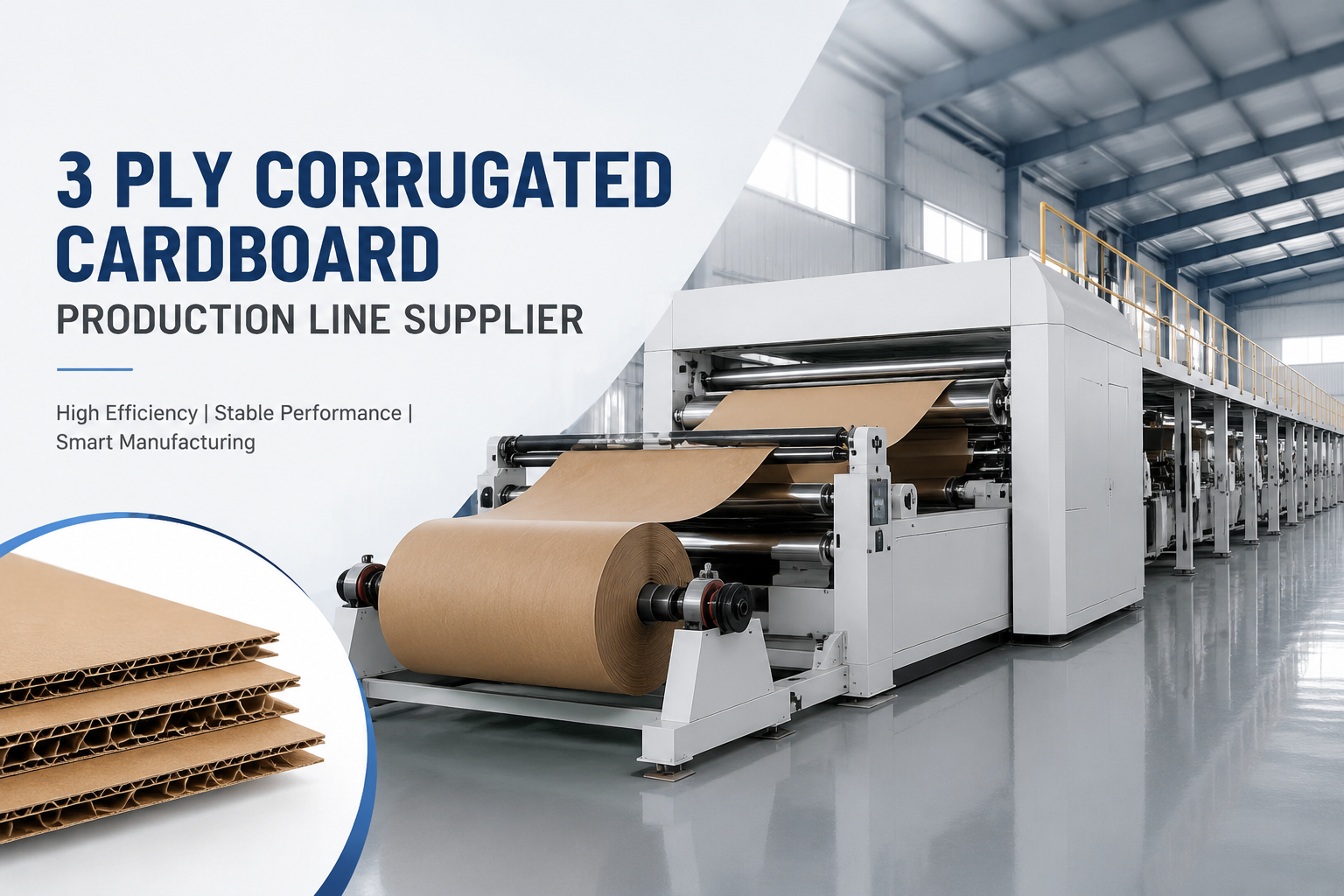
A 3-ply (single-wall) line runs one single facer and one bonding pass — simpler than a double-wall line, which is exactly why buyers get sold on speed claims that skip the details that actually decide output. Before comparing quotes, verify three benchmarks in writing: non-crush vacuum flute forming at the single facer, AC servo helical-knife cut-off holding tolerance at full running speed, and quick-change tooling that keeps flute-profile switches under minutes, not hours. A 3 ply corrugated cardboard production line suppliers quote missing any of these three isn’t ready for a serious RFQ comparison.
A 3 ply corrugated cardboard production line (Single Wall) is the industrial foundation for manufacturing high-strength shipping and moving boxes. Leading suppliers like Guangzhou Smart Machinery engineer these lines to bond a fluted medium between two liners using fingerless vacuum suction technology. This preserves the Edge Crush Test (ECT) value of the board. Modern 3-ply lines support production speeds of 150-300m/min and include Industry 4.0 PLC controls for automated order changeovers, ensuring maximum board flatness and vertical stacking strength for RSC box production.
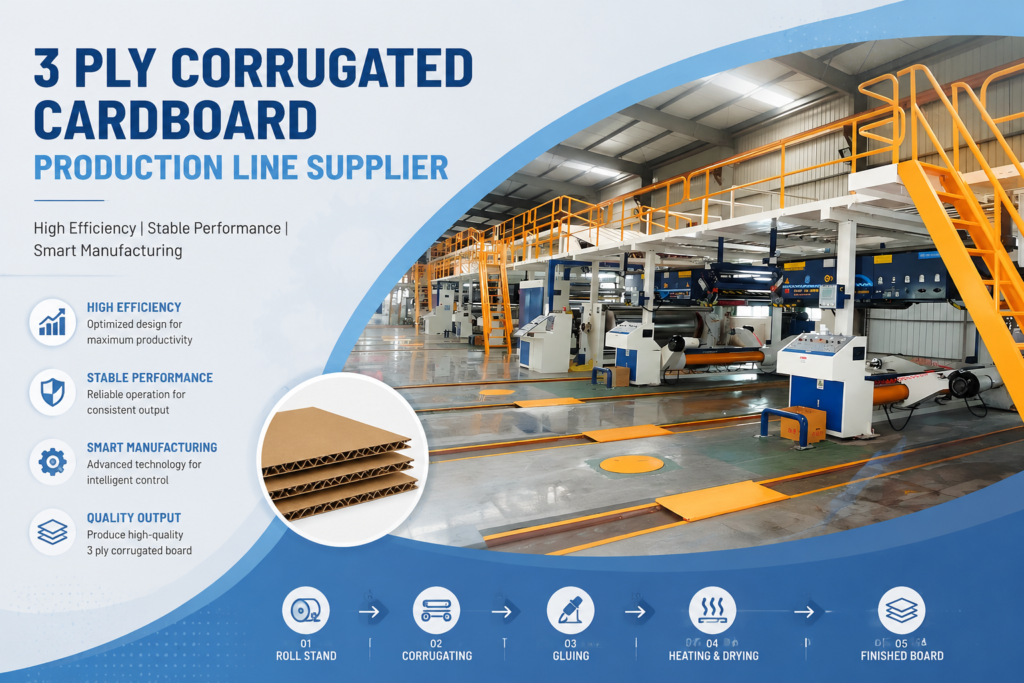
https://gzsmartmachinery.com/product/corrugated-cardboard-production-line/
Engineering Benchmark: Single-Wall Line Tiers Compared
Most “3 ply corrugated cardboard production line suppliers” pages lead with a single speed number and nothing else — which hides where a single-wall line actually loses output. The real gap between tiers is in flute-forming precision, roller-change downtime, and cut-off accuracy under load, not the headline m/min figure.
| Engineering Criterion | Legacy Mechanical Line | Semi-Servo Hybrid Line | Guangzhou Smart Machinery (3/5/7-Ply Line) |
|---|---|---|---|
| Flute Forming | Pressure-roller single facer, flute-crush risk | Partial vacuum assist | Vacuum suction single facer, up to 300 m/min (984 FPM) |
| Cut-Off Precision | ±2–3 mm, blade-wear dependent | ±1 mm typical | AC servo helical knife: ±0.5 mm (±0.02 in) |
| Roller Changeover | Full teardown, 2+ hours per set | Partial quick-release | Quick-change drawer design: full roller swap in 10 minutes |
| Line Synchronization | Manual speed matching, mechanical shaft | Shared line-shaft, limited digital correction | Central Monitoring Industrial PC synchronizes single facer through stacker |
| Corrugating Roller Wear | Untreated or hardened steel, frequent regrind | Coated steel | Tungsten carbide via supersonic spraying |
| Flute/Working-Width Range | Fixed configuration, single flute | 2–3 flute combinations | A/B/C/E/F/BC-AAA flutes; 1800–3300 mm (70.9–129.9 in) working width |
Inside the Line: Single-Facer Flute Forming Through the Bonding Pass
A 3-ply line’s entire quality story is decided at two stations: the single facer, where the fluted medium is formed and glued to the first liner, and the double facer, where that fluted web bonds to the second liner under heat and pressure. The single facer uses vacuum suction to hold the paper against the corrugating roll, which is the mechanism that keeps flute height consistent — pressure-roller designs on older lines crush flute geometry at the exact point they’re trying to form it.
Because a 3-ply line only runs one single facer instead of two, the synchronization load is lighter than on a double-wall line — but it still has to hold speed and phase against the double facer to avoid tension mismatch, which shows up downstream as bow-warp. A Central Monitoring Industrial PC manages that speed relationship across the full line, from single facer through the dry end and stacker, as one digital system rather than independently timed stations.
That single-pass simplicity is also the line’s practical advantage: fewer synchronized stations means faster commissioning and a lower entry point for Tier-2 and Tier-3 plants stepping up from a manual or semi-automatic corrugator for the first time.
Cut-Off Precision and Servo Drive Architecture
Sheet-length accuracy is decided entirely at the cut-off knife, and it’s the single spec most worth verifying before signing, because a dulling mechanical blade drifts tolerance gradually and rarely fails outright. The AC servo helical knife holds ±0.5 mm (±0.02 in) cut-off accuracy, correcting rotational phase against an encoder signal rather than relying on a fixed mechanical cam that wears unevenly over millions of linear meters.
That tolerance is what determines whether every sheet feeds cleanly into a downstream flexo folder gluer without manual re-registration — a corrugator running loose cut-off tolerance pushes its problem straight into the next machine on the floor. Request a Factory FAT (Factory Acceptance Test) Protocol Sheet that documents cut-off tolerance captured at full running speed, not an idle-bench measurement, before you commit capital.
Sheet-length drift rarely shows up as an obvious defect on the corrugator itself — it shows up three stations downstream as jammed feeding or crooked printing, which is a far more expensive place to diagnose a tolerance problem than at the point of purchase.
Material Science: Why the Corrugating Roller and Cut-Off Blade Set Real Lifespan
Roller wear is the primary driver of long-term flute-quality drift on any corrugator, and it’s the line item budget suppliers cut first to hit a lower quote. Tungsten carbide corrugating rollers, applied via supersonic spraying, hold flute height constant through the roller’s service life instead of gradually losing geometry the way untreated or standard hardened steel does under continuous abrasive paper-dust exposure.
A roller that’s slowly losing geometry doesn’t fail outright — it produces board that drifts out of caliper tolerance over months, which is far harder to catch on incoming inspection than an obvious defect. Ask any 3 ply corrugated cardboard production line supplier for the roller coating specification and expected regrind interval in writing, not a verbal assurance, before signing.
The quick-change drawer roller design, completing a full roller-set swap in 10 minutes, is the other component worth auditing directly against a supplier’s claimed changeover time — a flute-profile switch that takes two hours on a competitor’s line is lost production capacity every single time your order mix shifts.
Matching Flute Profile and Working Width to RSC and Shipping Box Production
Single-wall board built on a 3-ply line is the standard for RSC (Regular Slotted Container) shipping boxes, e-commerce mailers, and retail-ready cartons — the highest-volume category most Tier-2 and Tier-3 plants run day to day. The line’s A/B/C/E/F/BC-AAA flute support covers everything from heavier B and C flutes for standard shipping cartons down to the thinner E and F micro-flutes used in retail display and high-end printed packaging, on the same platform.
Working width from 1800 mm to 3300 mm (70.9 to 129.9 in) sets the maximum sheet size per pass, and undersizing this against your largest box blank is the single most common reason a corrugator runs under its rated daily output. A plant that orders a line sized to its median SKU instead of its largest one ends up splitting production runs that a properly specified line would handle in one pass.
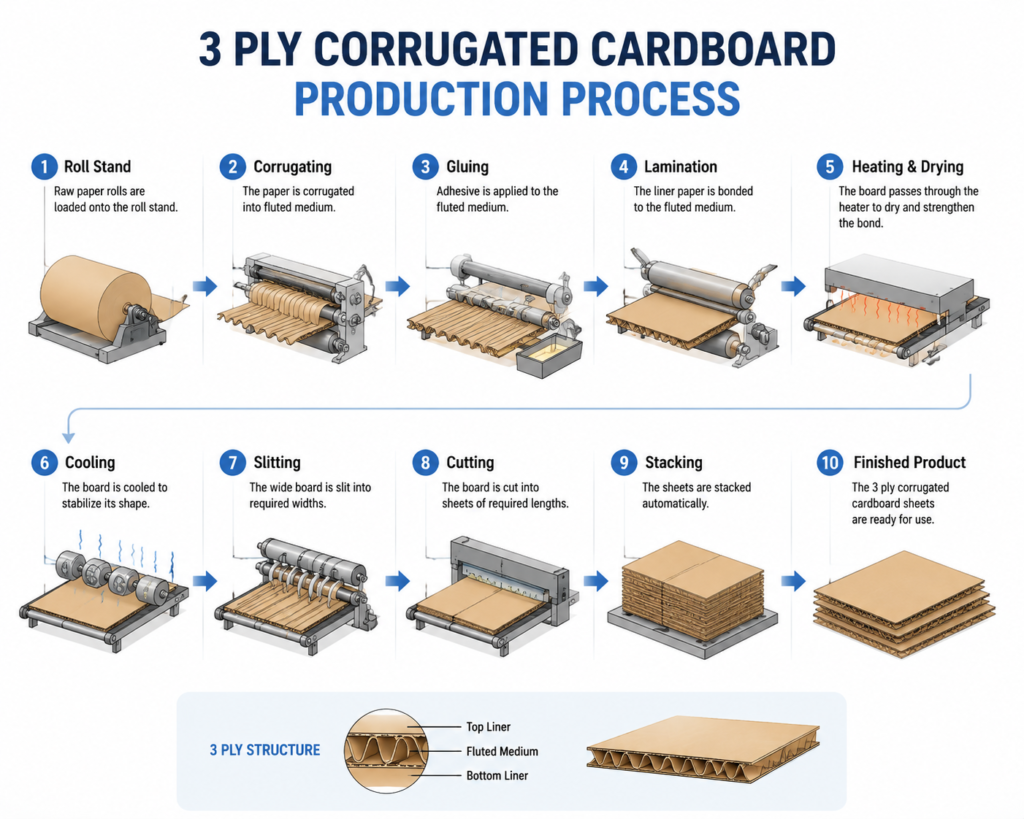
For the full flute-combination and working-width specification sheet matched to your order mix, inquire for Direct-Factory Wholesale B2B Pricing & Lead Times and specify your target box sizes and flute profiles up front.
Vetting a First-Tier Supplier: The Closing Checklist
Return to the three benchmarks that opened this audit — non-crush vacuum flute forming, AC servo cut-off accuracy under running load, and quick-change tooling measured in minutes — and require documented data for each, not a brochure adjective. A supplier who can’t isolate these three systems on paper, or whose spec sheet contradicts itself between the product page and the marketing copy, is not operating at first-tier standard.
A practical due-diligence checklist before you sign:
- Request cut-off tolerance data captured at full running speed, not idle
- Confirm the single-facer vacuum system and flute height consistency across a full production run
- Ask for corrugating-roller coating specification and regrind interval in writing
- Verify flute-profile range and working width match your actual box-blank sizes
- Cross-check every number on the quote against the supplier’s own published product specification — a mismatch is a red flag, not a rounding error
Guangzhou Smart Machinery’s Corrugated Cardboard Production Line — built for 3, 5, and 7-ply configurations on one platform — is the 3 ply corrugated cardboard production line suppliers this audit was built around: vacuum-formed flute geometry, tungsten carbide corrugating rollers, and ±0.5 mm (±0.02 in) cut-off precision engineered for continuous single-wall production.
Frequently Asked Questions
Q: How is a 3-ply (single-wall) line different from a 5-ply double-wall line, mechanically? A: A 3-ply line runs one single facer and one bonding pass at the double facer, while a 5-ply line runs two single facers that have to stay synchronized before reaching the double facer. The 3-ply architecture is inherently simpler to commission and requires less cross-station synchronization.
Q: What cut-off precision should I expect from a modern 3-ply line? A: An AC servo helical-knife cut-off system holds ±0.5 mm (±0.02 in) accuracy by correcting knife-cylinder phase against an encoder signal in real time, rather than relying on a fixed mechanical cam. Any supplier quoting looser tolerance on a servo-driven system is worth questioning directly.
Q: How fast can the line switch between flute profiles? A: The quick-change drawer roller design completes a full roller-set swap in 10 minutes, which is the mechanism that determines actual changeover time between flute profiles — ask for this figure verified at the specific model you’re quoting, not a generic industry claim.
Q: What should I request before signing a purchase order? A: A Factory FAT (Factory Acceptance Test) Protocol Sheet documenting cut-off tolerance and flute-height consistency captured at full running speed, corrugating-roller coating specification, and confirmation that every number on your quote matches the supplier’s own published product specification.
Ready to Specify Your 3-Ply Production Line?
A brochure speed rating doesn’t tell you how a single-wall line holds flute geometry, cut-off tolerance, or roller-change time over thousands of operating hours — that data has to come from the supplier in writing, and it has to match their own product page. Request a Factory FAT Protocol Sheet documenting verified tolerance data for the working width your box-blank sizes require.
For plants ready to move on pricing and lead times, inquire for Direct-Factory Wholesale B2B Pricing & Lead Times and speak directly with Guangzhou Smart Machinery’s engineering team about your flute-profile mix, target daily output, and site infrastructure