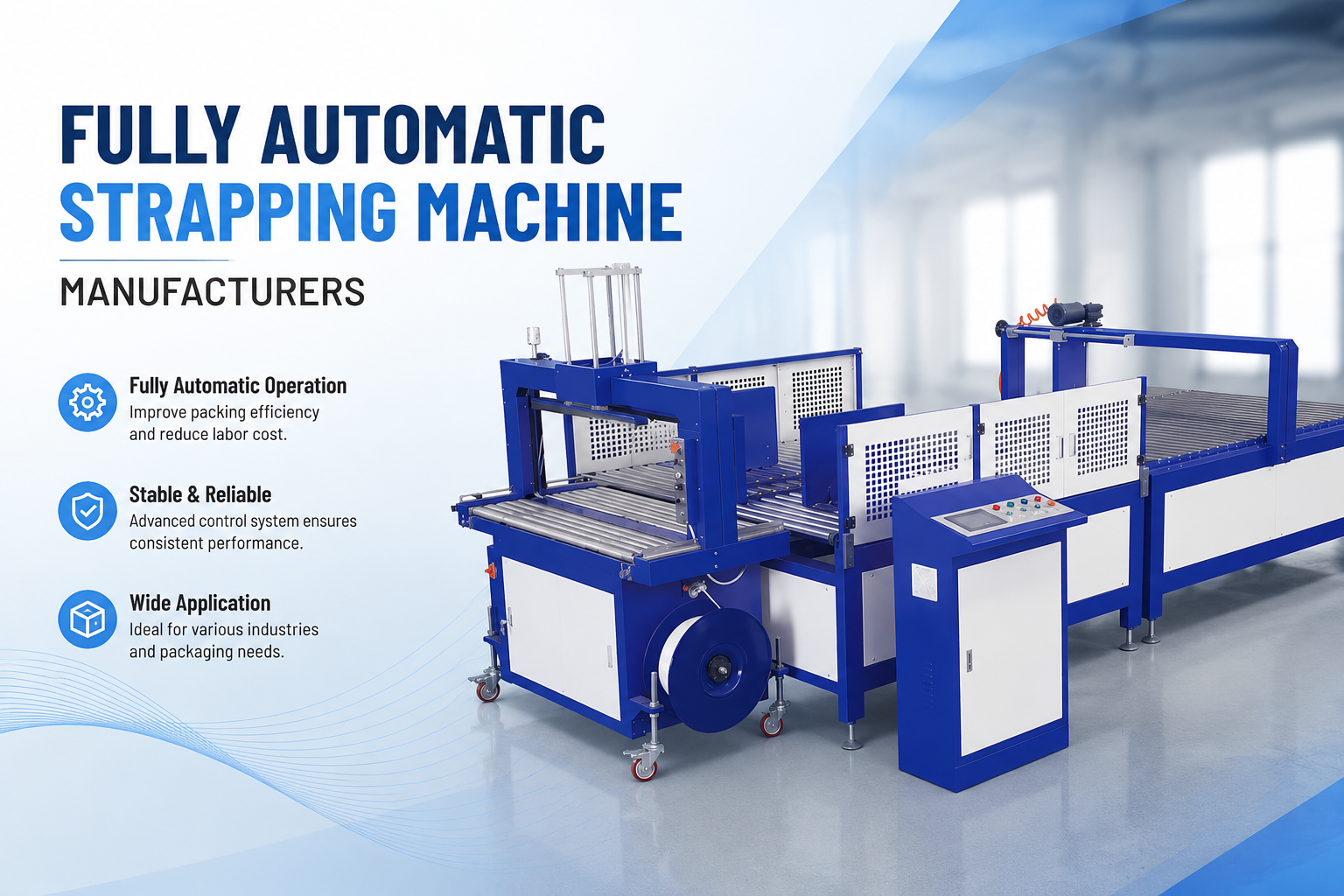
An end-of-line strapper that isn’t calibrated for corrugated board doesn’t fail obviously — it fails by cutting into flute edges or crushing box corners, damage that shows up after the client has already opened the shipment. Before comparing quotes, verify three benchmarks: tension control calibrated specifically for corrugated edges, not generic loads, inline speed synchronization with the upstream folder gluer, and a dust-tolerant mechanical design that holds sensor accuracy under continuous paper-fiber exposure. A fully automatic strapping machine manufacturer that can’t document all three is quoting a general-purpose strapper, not a carton-dedicated one.
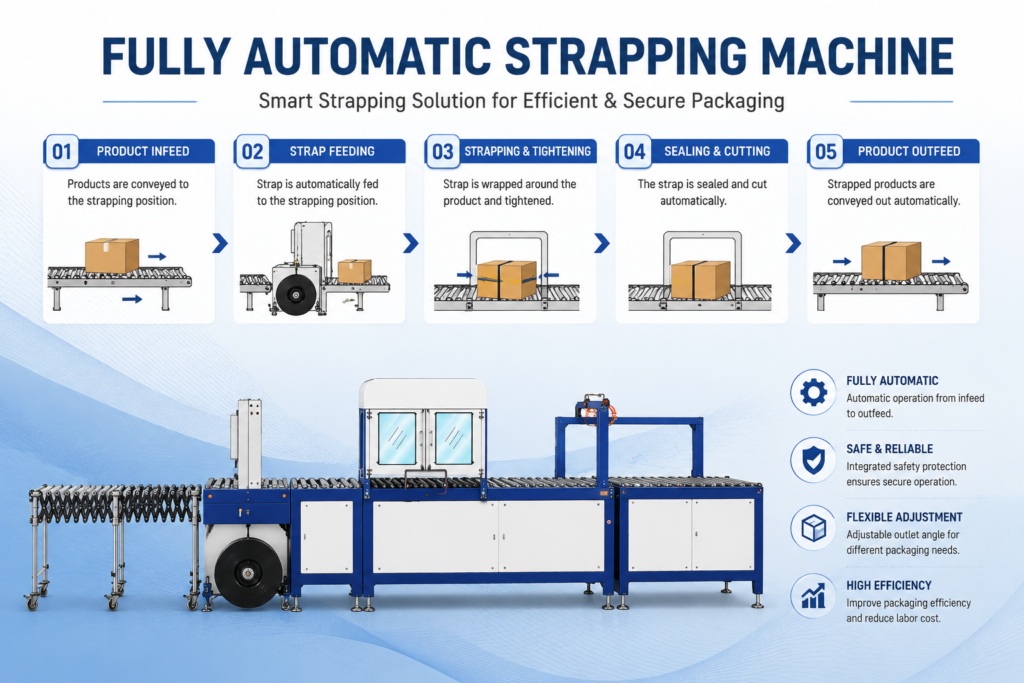
https://gzsmartmachinery.com/product/fully-automatic-strapping-machine/
Engineering Benchmark: Strapping Machine Tiers Compared
Most “fully automatic strapping machine manufacturers” listings sell the same strapping head used for lumber, tile, and steel coil — with a tension dial calibrated for rigid loads, not corrugated board. The gap between a generic strapper and a carton-dedicated one shows up in edge damage rates and downtime, not in the headline “fully automatic” claim.
| Engineering Criterion | Generic Industrial Strapper | Semi-Adapted Carton Unit | Guangzhou Smart Machinery Carton-Dedicated Strapper |
|---|---|---|---|
| Tension Control | Fixed mechanical dial, load-agnostic | Basic adjustable tension | Calibrated edge-protection tension control, tuned to prevent flute deformation |
| Line Integration | Standalone, manual feed | Conveyor-fed, unsynchronized | Seamless inline integration with folder gluer and stitcher output |
| Contact Surfaces | Standard rollers, generic guides | Partial dust shielding | Specialized rollers/guides engineered against paper-dust accumulation |
| Strap Compatibility | Single strap type, non-recyclable options common | Limited width range | PP/PET recyclable-compatible, multiple width configurations across the model range |
| Application Range | Fixed package geometry | Narrow size window | Small cartons through large appliance cartons on the same platform |
| Model Depth | Single SKU | 2–3 variants | General-purpose unit plus a dedicated high-speed 5mm configuration for folder-gluer-matched lines |
Inside the Machine: Why Tension Calibration Is the Whole Story
A generic strapping head applies a fixed tension curve regardless of what’s underneath it — fine for steel coil, destructive on corrugated board. Guangzhou Smart Machinery’s carton-dedicated strapper calibrates tension specifically to secure a stack tightly while preventing the strap from cutting into or deforming the corrugated flutes, which is the single mechanical difference between a “strapping machine” and a “carton strapping machine” that most manufacturer listings gloss over.
That calibration matters most at the edges, where the strap first contacts the box — the point where generic tension settings crush corner board or slice into liner paper on lighter-weight cartons. Specialized rollers and guides are engineered around this same problem from a different angle: preventing paper-dust accumulation that would otherwise interfere with tension-sensor accuracy over a production shift.
The application range this calibration supports is wide by design — from small medicine boxes to large appliance cartons on the same machine, without a tension-profile swap between package sizes.
Inline Synchronization: Matching Strapping Speed to the Folder Gluer
A strapper that runs slower than the folder gluer feeding it becomes the bottleneck at the exact point where a plant’s investment in upstream automation stops paying off. Seamless in-line integration with an Automatic Folder Gluer and Stitcher line is the design requirement that prevents this — the strapper has to match output pace, not just physically sit at the end of the conveyor.
For plants pushing higher folder-gluer output, Guangzhou Smart Machinery’s range extends to a high-speed 5mm configuration, engineered to keep pace with production lines up to 180 m/min (591 FPM) and using a thinner 5mm (0.2 in) strap to increase meters per coil versus standard 9mm or 12mm strapping. That’s a distinct model from the base carton-dedicated unit — worth specifying explicitly when you request a quote, since the two serve different throughput tiers on the same manufacturer’s line.
Request a Factory FAT (Factory Acceptance Test) Protocol Sheet that documents strapping cycle time measured against your specific folder gluer’s rated output, not a generic bench-test number, before you commit to a model.
Mechanical Durability: Dust Management and Sensor Reliability
Paper dust is the quiet failure mode on any end-of-line strapper running downstream of a corrugator and folder gluer — it accumulates on sensors and strapping heads gradually, degrading tension accuracy long before an operator notices a hard failure. An easy-access design for quick cleaning of paper fibers and glue residue is what keeps sensor accuracy stable shift over shift, instead of drifting until a strap either over-tensions and cuts board or under-tensions and fails to hold the stack.
Maintenance discipline compounds this: regular inspection of sealer temperature and cutter sharpness is what keeps every bundle transport-ready, and a manufacturer who trains your operators on this routine — rather than treating it as a warranty afterthought — is signaling they expect the machine to run in a real paper-dust environment, not a clean-room demo.
A supplier that can’t describe their dust-management approach beyond “regular cleaning” hasn’t engineered around the problem — they’re relying on your maintenance team to compensate for a mechanical gap.
Safety hardware belongs in this same durability conversation, not a separate compliance checkbox. Emergency stops and full safety guarding around the strapping zone protect operators working close to a high-tension strap head during continuous shift work, and a manufacturer who pairs that hardware with actual operator safety training — not just a manual left in a drawer — is treating the strapping station as a real workstation, not an afterthought bolted onto the end of the line.
Matching Model and Strap Specification to Your Application
The base fully automatic strapping machine is built for the general carton range — e-commerce shipping flats, food and beverage outer cases, and custom-printed cartons where edge protection during transit matters as much as bundle security. It’s the correct specification for plants running standard folder-gluer output without a dedicated high-speed bottleneck at the strapping stage.
For higher-volume lines, the high-speed 5mm configuration publishes a full model range — 1260/1460/1660/1810mm (49.6–71.3 in) maximum strapping widths, table height 850mm (33.5 in), packing speed 20+ packs/minute, and power 1P 220V 50Hz, 0.6 kW — worth requesting directly if your line runs at or above 150 m/min (492 FPM) upstream.
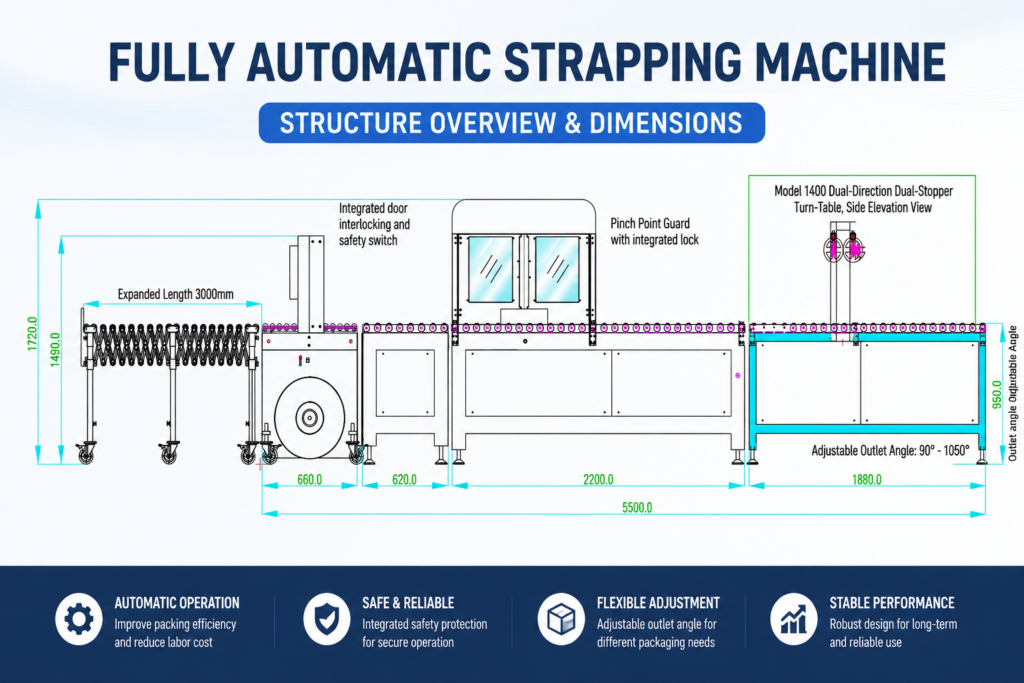
For the model comparison matched to your folder-gluer output and carton size range, inquire for Direct-Factory Wholesale B2B Pricing & Lead Times and specify both your maximum carton dimensions and your upstream line speed up front.
Vetting a First-Tier Manufacturer: The Closing Checklist
Return to the three benchmarks that opened this audit — edge-calibrated tension control, inline speed synchronization, and dust-tolerant sensor design — and require documented evidence for each, not a “fully automatic” headline claim. A manufacturer selling the same strapping head across lumber, tile, and cartons without carton-specific tension calibration is not a specialist, regardless of automation level.
A practical due-diligence checklist before you sign:
- Request tension-calibration data specific to corrugated board, not a generic load rating
- Confirm cycle-time synchronization against your actual folder gluer’s rated output, not an idle bench test
- Ask how the machine is engineered against paper-dust accumulation on sensors and strapping heads
- Verify which model in the manufacturer’s range matches your carton size and upstream line speed
- Confirm strap material compatibility (PP/PET, recyclable) matches your sustainability requirements
Guangzhou Smart Machinery’s carton-dedicated line — spanning the general-purpose unit through the high-speed 5mm configuration — is the fully automatic strapping machine manufacturer this audit was built around: calibrated edge-protection tension control, inline folder-gluer synchronization, and a maintenance approach built for real paper-dust production environments.
Frequently Asked Questions
Q: What makes a “carton-dedicated” strapping machine different from a general industrial strapper? A: Tension calibration. A carton-dedicated unit is tuned specifically to secure a stack tightly while preventing the strap from cutting into or deforming corrugated flutes — a fixed-tension generic strapper applies the same setting regardless of what’s underneath it.
Q: Can this strapping machine integrate directly with our folder gluer line? A: Yes — the fully automatic strapping machine is built for seamless in-line integration with an Automatic Folder Gluer and Stitcher line, creating one continuous flow from folding and gluing to the final strapped bundle.
Q: What strap widths and speeds are available across the model range? A: The base unit handles standard PP/PET strapping across a wide carton-size range. For higher-volume lines, the high-speed 5mm configuration offers maximum strapping widths from 1260mm to 1810mm and cycle speeds up to 180 m/min (591 FPM) to match high-output folder gluers.
Q: What should I request before signing a purchase order? A: A Factory FAT (Factory Acceptance Test) Protocol Sheet documenting cycle time against your specific folder gluer’s output, tension-calibration data for your carton weight range, and confirmation of which model in the manufacturer’s range matches your maximum carton dimensions.
Ready to Specify Your Strapping Machine?
A “fully automatic” label doesn’t tell you whether a strapper is calibrated for corrugated edges, synchronized to your folder gluer, or engineered against paper-dust drift — that data has to come from the manufacturer directly. Request a Factory FAT Protocol Sheet documenting tension-calibration and cycle-time data matched to your carton range and upstream line speed.
For plants ready to move on pricing and lead times, inquire for Direct-Factory Wholesale B2B Pricing & Lead Times and speak directly with Guangzhou Smart Machinery’s engineering team about your carton size range, folder-gluer output, and strap material requirements.