A nameplate speed rating tells you almost nothing about a high speed automatic folder gluer machine until it’s tied to correction data captured under load. Three benchmarks separate a genuine high-speed line from a machine that’s fast only on the spec sheet: a correction system that holds fold accuracy at rated speed rather than degrading past a certain throughput, a documented adhesive-consumption rate — since material waste scales directly with claimed speed — and a changeover time for switching box styles that doesn’t erase the speed advantage on mixed-batch days.
A supplier who can’t produce running-speed accuracy data and per-ton adhesive consumption figures, in writing, isn’t selling a high-speed machine — they’re selling a fast idle demo.
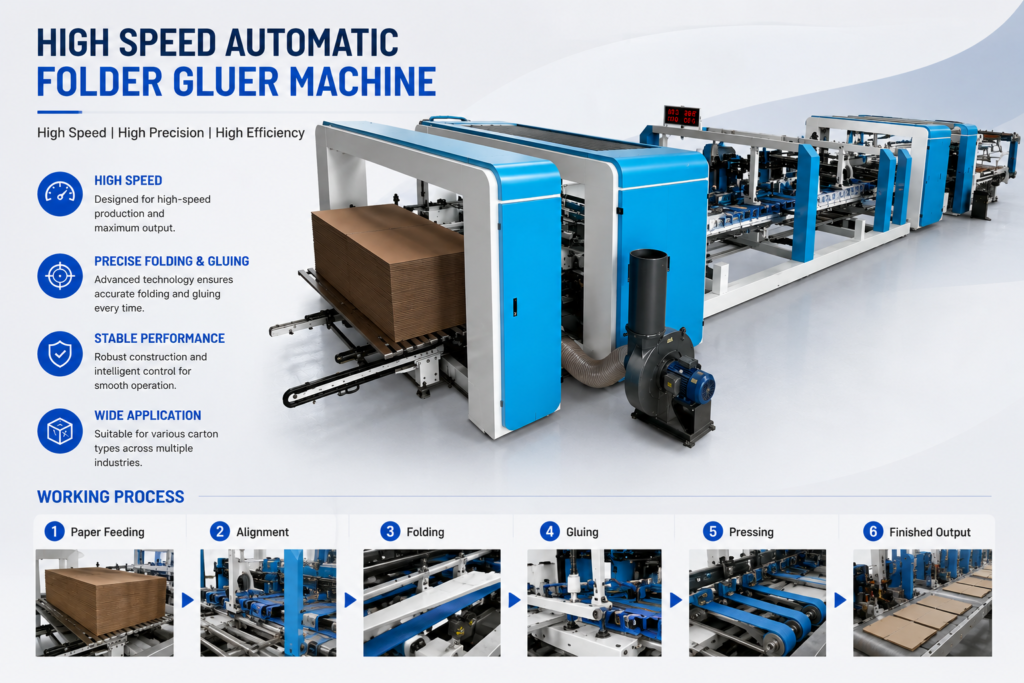
https://gzsmartmachinery.com/product/eco-automatic-folder-gluer-and-stitcher-machine/
Engineering Benchmark: What “High Speed” Means by Supplier Tier
Most listings for a “high speed automatic folder gluer machine” lead with a single peak number and stop there. The number that actually predicts daily output is what happens to fold accuracy and adhesive consumption once the line has been running for eight hours, not the first ten minutes of a factory demo video.
Procurement teams that anchor on peak m/min alone tend to discover the real cost later, in reject rates and adhesive invoices, rather than during the sourcing decision. A line that hits its rated speed only with a fresh operator resetting jams every few minutes isn’t a high-speed machine — it’s a mechanically fast one with an unsolved correction problem.
| Engineering Criterion | Tier 3 Manual/Mechanical Shop | Tier 2 Semi-Servo Assembler | Guangzhou Smart Machinery (Eco Automatic Line) |
|---|---|---|---|
| Peak Line Speed | 40–80 m/min (131–262 FPM), degrades under load | 100–140 m/min (328–459 FPM) | Up to 180 m/min (590 FPM) |
| Fold Correction | None; fishtailing corrected by hand downstream | Fixed mechanical guide, no run-time compensation | Secondary correction technology engineered to eliminate fishtails at running speed |
| Feeding System | Friction rollers, jam-prone at speed | Basic vacuum assist | Precision Feeder Unit — vacuum suction, one-by-one alignment |
| Adhesive Efficiency | No published consumption data | Manual glue-wheel application, high waste | Intelligent control system: starch consumption below 18 kg/t (39.7 lb/t) vs. an industry average above 22 kg/t (48.5 lb/t) |
| Stitching Integration | Separate machine, separate handling | Bolt-on stitcher, no shared control logic | Integrated stitching section, 30–120 mm (1.18–4.72 in) adjustable distance |
| Box Style Range | Straight-line only | Straight-line and basic lock-bottom | Straight-line, crash-lock bottom, and multi-corner via digital touchscreen |
Inside the Line: Feeder, Pre-Breaking, Correction, and Fold-Glue-Stitch
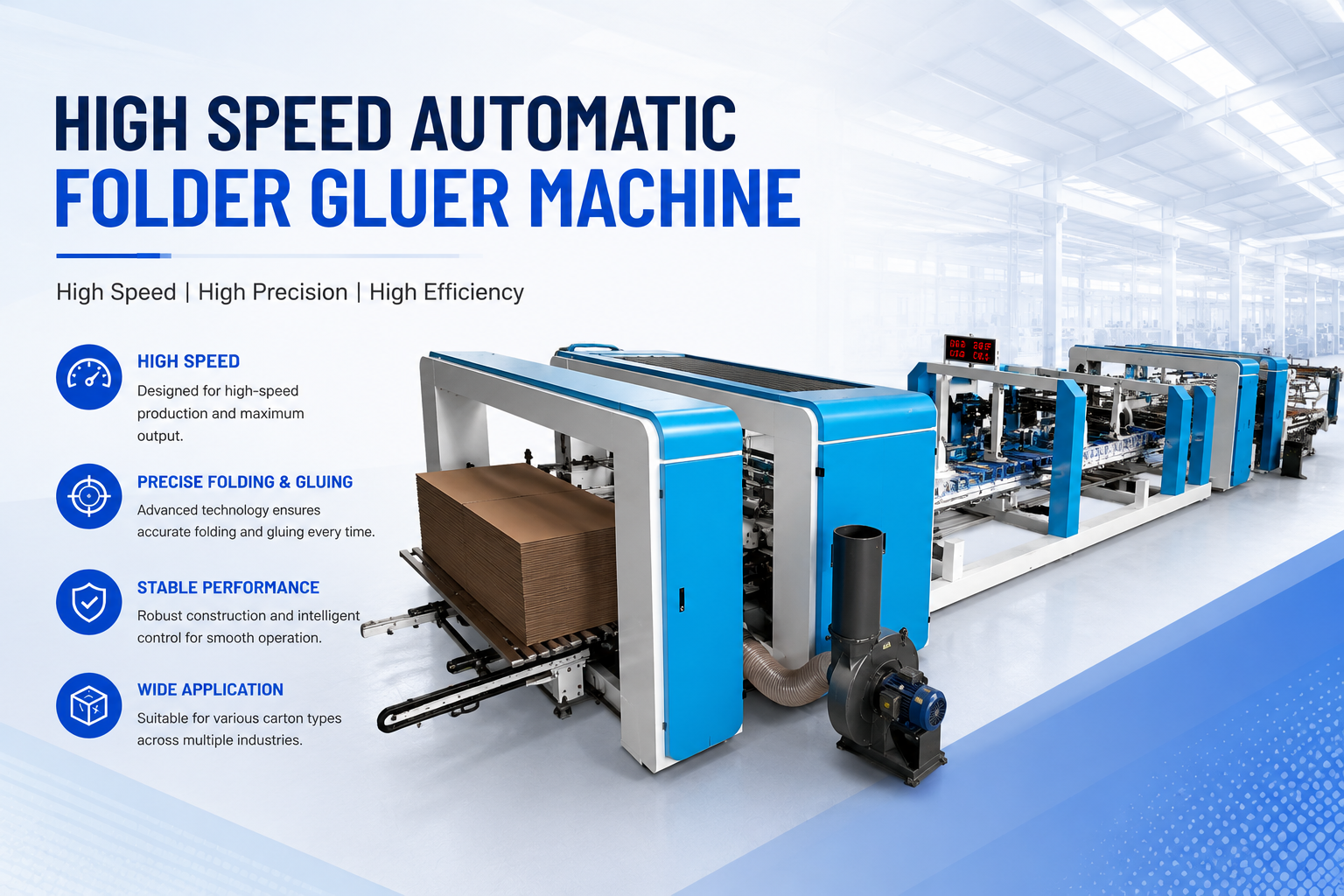
A genuine high speed automatic folder gluer machine starts at the Precision Feeder Unit, which uses a high-accuracy vacuum suction system to pull carton blanks one at a time with consistent alignment — the detail that prevents jams once the line is running at full rate rather than at demo speed. For complex or stiff cardboard, an Advanced Pre-breaking section optionally “pre-breaks” the crease lines ahead of the fold, so the board sets correctly instead of springing back.
Secondary correction technology is what actually earns the “high speed” claim: it’s engineered to eliminate fishtails — misaligned flaps — at production rate, not just at reduced test speed. From there, precisely positioned guides and hooks handle Intelligent Folding & Gluing for complex box geometries, applying either water-based cold glue or hot-melt adhesive through high-precision nozzles depending on the board and box style.
The Integrated Stitching Section adds mechanical reinforcement where a glued seam alone isn’t enough, with an adjustable stitching distance across 30–120 mm (1.18–4.72 in) to match box weight and transport requirements. A digital touchscreen drives rapid order changeovers, switching between straight-line, crash-lock bottom, and multi-corner box styles without a mechanical rebuild.
Running-Speed Accuracy: Why 180 m/min (590 FPM) Only Matters With Correction Data
A peak speed of 180 m/min (590 FPM) is only a meaningful number when it’s paired with what the correction system does to hold that speed without accuracy loss. The secondary correction technology is engineered specifically to eliminate fishtailing at running speed — the failure mode that forces plants to either slow the line down or accept a higher reject rate as throughput climbs.
Ask any supplier for fold-accuracy data captured at their claimed peak speed, not at a demo-friendly fraction of it. A machine that quietly runs its showroom demo at 60% of nameplate speed is telling you something about where its real accuracy ceiling sits.
Don’t accept a peak-speed number without running-load data behind it. Request a Factory FAT (Factory Acceptance Test) Protocol Sheet documenting fold accuracy, jam rate, and adhesive consumption at your target production speed, not a reduced demonstration rate.
The Hidden Speed Metric: Adhesive Consumption Per Ton
Adhesive and starch waste scale with line speed, which makes consumption data one of the most reliable — and most overlooked — indicators of whether a “high speed” claim holds up in daily operation. The intelligent control system on this line is engineered to bring starch consumption below 18 kg per metric ton (39.7 lb/t) of paper processed, against an industry average above 22 kg per metric ton (48.5 lb/t).
On a plant running thousands of tons of board annually, that gap compounds into real budget line items, not a rounding error. A supplier who can’t produce their own consumption-per-ton figure — measured, not estimated — is asking you to take their speed claim on faith while the adhesive bill quietly tells the real story.
Treat the consumption figure the same way you’d treat a fuel-economy rating: ask whether it was measured at the machine’s rated peak speed or at a slower, glue-friendly test rate. A number generated at reduced speed tells you almost nothing about what your adhesive budget will look like once the line is actually running at 180 m/min (590 FPM) on your production floor.
Box-Style Flexibility and Changeover Without a Rebuild
Peak speed on a single box style is a partial answer; most plants run a mix of straight-line, crash-lock bottom, and multi-corner designs across a single shift. This line’s digital touchscreen controls switch between those styles without a mechanical toolhead swap, which is what keeps the 180 m/min (590 FPM) rating meaningful across a real production mix rather than a single best-case run.
- Confirm changeover time between box styles under an actual production switch, not an idle demo
- Request the fold-accuracy figure at full rated speed, not a reduced showroom rate
- Get starch or adhesive consumption per ton in writing, measured rather than estimated
- Verify stitching-distance range (30–120 mm / 1.18–4.72 in) against your heaviest carton weight
Vetting a First-Tier Supplier: The Closing Checklist
Return to the three benchmarks that opened this audit — correction accuracy under load, documented adhesive efficiency, and changeover time across box styles — and require evidence for each rather than a brochure claim. A supplier who won’t share running-speed fold data or a measured starch-per-ton figure is not operating at first-tier standard.
A practical checklist before you sign:
- Request the Factory FAT Protocol Sheet with fold-accuracy data captured at full rated speed
- Get starch or adhesive consumption per ton in writing, and compare it against the industry average
- Confirm stitching-distance range and box-style compatibility against your actual product mix
- Verify changeover time under a real box-style switch, not a single-style demo run
Guangzhou Smart Machinery’s Eco Automatic Folder Gluer and Stitcher Machine — secondary correction technology, a Precision Feeder Unit, and starch consumption below 18 kg/t (39.7 lb/t) at up to 180 m/min (590 FPM) — is the high speed automatic folder gluer machine this audit was built around.
Frequently Asked Questions
Q: What actually separates a “high speed” machine from a standard one, beyond the peak m/min number? A: Whether fold accuracy holds at that peak speed. Secondary correction technology engineered to eliminate fishtailing at running speed is what keeps a 180 m/min (590 FPM) rating usable in production instead of just a showroom figure.
Q: How does adhesive consumption relate to speed claims? A: Directly — waste scales with throughput. This line’s intelligent control system is engineered to hold starch consumption below 18 kg per metric ton (39.7 lb/t), against an industry average above 22 kg per metric ton (48.5 lb/t), which is a measurable way to verify a speed claim rather than take it on faith.
Q: Can this line handle both gluing and stitching on the same carton? A: Yes. The Integrated Stitching Section adds mechanical reinforcement alongside the gluing process, with an adjustable stitching distance across 30–120 mm (1.18–4.72 in) for heavy-duty cartons that need more than an adhesive seam.
Q: What box styles does the machine support without a mechanical rebuild? A: Straight-line, crash-lock bottom, and multi-corner designs, switched via the digital touchscreen for rapid order changeover between small-batch and mass-production runs.
Q: What should I request before signing a purchase order? A: A Factory FAT Protocol Sheet documenting fold accuracy at full rated speed, a measured starch or adhesive consumption figure per ton, and confirmed stitching-distance and box-style compatibility against your own product mix.
Ready to Specify Your High Speed Line?
A brochure speed rating tells you almost nothing about daily output — running-speed fold accuracy, adhesive consumption per ton, and changeover time across box styles are what actually decide it. Request a Factory FAT Protocol Sheet documenting all three for your production mix before committing capital.
For plants ready to move on pricing and lead times, inquire for Direct-Factory Wholesale B2B Pricing & Lead Times and speak directly with Guangzhou Smart Machinery’s engineering team about your board mix, order volume, and target daily output.