Vetting a carton folder gluer strapping machine supplier starts before the speed spec sheet. Three benchmarks decide whether a machine survives a production floor for fifteen years: a correction system that holds fold alignment at running speed instead of after the fact, true dual-mode tooling that switches glue-only, stitch-only, or combined output without a mechanical rebuild, and a documented path from squared carton to strapped bundle.
A supplier who can’t produce changeover-time data and staple-distance tolerances by model, in writing, isn’t ready for a serious RFQ.

https://gzsmartmachinery.com/product/automatic-folder-gluer-stitching-machine/
Engineering Benchmark: Supplier Tiers for Folder-Gluer-Stitcher Lines
Most listings for a “carton folder gluer strapping machine supplier” describe a single fixed-function machine and call it versatile. The real differentiator is whether gluing, stitching, and the downstream strapping handoff run as one engineered system or as three separately sourced problems.
Procurement teams tend to compare nameplate speed first and mode flexibility second, which is backwards for any plant running mixed box styles in the same shift. A line that needs a manual toolhead swap to move from a glued RSC box to a stitched heavy-duty carton loses more daily output to changeover than it ever gains from a higher peak speed rating.
| Engineering Criterion | Tier 3 Manual/Mechanical Shop | Tier 2 Semi-Servo Assembler | Guangzhou Smart Machinery (Dual-Mode Servo Line) |
|---|---|---|---|
| Mode Switching | Single function only — glue OR stitch, manual retool between jobs | Two functions available, manual toolhead swap required | Glue-only, stitch-only, or combined glue-and-stitch — selected on the touchscreen |
| Fold Correction | None; fishtailing corrected by hand downstream | Fixed mechanical guide, no run-time compensation | Secondary Correction Unit engineered for 100% folding accuracy at production speed |
| Order Changeover | 30–60+ minutes of manual re-tooling | 15–20 minutes | 3–5 minutes at up to 180 m/min (590 FPM) |
| Staple/Nail Distance Control | Fixed single setting | Limited manual range | Servo-controlled 30–90 mm (1.18–3.54 in), stable at running speed |
| Board Compatibility | Single flute/layer only | 2–3 flute types | 3/5-layer board, A, B, C, or AB flute |
| End-of-Line Path | Manual palletizing, no strapping link | Standalone strapper, separate handling and re-registration | Squaring section feeds directly toward a matched Automatic Carton Strapping Machine line |
Inside the Dual-Mode Line: Fold, Glue, Stitch, Square
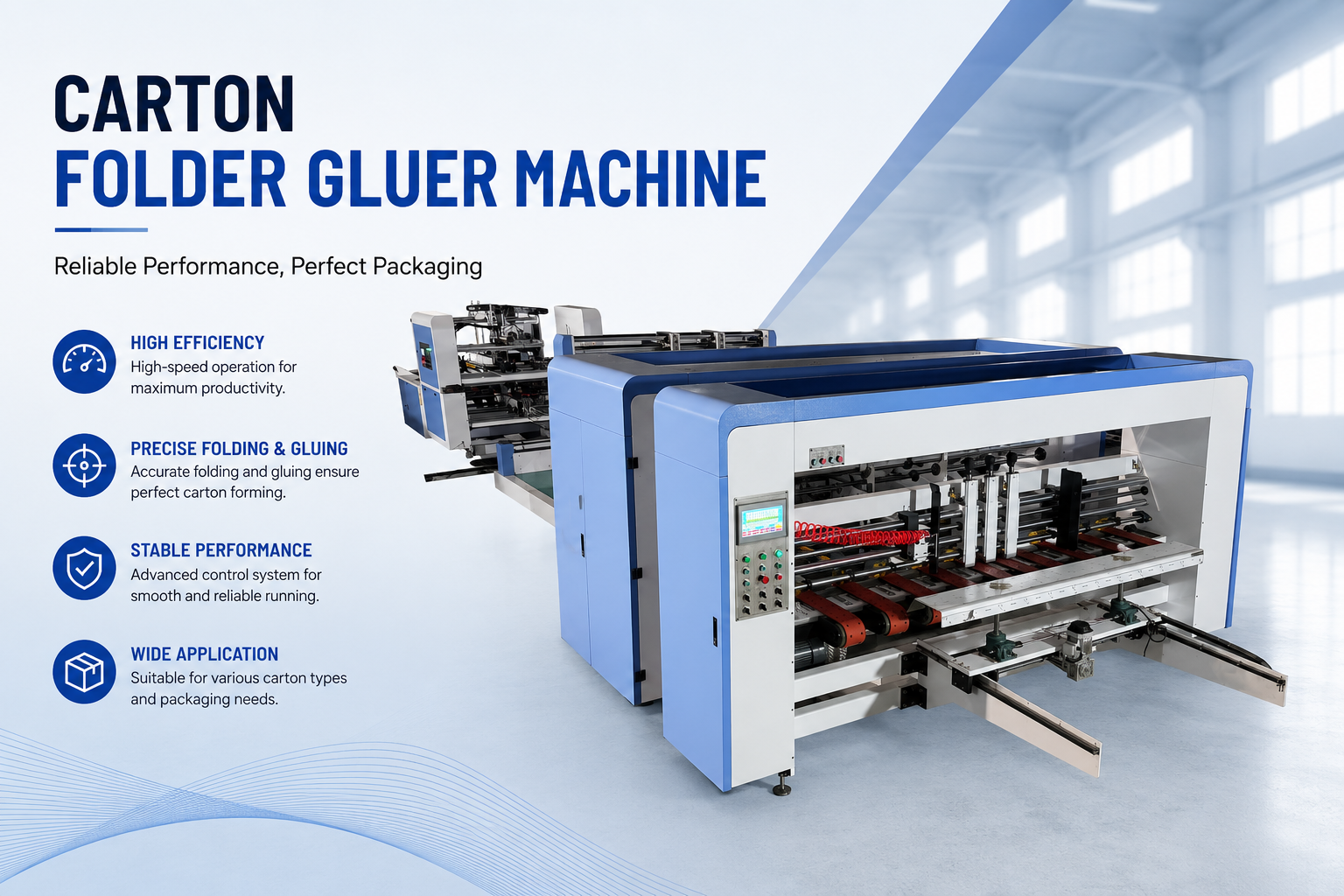
A genuine carton folder gluer strapping machine supplier builds gluing and stitching into one physical pass rather than bolting two machines end to end. Board enters the feeder section and moves into the Secondary Correction Unit, which is purpose-built to eliminate “fishtails” — misaligned flaps that would otherwise require a manual re-fold downstream.
From there the line does one of three things, set from the touchscreen: glue-only, stitch-only, or combined glue-and-stitch for cartons that need both a bonded seam and mechanical reinforcement. The stitching path draws from a 20 kg (44 lb) wire feeder and holds nail (staple) distance across a 30–90 mm (1.18–3.54 in) range under full servo control, so spacing doesn’t drift as the run continues.
A squaring section finishes the pass, aligning the carton before it exits — the same stage that determines whether a downstream strapping arch receives a properly registered bundle or one that needs manual correction. The line handles 3-layer and 5-layer corrugated board across A, B, C, or AB flute, and switches between straight-line and crash-lock bottom box styles without a tooling change.
Fold and Stitch Registration Under Running Conditions
A correction system only means something if it holds at production speed, not on an idle demo run. The Secondary Correction Unit is engineered against the same ±0.5 mm (±0.02 in) folding-precision standard Guangzhou Smart Machinery applies across its automatic folder gluer range, and the same servo logic governs stitch spacing across the full 30–90 mm (1.18–3.54 in) nail-distance window.
Order changeover runs 3–5 minutes: an operator inputs the new carton dimensions on the touchscreen and the line auto-adjusts, rather than re-threading belts or resetting mechanical stops by hand. At a rated 180 m/min (590 FPM), that changeover speed is what actually determines daily output on mixed-batch production, not the peak linear speed alone.
Don’t accept a peak-speed number without registration data behind it. Request a Factory FAT (Factory Acceptance Test) Protocol Sheet that documents fold tolerance, nail-distance stability, and changeover time under an actual running load for the box styles you produce.
Wire Feed, Glue Application, and Spare-Parts Transparency
Wear components decide whether a “carton folder gluer strapping machine supplier” is a one-time vendor or a long-term partner. The 20 kg (44 lb) wire feeder that supplies the stitching head has a finite run time before reload — ask for the feed rate at your target nail distance so you can plan reload intervals against your shift schedule instead of discovering the gap on the floor.
On the gluing side, confirm nozzle type and adhesive compatibility for your specific board coating before ordering; a machine rated for standard kraft liner may need adjustment for coated or laminated stock. A first-tier supplier answers these questions with documentation, not a verbal assurance.
The combined mode carries its own procurement question: when gluing and stitching run simultaneously on the same carton, ask how the two heads are timed against each other so the stitch doesn’t land before the glue has set its initial tack. This is the kind of sequencing detail that separates a machine engineered for dual-mode output from two single-function units sharing a frame.
- Request wire consumption rate at your target nail distance and shift length
- Confirm glue nozzle type and compatibility with your board’s surface coating
- Get spare-parts lead time in writing for the wire feed mechanism and correction unit components
- Verify which flute types (A, B, C, AB) and board layers (3-ply, 5-ply) are covered under warranty
End-of-Line Integration: From Squared Carton to Strapped Bundle
The “strapping” half of a carton folder gluer strapping machine supplier’s value isn’t a marketing add-on — it’s whether the squaring section at the end of the fold-glue-stitch pass is actually built to hand off cleanly into a strapping arch. Guangzhou Smart Machinery carries both the dual-mode folder-gluer-stitcher line and a dedicated Automatic Carton Strapping Machine product category under one factory, which removes the integration risk of matching two different manufacturers’ registration tolerances at the handoff point.
Sourcing both stages from one supplier also means one point of contact for spare parts, one control-system logic to train operators on, and one factory audit instead of two. For plants running mixed box styles — straight-line and crash-lock bottom in the same shift — that single-source path matters more than a marginal speed difference between competing standalone units.
For a matched folder-gluer-stitcher and strapping line quote, inquire for Direct-Factory Wholesale B2B Pricing & Lead Times and specify your board mix, box styles, and target daily volume.
Vetting a First-Tier Supplier: The Closing Checklist
Return to the three benchmarks that opened this audit — run-time fold correction, true dual-mode switching, and a documented handoff into strapping — and require evidence for each rather than a brochure claim. A supplier who won’t share nail-distance data by model, wire-feeder capacity, or changeover time under load is not operating at first-tier standard.
A practical checklist before you sign:
- Request the Factory FAT Protocol Sheet with fold tolerance and nail-distance data captured at running speed
- Confirm 3-ply/5-ply board and A/B/C/AB flute compatibility against your actual stock
- Get wire-feeder capacity and glue-nozzle specification in writing
- Verify changeover time under an actual box-style switch, not an idle demo
- Confirm the squaring section’s registration compatibility with your intended strapping equipment
Guangzhou Smart Machinery’s Automatic Folder Gluer Stitching Machine — dual-mode glue/stitch switching, Secondary Correction Unit, and a 3–5 minute changeover at 180 m/min (590 FPM) — is the carton folder gluer strapping machine supplier this audit was built around.
Frequently Asked Questions
Q: When a supplier lists both folder-gluer and strapping equipment, is that one machine or two separate machines? A: Typically both, from one factory. Guangzhou Smart Machinery’s Automatic Folder Gluer Stitching Machine handles the fold, glue, and stitch stages in one pass, and pairs with a separate Automatic Carton Strapping Machine line for the bundling stage — sourced together to keep registration tolerances consistent across the handoff.
Q: Can one machine really switch between gluing and stitching without a full mechanical rebuild? A: Yes. The line offers glue-only, stitch-only, or combined glue-and-stitch modes selected directly on the touchscreen, which is what separates a true dual-mode system from a machine that requires a toolhead swap between jobs.
Q: What board types and box styles does this line handle? A: 3-layer and 5-layer corrugated board across A, B, C, or AB flute, in straight-line and crash-lock bottom box styles, with cover or without-cover configurations.
Q: How fast is a realistic order changeover? A: 3–5 minutes. An operator enters the new carton dimensions on the touchscreen and the line adjusts automatically, rather than requiring manual re-threading or mechanical stop resets.
Q: What should I request before signing a purchase order? A: A Factory FAT Protocol Sheet documenting fold tolerance and nail-distance stability at running speed, wire-feeder capacity, glue-nozzle specification, and confirmed flute/board-layer compatibility against your own stock.
Ready to Specify Your Fold-Glue-Stitch-Strap Line?
A brochure speed rating tells you almost nothing about daily output — changeover time, fold correction under load, and a clean handoff into strapping are what actually decide it. Request a Factory FAT Protocol Sheet documenting tolerance and changeover data for your box styles before committing capital.
For plants ready to move on pricing and lead times, inquire for Direct-Factory Wholesale B2B Pricing & Lead Times and speak directly with Guangzhou Smart Machinery’s engineering team about your board mix, order volume, and end-of-line strapping requirements.