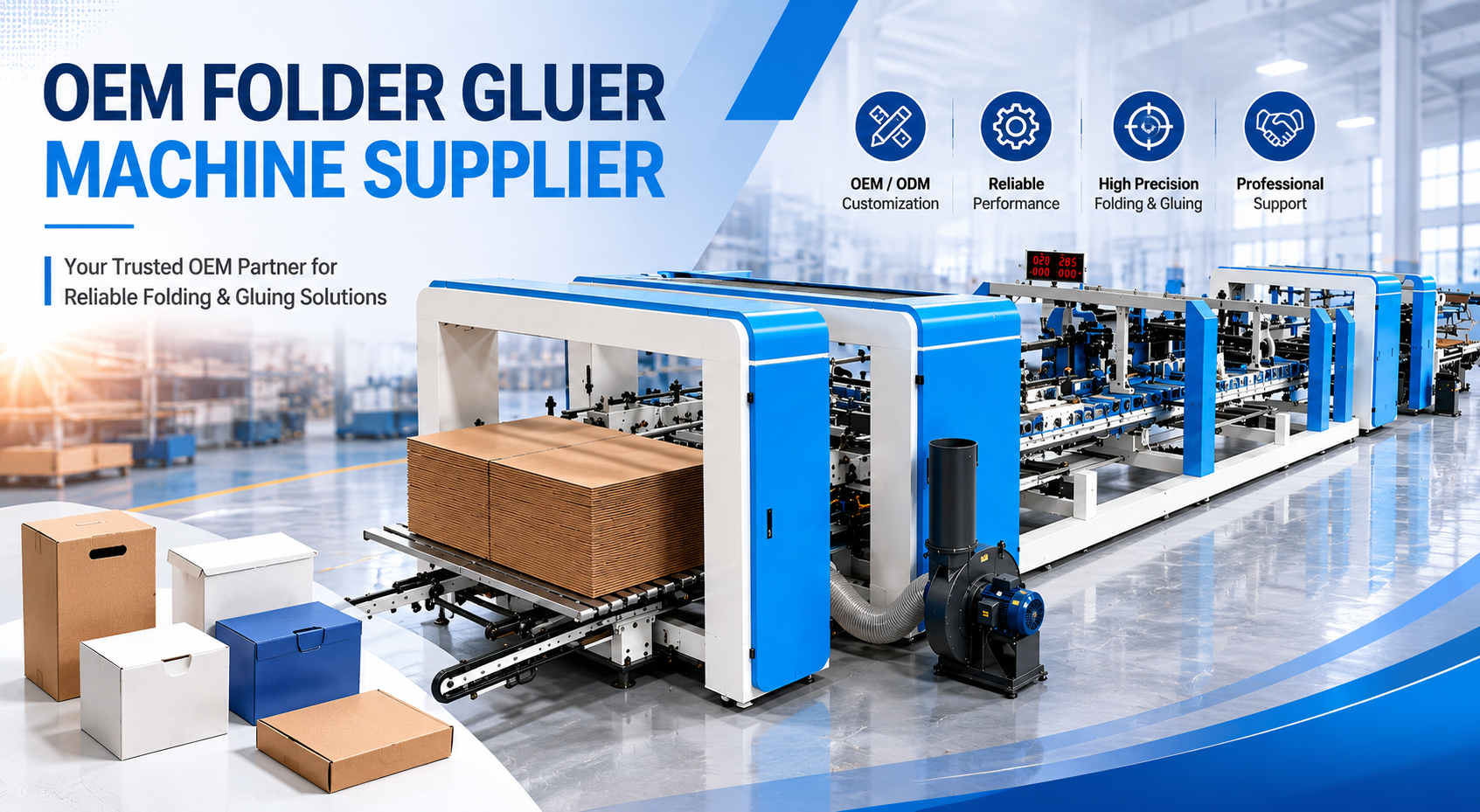
Vetting an OEM folder gluer machine supplier means checking whether “customization” is a real engineering menu or a sales word. First, get the documented substitution list — which PLC brand, glue system, and finishing module can actually swap into the base platform, in writing. Second, confirm direct factory FAT access — a trading company relaying your spec sheet to an unnamed subcontractor cannot show you a Factory Acceptance Test on your exact configuration. Third, get spare-parts lead time in writing for the specific components in your build, not a generic “fast shipping” promise. A supplier who can’t produce all three in writing isn’t set up for OEM work, regardless of what the homepage claims.
https://gzsmartmachinery.com/product/eco-automatic-folder-gluer-and-stitcher-machine/
Engineering Benchmark: Three Tiers of OEM Sourcing Capability
Most listings under “OEM folder gluer machine supplier” describe a trading company willing to put a private label on a standard unit, not a factory offering documented component substitution. The gap shows up in three places: whether the PLC brand is a real choice, whether the servo/bearing/motor brands are named, and whether a Factory Acceptance Test happens on your exact build.
| Engineering Criterion | Trading Company / Middleman | Regional OEM Fabricator | Guangzhou Smart Machinery (Direct-Factory OEM) |
|---|---|---|---|
| PLC Brand Substitution | Fixed to whatever the subcontractor stocks | Limited to one or two house brands | Delta, Siemens, or Mitsubishi — buyer’s choice, documented in the order |
| Component Traceability | Relayed specs, no factory visibility | Partial — frame confirmed, electronics unnamed | Named servo, bearing, and motor brands (Delta/NSK/HIWIN/Schneider/Omron) per build |
| Factory Acceptance Test | Not available — no factory access | Available on standard models only | FAT run on your exact configuration before shipment |
| Glue System Customization | Single glue type, fixed nozzle | Cold glue only, no hot-melt option | Water-based cold glue or hot-melt, high-precision nozzles, buyer’s choice |
| Private-Label / OEM Branding | Not offered | Case-by-case, undocumented | OEM/ODM branding, documented in contract |
| Spare-Parts Lead Time | Unknown until a part fails | Estimated, not guaranteed | Named lead time per component, in writing |
What “OEM” Actually Means When Sourcing a Folder Gluer — and Where Middlemen Break the Chain
“OEM” gets used two ways in this market, and only one of them means anything to a buyer. The honest version is a factory that manufactures the base platform itself and lets a buyer specify components, glue systems, and finishing modules within a documented range. The marketing version is a trading company that relays a spec sheet to whichever subcontracted factory has open capacity that month, then puts its own label on the crate.
The difference shows up the first time something breaks. A genuine OEM factory traces a failed part back to a named component brand and ships a matched replacement. A relabeled machine from an unnamed subcontractor leaves the buyer guessing which servo drive, which bearing, and which spare-parts catalog actually applies to their unit.
Inside the Customization Process: PLC Brand Selection, Glue System, and Private Labeling
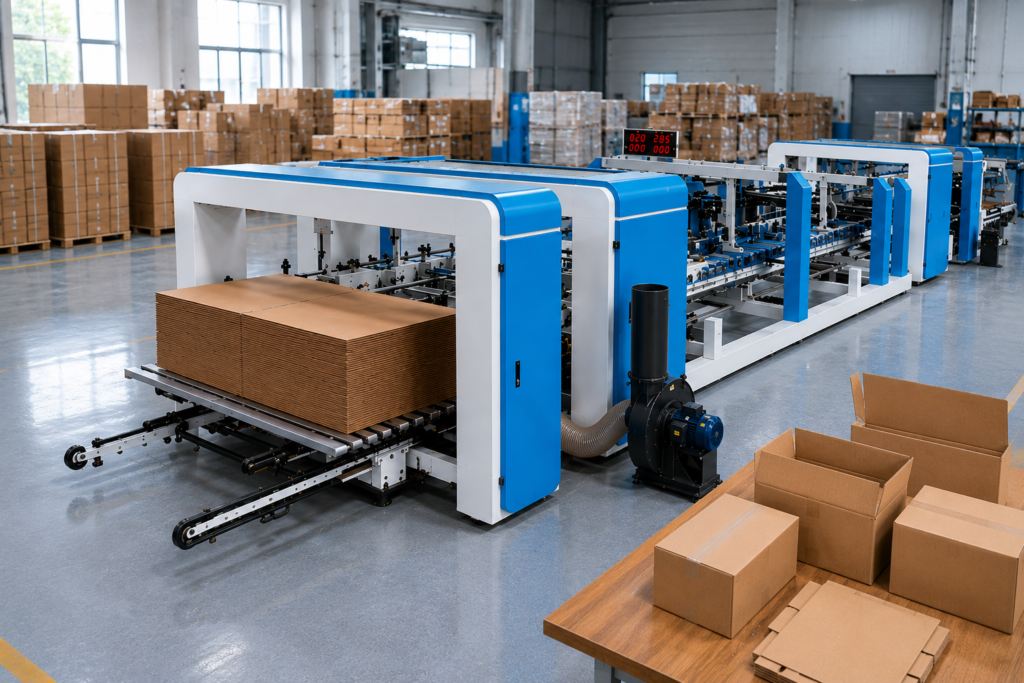
On Guangzhou Smart Machinery’s Eco 1224/1230 platform — the base architecture behind the eco automatic folder gluer and stitcher machine — customization starts with the control system. Buyers can specify Delta, Siemens, or Mitsubishi PLC hardware rather than accepting whatever the factory has on the shelf, and that choice is documented in the order rather than left as a verbal promise.
Glue application is a second real customization point, not a cosmetic one. The base platform runs water-based cold glue or hot-melt adhesive through high-precision nozzles, and which system ships depends on the buyer’s board stock and climate, since hot-melt sets faster in humid, high-throughput environments where cold glue struggles to cure fast enough.
For buyers producing UV-coated or laminated cartons, a plasma surface treater module is available as an add-on, conditioning the coated surface so adhesive bonds to it instead of beading off — a detail that matters more for premium retail and cosmetics packaging than standard shipping cartons. An oem folder gluer machine supplier worth vetting documents this module list, and private-label branding on the finished machine, directly in the sales contract rather than handling them as informal add-ons after the deposit clears.
Verified Machine Data Behind the OEM Spec Sheet: Speed, Correction, and Stitching Range
The base Eco 1224/1230 platform runs continuous production up to 180 m/min / 591 FPM, with secondary correction technology that actively re-squares the blank mid-pass to eliminate “fishtailing” — the geometric skew that jams automated case packers downstream at a distribution center. Integrated stitching covers an adjustable range of 30–120 mm / 1.18–4.72 in, letting one machine handle lightweight cartons and heavy-duty transit boxes without a hardware swap.
Starch consumption is engineered down to under 18 kg per metric ton of board (≈40 lb/ton), against an industry average above 22 kg/t (≈48 lb/ton) — a running cost line that compounds over a multi-year contract far more than the purchase price does. Guangzhou Smart Machinery’s servo-driven folder-gluer platforms, including this one, are built to the same ±0.5 mm (±0.02 in) fold-registration class used across the company’s product line.
Request a Factory FAT (Factory Acceptance Test) Protocol Sheet confirming registration tolerance and starch-consumption data for your specific PLC and glue-system configuration before signing.
Component Traceability: Why Servo Drives, Bearings, and Motors Decide Real Lifespan
A folder-gluer’s frame will outlast the business relationship that sold it. What actually fails first — and what determines whether repairs take days or months — is the servo drive, the linear bearing, and the motor, none of which show up on a spec sheet’s headline speed number.
Guangzhou Smart Machinery’s standard component menu draws from Delta, NSK, HIWIN, Schneider, and Omron — internationally distributed brands with parts networks outside China, rather than proprietary house-brand electronics that vanish the moment a subcontractor changes suppliers. Ask any OEM folder gluer machine supplier to name the actual brand behind each subsystem in writing; “premium imported components” without a brand name attached is not traceability.
A proprietary or unbranded servo amplifier failing at year eight or ten of a 15-to-20-year service life can idle a finishing line for weeks while a buyer searches for a compatible replacement. Internationally distributed component brands cut that exposure to days, because the part number exists in a global distribution network instead of one factory’s back room.
Spare-Parts Supply Chain and the True 15-to-20-Year TCO
Purchase price is the smallest line item in a folder-gluer’s total cost of ownership over a 15-to-20-year service life. Starch consumption, changeover downtime, and spare-parts lead time compound every month the machine runs, while the purchase price is a single entry on one invoice.
A trading company selling a relabeled machine typically cannot quote a spare-parts lead time at all, because it doesn’t control the factory’s production schedule or inventory. A direct-factory OEM supplier can name a lead time for each wear component in the build — fold belts, glue nozzles, stitching heads — because it manufactures and stocks them.
Run the comparison against your own volume before signing. A machine priced 10% lower on the invoice but running four percentage points of starch consumption above the 18 kg/t benchmark erases that discount within the first year of continuous operation on a mid-volume line.
Vetting an OEM Folder Gluer Machine Supplier: The Closing Checklist
Return to the three benchmarks this audit opened with — a documented component-substitution list, direct factory FAT access, and named spare-parts lead time — and require all three in writing before a deposit changes hands.
A practical due-diligence checklist before you sign:
- Request PLC brand options in writing (Delta/Siemens/Mitsubishi or equivalent) rather than accepting “customizable” as a standalone answer
- Confirm whether the glue system, finishing modules (such as a plasma surface treater), and stitching range are documented in the contract or left informal
- Ask for named component brands behind the servo drive, bearings, and motors, not just “imported parts”
- Verify spare-parts lead time per component, in writing, for your specific configuration
- Confirm the factory will run a Factory Acceptance Test on your exact build before shipment, not a generic demo unit
Guangzhou Smart Machinery’s Eco Automatic Folder Gluer and Stitcher Machine is the direct-factory platform this audit was built around — the oem folder gluer machine supplier relationship it supports runs 180 m/min / 591 FPM, 30–120 mm / 1.18–4.72 in adjustable stitching, and starch consumption under 18 kg/t (≈40 lb/ton), with PLC brand, glue system, and finishing modules documented per build.
Frequently Asked Questions
Q: What does “OEM” actually guarantee when sourcing a folder gluer machine? A: Documented component substitution (PLC brand, glue system, finishing modules), direct factory FAT access on your exact configuration, and a named spare-parts lead time in writing — not just a factory willing to put a private label on a standard unit.
Q: Which PLC brands can be specified on an OEM folder gluer build? A: On Guangzhou Smart Machinery’s Eco 1224/1230 platform, buyers can specify Delta, Siemens, or Mitsubishi PLC hardware, documented in the order rather than left to whatever the factory has in stock.
Q: How much does starch consumption actually matter over the life of the machine? A: Engineered starch consumption under 18 kg/t (≈40 lb/ton) versus an industry average above 22 kg/t (≈48 lb/ton) compounds every production day — a running cost line that typically outweighs the purchase-price difference between suppliers within the first year or two of continuous operation.
Q: What should I request before signing an OEM purchase order? A: A Factory FAT Protocol Sheet confirming fold-registration tolerance and starch data for your exact configuration, named component brands for the servo drive, bearings, and motors, and a written spare-parts lead time per component.
Ready to Specify Your OEM Folder Gluer Build?
A “customizable” claim on a spec sheet is not a contract. Request a Factory FAT Protocol Sheet confirming your PLC brand, glue system, and finishing-module selection in writing before you commit capital.
For plants ready to move on pricing and lead times, inquire for Direct-Factory Wholesale B2B Pricing & Lead Times and speak directly with Guangzhou Smart Machinery’s engineering team about your PLC preference, board mix, and target production volume.