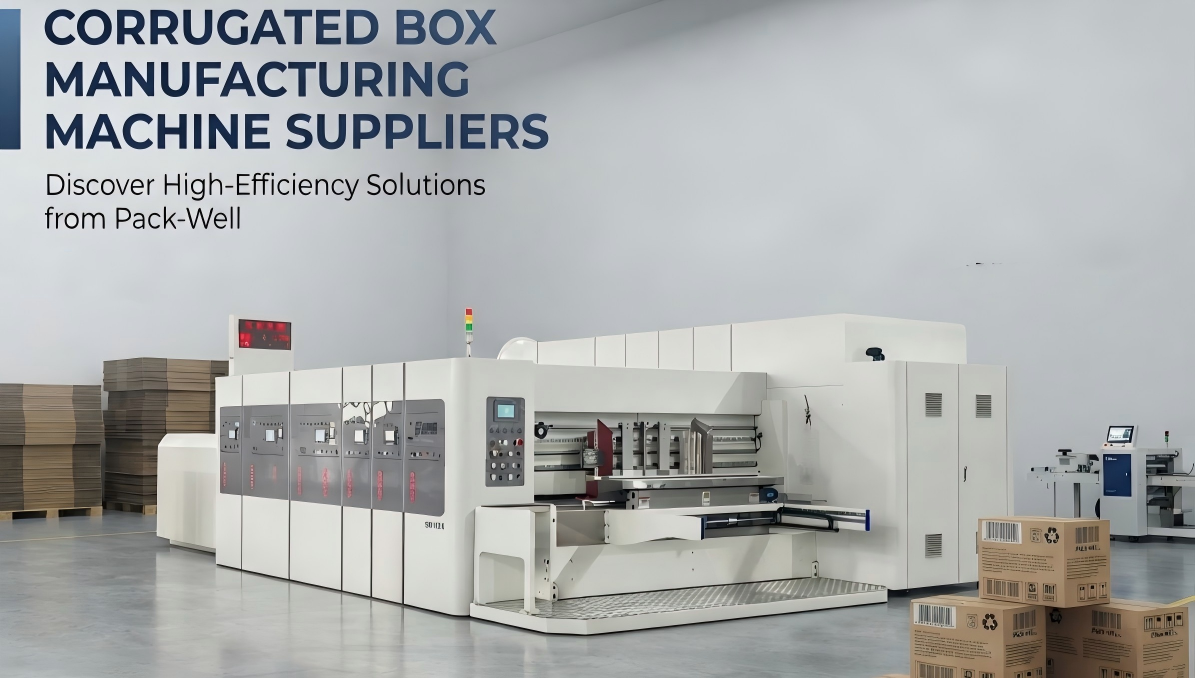
When sourcing corrugated box manufacturing machine suppliers, procurement teams should filter on three non-negotiable engineering benchmarks before a quote request goes out. First, rigid wall-plate metallurgy — stress-relieved, ribbed steel frames that resist deflection under sustained running loads. Second, closed-loop motion control protocol — dual or multi-axis servo synchronization, not a mechanical line-shaft. Third, internationally standardized component assembly — servo drives, bearings, and PLC hardware sourced from recognized global brands rather than unspecified substitutes. A supplier that cannot document these three items on a factory acceptance test (FAT) sheet is an assembler, not a manufacturer.
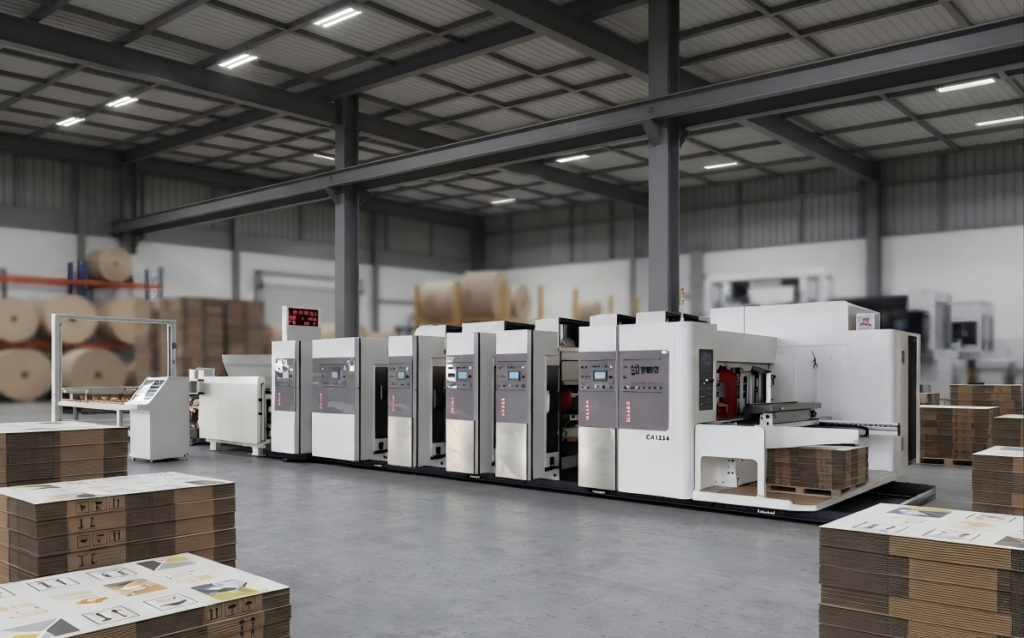
https://gzsmartmachinery.com/product/corrugated-box-printing-machine/
Reframing the Search: A “Supplier” Query Is an OEM Partnership Audit
Most searches for a machine supplier get answered with a features list. That misses the actual procurement question: who is accountable when a servo drive fails at 2 a.m. on a Tuesday shift.
A tier-1 OEM factory carries its own design IP, machines its own wall plates, and stocks its own spare parts. A trading company resells someone else’s iron with a markup and a shrug.
The distinction matters most on secondary and tertiary converting lines — folder-gluers, printer-slotters, and rotary die-cutters — where ±0.1 mm of frame drift compounds into scrap rate within a single production shift.
Two buyer profiles drive this search differently, and both are common among current inquiries. A semi-integrated corrugator plant is vetting a printer-slotter to slot into an existing single-facer line at a fixed board speed. A sheet plant buying pre-converted board from a corrugator is vetting the same station as a standalone finishing cell running its own independent feed timing. The three engineering benchmarks apply to both buyer types, but the FAT protocol should be run against the buyer’s actual board spec and job mix — not a generic demo sheet the supplier keeps on hand for showroom visits.
Tier Classification Matrix: Servo Logic, Wall-Plate Metallurgy, and Software Stack
| Engineering Criterion | Tier-1 OEM Factory | Tier-2 Regional Assembler | Tier-3 Trading Reseller |
|---|---|---|---|
| Motion control logic | Multi-axis closed-loop servo synchronization | Single-servo assist on a mechanical line-shaft | Cam-driven, no closed-loop feedback |
| Wall-plate construction | Ribbed, stress-relieved welded steel | Standard flat-plate steel, no stress-relief cycle | Thin-gauge fabricated frame |
| Registration accuracy | ±0.35 mm / ±0.014 in | ±0.5–0.8 mm / ±0.020–0.031 in | ±1.0 mm+ / ±0.039 in+ |
| PLC / software stack | Integrated PLC + HMI + IIoT remote diagnostics | PLC present, no remote telemetry | Relay-based control, no PLC |
| Spare parts lead time | Direct factory stock, 48–72 hr dispatch | 1–3 week reseller sourcing | Broker-dependent, unverified |
| Standard components | International-brand servos and bearings | Mixed domestic/international sourcing | Non-standard, unspecified origin |
A machine that scores Tier-1 on every row is rare. Most quotations land somewhere in the middle — which is exactly why the FAT protocol sheet exists as a verification tool, not a formality.
Motion Control Synchronization: Why Closed-Loop Servo Beats a Mechanical Line-Shaft
A mechanical line-shaft ties every station’s timing to a single physical shaft. Wear in one bearing propagates phase error to every downstream unit, and that error is cumulative across a shift.
Dual-servo synchronization decouples each station onto its own closed-loop axis, cross-referenced through the PLC in real time. On a modern printer-slotter, this is what a motorized phase adjustment system with automatic zero-return and memory functions delivers — the line resumes a stopped job at 100% registration accuracy instead of re-threading manually.
Linear velocity compensation technology is the detail most competitor content skips entirely. It keeps die-cutting and printing aligned as mechanical wear accumulates over the machine’s service life, rather than only at commissioning.
A production line running 300+ sheets per minute across 3-ply, 5-ply, and 7-ply board (roughly 3 mm / 0.118 in single-wall up to 15 mm / 0.591 in triple-wall) needs that real-time correction — a fixed-timing system cannot hold ±0.35 mm / ±0.014 in registration at that throughput once flute crush and roller wear enter the equation.
Buyers evaluating this stage of the line should Request a Factory FAT (Factory Acceptance Test) Protocol Sheet before wiring a deposit — it is the only document that shows registration accuracy tested under load, not on a spec sheet.
Wear-Part Metallurgy: The Consumables That Actually Drive Total Cost of Ownership
Sales literature quotes machine speed. Plant managers get billed on consumables — and that’s where supplier quality actually shows up over 24 months of operation.
- Anilox rollers: laser-engraved ceramic surfaces hold cell volume and ink transfer consistency far longer than chrome-plated alternatives under continuous multi-shift use.
- Feed-section friction components: tungsten carbide coatings on high-wear contact surfaces resist the abrasive dust generated by recycled-fiber board, which is now the dominant furnish in most regions.
- Die-cutting pads: imported polyurethane rubber pads hold crease geometry across millions of cycles without the “memory loss” that causes liner cracking on cheaper compounds.
- Glue application: high-frequency electronic glue valves deliver consistent bead width at speed, versus mechanical wheel-glue systems that drift as the wheel wears unevenly.
A wall-plate frame ballasted in the 4–6 t / 8,800–13,200 lb range is standard across tier-1 converting lines of this class — mass that damps vibration at speed instead of transmitting it into the registration system.
None of these line items appear on a headline price quote. All of them appear on a year-two maintenance invoice.
Total Cost of Ownership: CAPEX vs. Five-Year Operating Cost
A quotation comparison built on sticker price alone is comparing the wrong unit. Total cost of ownership (TCO) is the correct model, and it separates into three ledger lines that a spec sheet never shows.
Energy draw is the first line. A servo-synchronized line applies torque only where each axis actually needs it; a continuous mechanical line-shaft runs every station at rated torque regardless of that station’s real load, which widens the efficiency gap on shorter, high-mix production runs typical of e-commerce packaging.
Changeover downtime is the second line. Motorized digital phase and position input completes a job reset in a fraction of the time a manual mechanical reset requires — across a full production year on a plant running frequent short orders, that reclaimed shift time is not a marginal figure.
Scrap rate from registration drift is the third and most expensive line. A printed carton that drifts past roughly ±0.5 mm / ±0.020 in commonly triggers a reject at a retail brand’s incoming QC gate. A Tier-1 machine holding ±0.35 mm / ±0.014 in carries margin against that threshold; a Tier-3 machine already running near the reject line at commissioning has none left once wear accumulates.
Run the math before comparing quotes: a landed price 15% higher on a documented Tier-1 build is routinely offset inside 12–18 months once scrap rate and unplanned downtime are priced against it — but only for plants actually running the short-run, high-mix order profile this class of machine is built for. Standard industry payment terms — typically a 30% deposit with balance due against FAT sign-off — exist specifically so the buyer isn’t paying the full invoice before that test data exists.
Spare Parts Logistics and After-Sales Telemetry: Vetting for Five-Year Uptime
A machine’s first breakdown reveals what the supplier relationship actually is. Direct-factory sourcing eliminates the intermediary trading markup and, more importantly, eliminates the intermediary in the support chain — the entity you’re calling at 2 a.m. is the entity that built the servo drive.
IIoT remote diagnostics on tier-1 lines let a factory engineer read fault codes and drive parameters before a technician is even dispatched, cutting diagnosis time from hours to minutes. Tier-2 and Tier-3 suppliers typically route a support ticket through a reseller who then contacts the actual OEM — adding a full business day before anyone with schematic access is even looped in.
Before signing, procurement directors should Inquire for Direct-Factory Wholesale B2B Pricing & Lead Times on both the machine and its year-one consumables package. A quote without a stocked spare-parts list attached is a quote from a reseller, regardless of what the cover letter says.
Export readiness is a separate line item that buyers in North America, Europe, Southeast Asia, and the Middle East should confirm before shipment, not after. A tier-1 factory pre-configures the electrical cabinet for the destination’s actual supply — 60 Hz / 480V or 208–230V for most North American plants versus 50 Hz / 380–415V across Europe, Southeast Asia, and the Middle East — and provides CE documentation for EU import and UL/NEC-aligned panel wiring for US and Canadian plants. Confirming this on the FAT protocol sheet avoids a container arriving with a control cabinet built for the wrong grid.
The final differentiator among corrugated box manufacturing machine suppliers is whether the corrugated box manufacturing machine suppliers on the quote sheet ships with a documented FAT protocol, a stocked spare-parts commitment, and telemetry access from day one — or whether those three items get promised verbally and never appear in writing.
FAQ: Corrugated Box Manufacturing Machine Suppliers
What separates a Tier-1 factory from a trading company on paper?
A Tier-1 factory documents servo synchronization architecture, wall-plate metallurgy, and component sourcing on a FAT protocol sheet. A trading company typically supplies only a features brochure with no verifiable test data.
What registration accuracy should a modern printer-slotter achieve?
Tier-1 lines commonly hold ±0.35 mm / ±0.014 in under production load, verified through automatic zero-return and linear velocity compensation systems rather than static commissioning tests alone.
How fast should spare parts ship from a direct-factory supplier?
Direct-factory stock typically dispatches in 48–72 hours. Reseller-sourced parts routinely take one to three weeks, since the reseller itself has to place a request with the actual manufacturer first.
Can one machine really run 3-ply, 5-ply, and 7-ply board without retooling?
Yes, on lines engineered with adjustable lead-edge feeding and motorized phase control — the feeder and creasing sections adjust digitally rather than requiring mechanical part swaps between board calipers.
What does a Factory Acceptance Test (FAT) actually verify?
A FAT verifies registration accuracy, servo synchronization, and speed performance under load, on the actual machine being shipped — not on a demo unit or a spec sheet projection.
Does the electrical configuration change by export region?
Yes. North American plants typically require a 60 Hz / 480V or 208–230V cabinet configuration, while Europe, Southeast Asia, and the Middle East run on 50 Hz / 380–415V — this should be confirmed and documented before the machine ships, not on arrival.
Ready to move past brochure specs?
Request a Factory FAT (Factory Acceptance Test) Protocol Sheet to see registration accuracy and servo synchronization data tested under real production load before you commit CAPEX. Or Inquire for Direct-Factory Wholesale B2B Pricing & Lead Times to compare a stocked, direct-factory quote against whatever a reseller has been sitting on. Guangzhou Smart Machinery engineers, machines, and stocks parts for its own lines — the accountability doesn’t route through a middleman.