Confirming a folder gluer machine manufacturer is a real factory, not a trading company relabeling someone else’s equipment, takes about four data points — and most listings supply none of them. First, request registered business documentation tied to an actual production address, not just a sales office. Second, ask who wrote the PLC logic: an in-house engineering team, or a subcontracted integrator with no long-term accountability for the code.
Third, demand Factory Acceptance Test (FAT) records showing per-unit tolerance data, not a single marketing spec sheet reused across every listing. A manufacturer that hesitates on any of these three points is a reseller wearing a manufacturer’s label, and that distinction determines your warranty recourse for the next fifteen years.
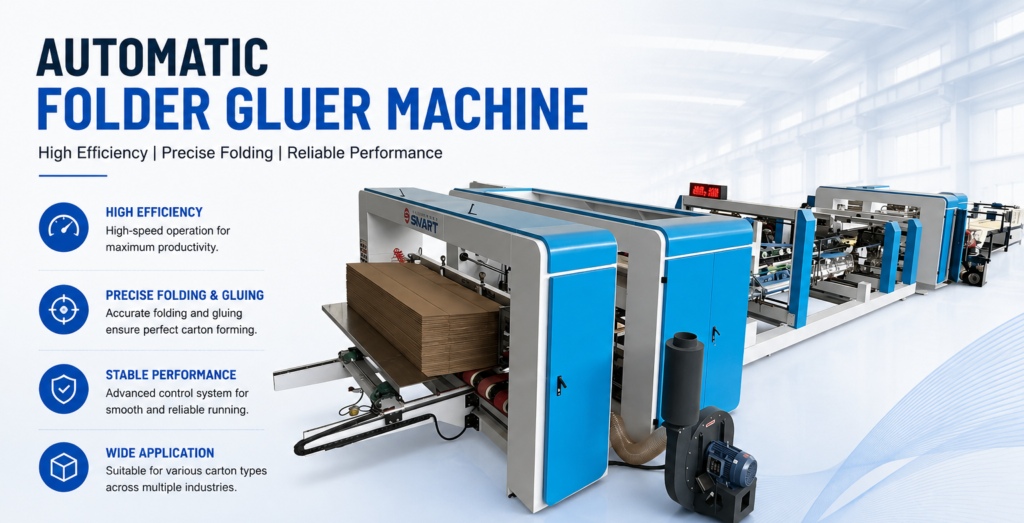
https://gzsmartmachinery.com/product/eco-automatic-folder-gluer-and-stitcher-machine/
Verifying a Folder Gluer Machine Manufacturer: The Audit Matrix
Anyone can put “manufacturer” in a domain name; proving it requires documentation a reseller cannot produce. Sourcing a genuine folder gluer machine manufacturer rather than an intermediary changes your warranty terms, your customization ceiling, and how fast a replacement part reaches your dock. The matrix below lines up the verification criteria that separate the three tiers procurement teams actually encounter.
| Verification Criterion | Unverified Trading Company | Small Assembly Workshop | Guangzhou Smart Machinery (Verified Manufacturer) |
|---|---|---|---|
| Business Registration | Sales entity only, no factory address on file | Registered, but shared/rented assembly space | Registered manufacturer, dedicated Panyu, Guangzhou facility |
| Engineering / R&D Team | None — relays specs from an unnamed third-party factory | 1–2 technicians, no formal PLC programming staff | In-house engineering team, custom PLC logic per order |
| QC / FAT Documentation | Not available; specs copied from a catalog PDF | Informal, undocumented visual check | Per-unit FAT protocol, ±0.5 mm (±0.02 in) tolerance verified pre-ship |
| Export & Compliance Record | Unverifiable shipping history | Domestic sales only, no export documentation | CE-documented, multi-region container export experience |
| After-Sales / Spare Parts | Routed through original factory, delayed | No stocked inventory | Factory-direct stock, no reseller markup |
| Customization (OEM/ODM) | Not authorized to alter specs | Ad hoc, no engineering sign-off | OEM/ODM: PLC brand, stitching range, glue system |
Inside the Factory: What a Genuine Manufacturer’s Engineering Team Builds
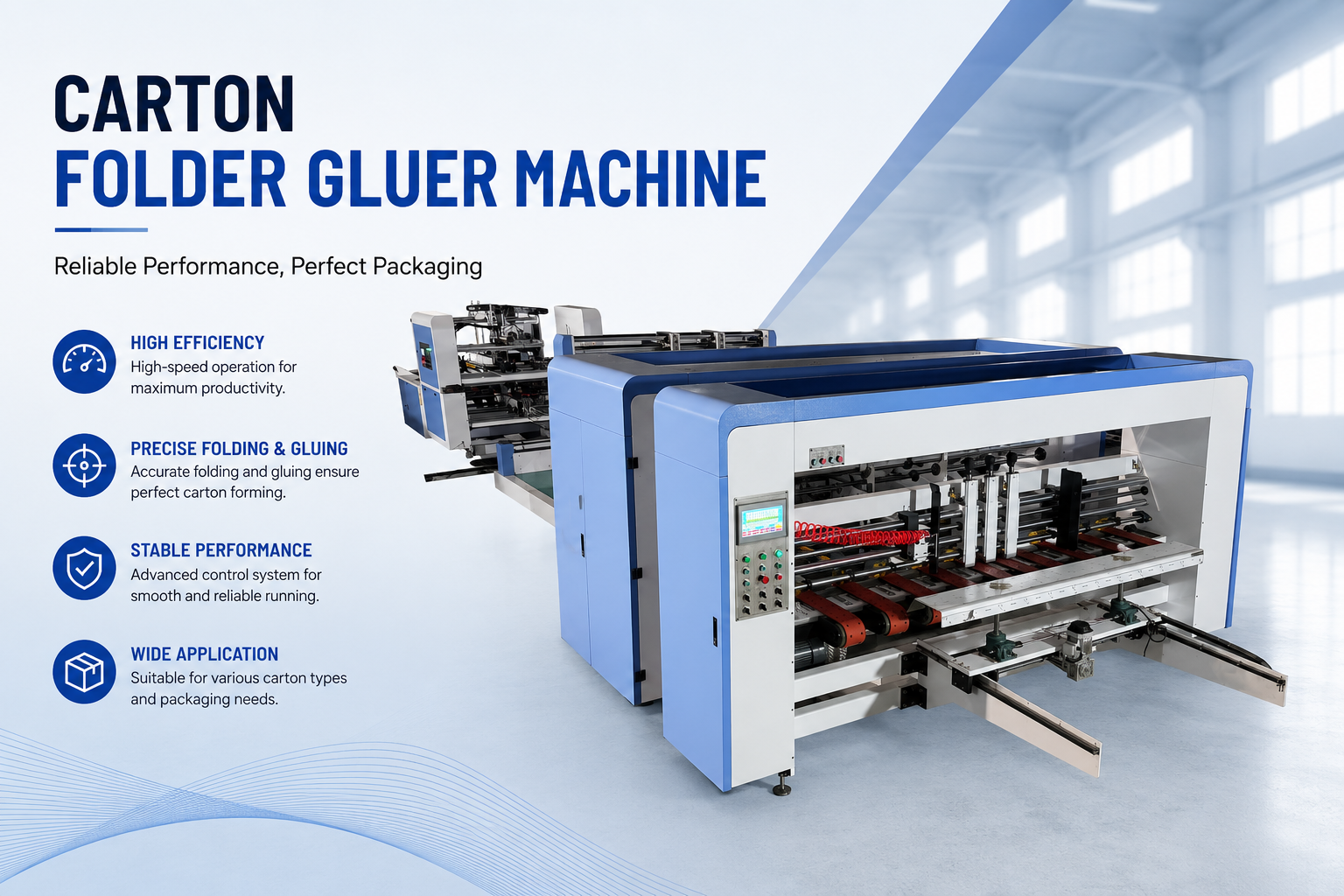
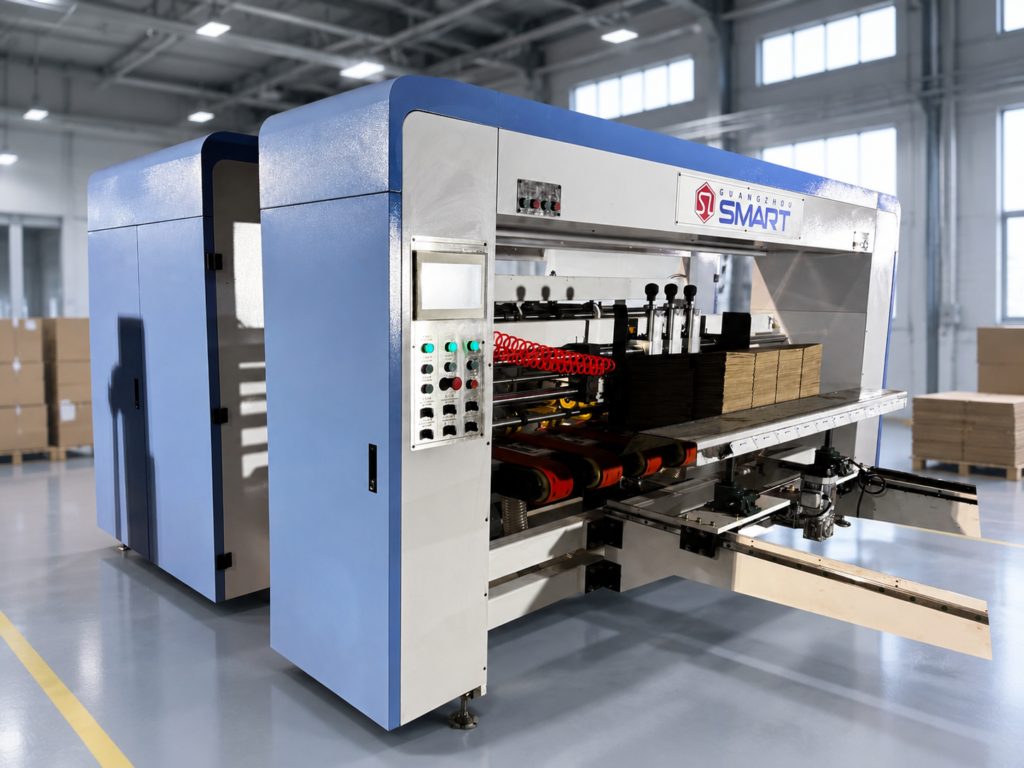
The clearest proof of manufacturing capability isn’t a claim — it’s the mechanism detail a real engineering team can explain station by station. On the Eco Automatic Folder Gluer and Stitcher Machine (1224 and 1230 series), the Precision Feeder Unit uses a high-accuracy vacuum suction system to pull carton blanks one at a time into alignment, a design choice that prevents double-feeds rather than just detecting them after a jam. An Advanced Pre-breaking module, offered as an add-on, “pre-breaks” crease lines ahead of the main fold specifically for complex or stiff cardboard that would otherwise spring back at the corner.
At the Intelligent Folding & Gluing stage, precisely positioned guides and hooks route the blank while high-precision nozzles apply either water-based cold glue or hot-melt adhesive — a dual-mode option that only makes sense if the engineering team designed the nozzle and glue-delivery system in-house, not bolted on a fixed third-party unit. Squaring accuracy comes from independent belt speed regulation: the PLC interface adjusts outer folding belts relative to inner belts in real time, holding a square fold at the machine’s full 180 m/min (590 FPM) rated speed rather than degrading at top speed the way fixed-ratio mechanical drives do.
The Integrated Stitching Section closes the line with adjustable stitching distances from 30 mm to 120 mm (1.18–4.72 in), and a final pressure, counting, and stacking stage seals and tallies finished cartons automatically. A trading company reselling a catalog machine cannot answer follow-up engineering questions about any of these five stations — a genuine manufacturer’s team can, because they wrote the control logic that runs them.
Quality Control: FAT Protocol and Per-Unit Tolerance Documentation
A specification sheet describes what a machine is designed to do; a Factory Acceptance Test record proves what your specific unit actually does before it ships. Legitimate manufacturers run each unit through a documented FAT protocol, verifying secondary correction technology holds squaring accuracy at ±0.5 mm (±0.02 in) under running load rather than on an idle bench, and logging that result against the serial number of the machine leaving the factory.
This documentation is what separates a manufacturer from an assembler: an assembly workshop bolting together purchased sub-components has no reason to test squaring tolerance per unit, because no single team is accountable for the finished machine’s performance. Request a Factory FAT (Factory Acceptance Test) Protocol Sheet for your specific model series before wiring a deposit — a genuine manufacturer produces this on request; a reseller cannot.
Material Science: Wear Components That Separate Manufacturers From Assemblers
A machine’s frame will run for a decade or more without incident; the wear components are what expose whether the builder engineered for a full service life or for passing a demo. Tungsten-carbide-coated feed friction plates at the infeed resist the abrasive wear of recycled-fiber dust far longer than untreated steel — a specification an assembler sourcing generic parts rarely controls for, because it isn’t visible on a spec sheet or in a showroom demo.
High-grip, anti-stretch folding belts hold consistent tension through the fold section; a belt that stretches under sustained heat and load is what quietly degrades squaring accuracy over months, not days. High-frequency electronic glue-spray valves fire precise adhesive beads in milliseconds at the folding-and-gluing stage, a component that requires in-house calibration expertise to tune correctly for both water-based cold glue and hot-melt adhesive — evidence of engineering depth a pure reseller has no reason to develop.
Export Track Record and After-Sales: What Happens After the Container Ships
A manufacturer’s real test isn’t the sale — it’s what happens when a part needs replacing two years and one ocean away. Guangzhou Smart Machinery ships direct from its Panyu, Guangzhou factory with CE-documented compliance for EU import and a spare-parts chain that skips the reseller markup and delay entirely, because the same facility that built the machine holds the parts inventory.
The Eco machine’s operating economics reinforce that this is engineering, not assembly: paired with an intelligent glue system, starch consumption drops from the industry average of over 22 kg/ton (48.5 lb/ton) of board processed to under 18 kg/ton (39.7 lb/ton) — a measurable, roughly 20% reduction in a recurring consumable that only a manufacturer controlling the glue-delivery engineering can credibly claim. The machine is also compatible with a zero-discharge circulating system, relevant for plants operating under tightening regional wastewater rules. Inquire for Direct-Factory Wholesale B2B Pricing & Lead Times and ask specifically for export references in your region before you commit.
Manufacturer Vetting Checklist Before You Sign
Return to the three benchmarks that opened this audit — registered factory address, an in-house engineering team accountable for the PLC logic, and documented per-unit FAT tolerance data — and require evidence for each rather than a brochure claim. A supplier who can’t produce any of the three is a relabeled reseller, whatever the domain name says.
A practical due-diligence checklist before signing with any folder gluer machine manufacturer:
- Request registered business documentation tied to an actual factory address, not a sales office
- Ask who wrote the PLC control logic — an in-house team, or an unnamed third-party integrator
- Require a Factory FAT Protocol Sheet with per-unit squaring tolerance data, not a generic spec PDF
- Verify wear-component specification: friction-plate coating, folding-belt material, glue-valve type
- Confirm export references, CE documentation, and spare-parts lead time in writing before signing
Guangzhou Smart Machinery’s Eco Automatic Folder Gluer and Stitcher Machine — engineered, tested, and shipped from its own Panyu, Guangzhou facility — is the output of the kind of folder gluer machine manufacturer this audit was built to identify: an in-house engineering team, documented FAT tolerance data, and a spare-parts chain that doesn’t route through a third party.
Frequently Asked Questions
Q: How do I confirm a supplier is an actual manufacturer and not a trading company? A: Request registered business documentation tied to a specific factory address, ask who wrote the machine’s PLC control logic, and require a Factory FAT Protocol Sheet with per-unit tolerance data. A trading company can supply none of these three consistently.
Q: What does a Factory Acceptance Test protocol actually verify? A: It documents your specific unit’s squaring accuracy — for this machine, secondary correction technology holding ±0.5 mm (±0.02 in) — measured under running load and logged against the unit’s serial number before it ships, not a generic catalog specification.
Q: Does an OEM/ODM manufacturer let me customize the PLC brand or glue system? A: Yes, when the manufacturer has an in-house engineering team. Buyers can typically specify PLC brand, stitching-range configuration within 30–120 mm (1.18–4.72 in), and cold-glue versus hot-melt nozzle setup — options unavailable once a machine has already left the factory through a reseller.
Q: Why does the wear-component specification matter more than the frame construction? A: The frame will outlast the machine’s useful economic life; friction-plate coating, folding-belt material, and glue-valve type are what actually fail first and determine real service intervals, so a manufacturer’s control over these specifically indicates engineering depth beyond assembly.
Q: What should I request before signing with a folder gluer machine manufacturer? A: Registered factory documentation, confirmation of the in-house engineering team, a Factory FAT Protocol Sheet with per-unit tolerance data, wear-component specifications, and export references with CE documentation for your region.
Ready to Verify Your Manufacturer?
A domain name claiming “manufacturer” proves nothing on its own — a registered factory address, an in-house engineering team, and documented per-unit FAT tolerance data are what actually separate a builder from a reseller. Request a Factory FAT Protocol Sheet for the 1224 or 1230 series configuration before you commit capital.
For plants ready to move forward, inquire for Direct-Factory Wholesale B2B Pricing & Lead Times and ask Guangzhou Smart Machinery’s engineering team directly for export references and FAT documentation in your region.