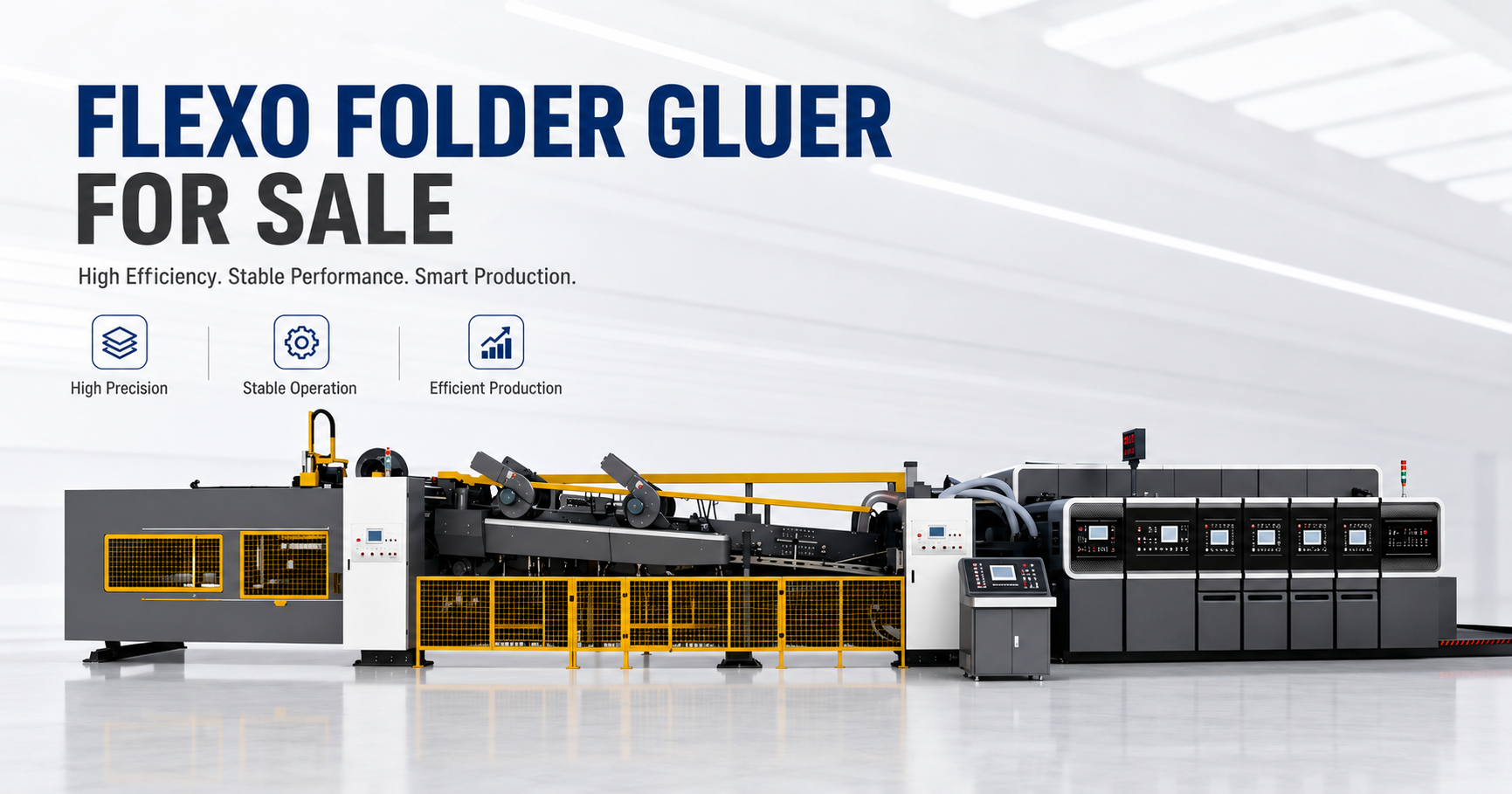
A tier-1 flexo folder gluer for sale clears three checkpoints before price ever enters the conversation. First, the machine holds its rated fold and slot tolerances at production speed, not just at idle — ask for the topping, feeding, and slotter accuracy figures in writing, not a single generic “high precision” claim. Second, the registration system runs on computerized phase adjustment referenced through a PLC-touchscreen interface, so print, slot, and fold recall the same job setting instead of relying on an operator’s manual re-guess. Third, the wear components — die-cutting pads, folding belts, drive gears — are named and documented, not glossed over as “durable” with no material spec behind the word.
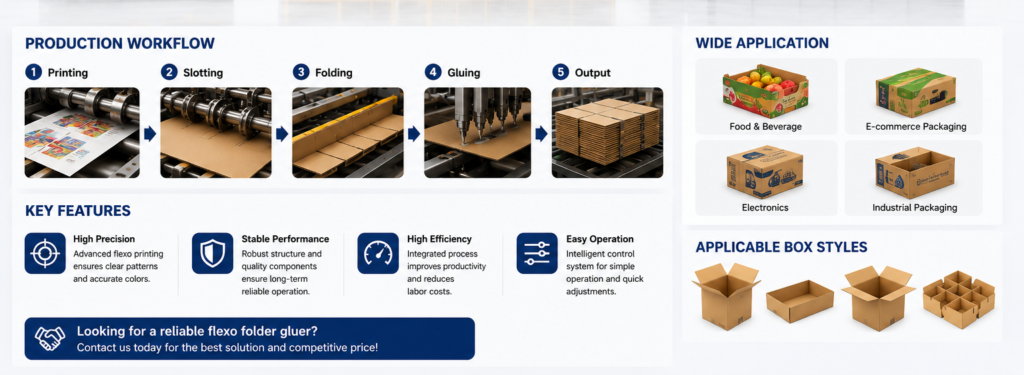
https://gzsmartmachinery.com/product/flexo-folder-gluer-inline-printing-machine/
Verified Specification: Flexo Folder Gluer Inline Printing Machine
This is the published spec range across the model series (920 through 1632), not an industry-average estimate.
| Spec | Compact model (920) | Full-width model (1632) |
|---|---|---|
| Rated speed | up to 260 pcs/min | up to 120 pcs/min |
| Suitable board thickness | 2–10 mm / 0.08–0.39 in | 2–11 mm / 0.08–0.43 in |
| Feeding accuracy | ±1 mm / ±0.04 in | ±1 mm / ±0.04 in |
| Topping (fold) accuracy | ±0.5 mm / ±0.02 in | ±0.5 mm / ±0.02 in |
| Slotter accuracy | ±1.5 mm / ±0.06 in | ±1.5 mm / ±0.06 in |
| Die-cutter accuracy | ±1 mm / ±0.04 in | ±1 mm / ±0.04 in |
| Standard printing plate thickness | 7.2 mm / 0.28 in | 7.2 mm / 0.28 in |
| Die-cutter knife height | 25.4 mm / 1.0 in | 25.4 mm / 1.0 in |
Speed drops as board format grows across the nine-model line, which is normal: a larger feeding and folding section carries more mechanical travel per cycle. Match the model number to your actual order-size mix before comparing speed claims against a competitor’s headline number.
Supplier Engineering Tier Framework
| Engineering Criterion | Entry-Level / Regional Builds | Mid-Tier OEM | This Line (Verified) |
|---|---|---|---|
| Topping/fold accuracy | Often ±2 mm or looser under load | ±1–1.5 mm, inconsistent shift-to-shift | ±0.5 mm / ±0.02 in, all 9 models |
| Registration control | Independent motors, mechanical linkage | Single-axis servo on lead station only | Computerized phase adjustment + PLC recipe recall |
| Board thickness range | Narrow, single-flute only | 2–8 mm typical | 2–11 mm / 0.08–0.43 in |
| Die-cutting wear component | Steel anvil, no compensation | Rubber pad, fixed setting | Imported polyurethane pad + linear velocity compensation |
| Changeover method | Manual hand-crank adjustment | Partial digital recall | PLC-touchscreen setting recall |
| Spare parts sourcing | Factory-only part numbers | Partial cross-reference | Confirm cross-reference list in writing before ordering |
Use this as a scoring sheet on your own RFQ, not a marketing chart. Any supplier who won’t put topping, feeding, and slotter accuracy in writing has already answered the vetting question.
Drive-Train Metallurgy: Why Gear Quality Decides Long-Run Noise and Wear
Fishtailing and drifting registration are rarely a belt problem first. They’re a drive-train problem. On this line, all drive gears are alloy steel, heat-treated and ground — a specification that directly targets two failure modes: gear noise climbing over years of duty cycles, and backlash creeping into the registration chain as tooth profiles wear unevenly.
A factory that can’t confirm gear material and heat-treatment process in writing is asking you to trust marketing language instead of a metallurgy spec. Ask for the gear material certificate the same way you’d ask for the accuracy figures — it’s the input every downstream tolerance depends on.
Registration Control: Computerized Phase Adjustment and Recipe Recall
The print unit runs on touchscreen-controlled roller phase movement with a “zero line” memory function, so a repeat job recalls its prior registration setting instead of starting from a manual re-guess. The die-cutting station adds a speed-difference compensation mechanism, which offsets the gradual diameter loss on the rubber grinding knife as it wears, holding cut quality consistent between re-grinding cycles rather than letting cut cleanliness degrade silently.
That combination is what keeps ±0.5 mm / ±0.02 in topping accuracy and ±1 mm / ±0.04 in die-cutter accuracy stable across a production run, not just on the first sheet off the line. On a multi-color print job with tight slot-to-score alignment, that stability is the difference between a saleable case and scrap. Ask any supplier to name the specific compensation mechanisms in the quotation — a vague answer here predicts a vague answer on everything else.
Wear Component Specification: Die Pads, Folding Belts, and Glue Delivery
Three wear components decide whether a machine holds its rated output past the first year of duty. The die-cutting station uses imported polyurethane rubber pads paired with the velocity-compensation mechanism above, which is the documented reason cut quality holds up under continuous wear rather than degrading between service intervals. Vacuum-assisted folding belts keep the board seated against the fold rail through the cycle, which is the mechanical basis for avoiding fishtail on the folder-gluer unit.
The glue delivery system uses a large gluing wheel with reticulated (network-pattern) surface texture and motorized control of glue wheel position, which governs bead consistency across board weights more precisely than a fixed mechanical setting. Request a Factory FAT (Factory Acceptance Test) Protocol Sheet before ordering, and confirm the die pad material, folding belt spec, and glue wheel control method are documented line items in the quotation — not verbal assurances from a sales rep.
Spare Parts Sourcing and Component Transparency
A machine is only as available as its slowest spare part. Alloy-steel drive gears, motorized glue-wheel actuators, and PLC/HMI modules built on cross-referenceable industry part numbers can be sourced from a regional distributor without routing every failure back through one factory’s production queue.
- Drive gears: confirm the alloy grade and heat-treatment spec are documented, not house-numbered with no material trace
- PLC/HMI platform: confirm the brand and whether firmware/ladder logic documentation is available outside the OEM’s own service technician
- Die-cutting pads: confirm whether the polyurethane pad is a catalog part or a custom-molded piece with no cross-reference
- Glue system components: confirm the glue wheel and motorized actuator match a catalog number
Ask for a written cross-reference list before signing, not a verbal assurance that “parts are always available.”
Total Cost of Ownership: Matching Model Size to Real Order Volume
Landed price is the smallest number in this decision. The nine-model range (920 through 1632) exists because speed and board-format capacity trade against each other — the compact 920 model rates up to 260 pcs/min on smaller formats, while the full-width 1632 model rates up to 120 pcs/min to handle up to 1,540 × 3,350 mm continuous feeding. Buying a larger-format model than your order mix requires means paying for unused board-width capacity while running below the smaller model’s rated speed.
The PLC-touchscreen control is built specifically to shorten this decision’s downstream cost: the vendor documentation states operators can complete setting, revision, and execution functions “in seconds” through the recipe-recall interface, rather than through hand-crank re-adjustment. Confirm that claim directly against your own job-change frequency during the FAT, since a changeover-speed claim only matters if it holds on your actual product mix.
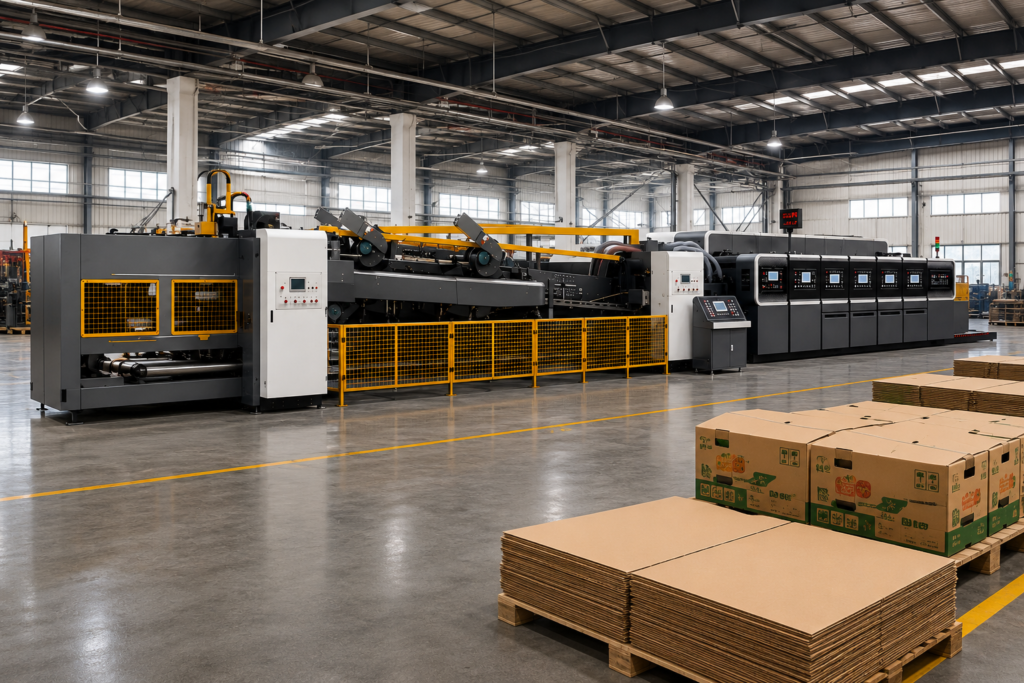
inquire for Direct-Factory Wholesale B2B Pricing & Lead Times
Vetting the Factory Directly: FAT Protocols and Line Integration
The fastest way to separate a trading-company quote from a factory quote is to request a live or recorded FAT (Factory Acceptance Test) run on your own board specification, verifying topping, feeding, slotter, and die-cutter accuracy on camera against the published figures — not a demo reel of a different job. A direct factory will also confirm gear material certificates and die-pad specification as part of the shipping documentation, not as a favor.
Ask, too, how the machine integrates with your existing corrugator or downstream stitcher and strapper, since a folder gluer bought in isolation from the rest of the line creates a new bottleneck instead of removing one. Inquire for Direct-Factory Wholesale B2B Pricing & Lead Times once the FAT protocol, gear material spec, and spare parts cross-reference list are in writing — not before. When every one of those documents matches the flexo folder gluer for sale spec sheet you were quoted against, you’re vetting a factory, not a listing.
FAQ
Which model in the line fits a mid-size sheet plant? Match board format to your actual order mix first: the compact 920 model rates up to 260 pcs/min on smaller feeding sizes, while the largest 1632 model rates up to 120 pcs/min but handles continuous feeding sizes up to 1,540 × 3,350 mm / 60.6 × 131.9 in.
What’s the real difference between a folder gluer and a flexo folder gluer? A standard folder gluer only slots, folds, and glues; a flexo folder gluer adds inline flexographic print stations ahead of the folding section, so branding and case-coding happen in a single pass instead of a separate printing step.
How should I confirm FAT duration and protocol before ordering? Ask the factory directly for the FAT protocol document and expected duration in writing, and request that topping, feeding, slotter, and die-cutter accuracy all be measured on camera against your own board specification rather than a standard demo run.
What lead time should I expect on a direct-factory order? Lead time varies by model and configuration — request it in writing as part of the quotation, tied to the specific model number and any custom printing-station or width requirements, rather than relying on a general industry estimate.
Which wear components should be audited before signing a purchase order? Confirm the die-cutting pad material and velocity-compensation mechanism, the folding belt specification, the glue wheel control method, and the drive gear alloy and heat-treatment certificate — these four items are documented on this line and worth requesting in writing from any competing quote.
Get Your Factory-Direct Quote
Stop comparing spec sheets and start comparing documentation. Request a Factory FAT (Factory Acceptance Test) Protocol Sheet to see topping, feeding, slotter, and die-cutter accuracy verified on camera against the published figures before you commit. Or inquire for Direct-Factory Wholesale B2B Pricing & Lead Times to get landed cost and shipping windows for your specific model, board specification, and print-station count in writing — direct from the factory floor that builds the machine.