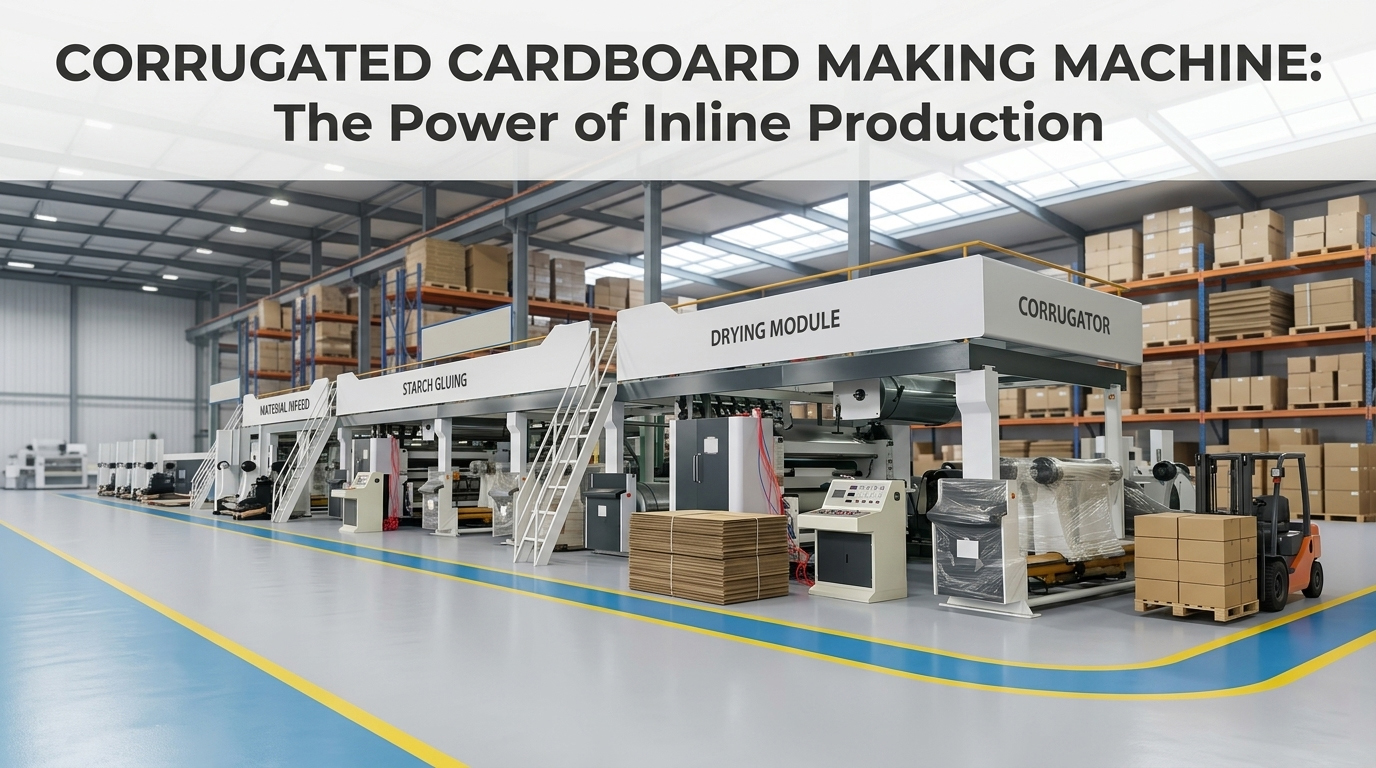
Most procurement briefs for a corrugated cardboard making machine open with a speed number. That number is the least useful figure on the spec sheet. Roller metallurgy, control-system synchronization, and cut-off tolerance under running load determine whether that speed number is real or a brochure ceiling the line never touches on a live production floor.
Three benchmarks separate a production-grade line from an assembly of steel and motors: corrugating roller wear coating (tungsten carbide-class metallurgy, not painted steel), a control architecture that synchronizes every station from single facer to stacker under one system rather than independent mechanical shafts, and cut-off accuracy verified at operating speed — not measured at a standstill. Confirm all three before a supplier quote goes any further.
A machine that fails any one of these checks recovers its shortfall through trim waste, unplanned stoppages, and rejected pallets — costs that exceed the purchase-price difference within the first year of three-shift operation
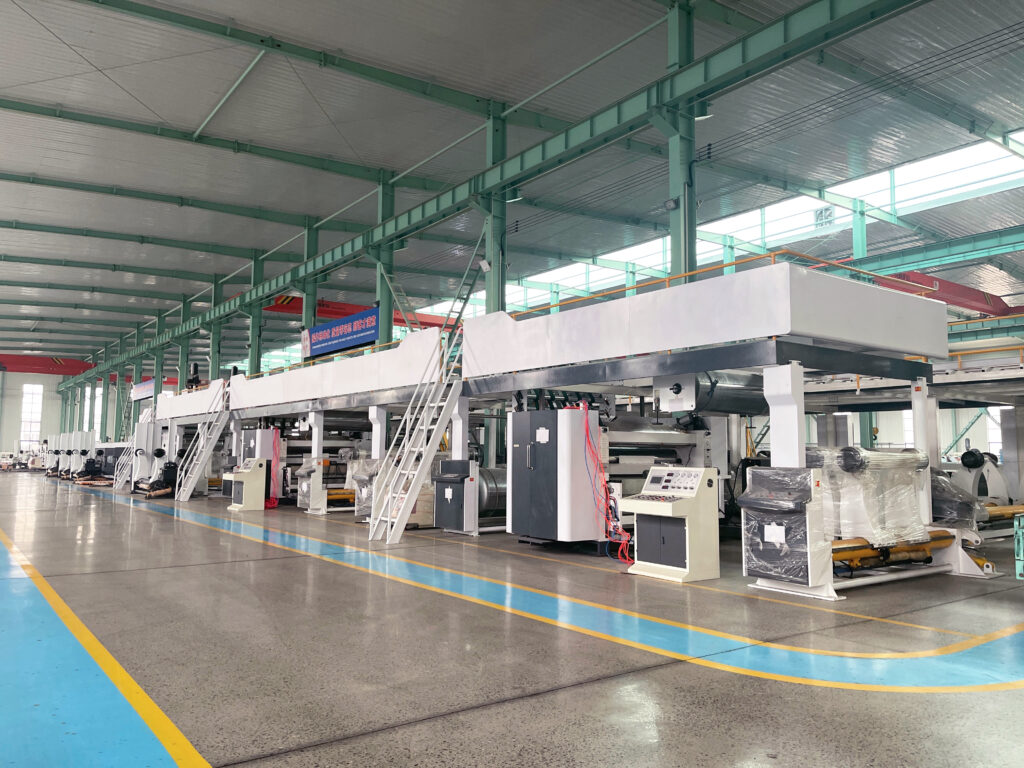
https://gzsmartmachinery.com/product/corrugated-cardboard-production-line/
Engineering Benchmark Comparison: Where a Corrugated Cardboard Making Machine Line Wins or Loses
Corrugator suppliers fall into three rough tiers. The table below compares them on the criteria that actually determine flute integrity, changeover speed, and long-run precision — not on marketing language.
| Engineering Criterion | Entry-Level / Standalone Corrugator | Semi-Integrated Line | Full Inline Servo System (GZ Smart Machinery) |
|---|---|---|---|
| Corrugating roller coating | Standard carbon steel — flute height drifts as coating wears | Hardened steel, mid-service coating | Tungsten carbide, supersonic-sprayed — flute height holds constant across service life |
| Line synchronization | Independent motors per section, manually coordinated | Centralized PLC, partial servo control | Central Monitoring Industrial PC — single facer through stacker synchronized as one system |
| Roller changeover | Full teardown, 60–120 min | Modular but bolted, 30–45 min | Quick-change drawer design — 10 min full roller swap |
| Ply configuration | Fixed 3-ply only | 3/5-ply with manual reconfiguration | Seamless 3/5/7-ply switching on one line |
| Glue film control | Fixed-rate applicator, drifts with speed changes | Single shared servo across layers | Independent servo-motor control per layer — uniform film regardless of speed |
| Cut-off accuracy | ±2–3 mm (±0.08–0.12 in), mechanical shear | ±1 mm (±0.04 in), semi-servo | ±0.5 mm (±0.02 in), AC servo-controlled helical knife |
| Working width range | Fixed single width | Limited range | 1800–3300 mm (70.9–129.9 in) |
A corrugated cardboard making machine that clears every row in the right-hand column is engineered as one synchronized system, not a chain of separately-sourced stations bolted together on the factory floor.
Roller Metallurgy and Flute Integrity: Why the Coating Determines the Machine’s Real Lifespan
The single facer’s corrugating rollers set the ceiling on board quality for the entire line’s service life — everything downstream inherits whatever flute geometry the rollers produce. Tungsten carbide corrugating rollers, applied through supersonic spraying, resist wear at a materially higher rate than untreated or plated steel.
This matters because flute height is not a fixed spec — it degrades as the roller surface wears. A roller that holds its geometry keeps flute height constant across its service life, which directly protects starch consumption, paper usage, and board quality consistency without requiring the operator to compensate manually as the tooling ages.
Roller changeover is the other lifespan variable buyers underweight. The quick-change drawer design completes a full roller swap in 10 minutes, which is the difference between a scheduled maintenance window and an unplanned multi-hour line stoppage during a production run.
Request a Factory FAT (Factory Acceptance Test) Protocol Sheet before ordering — it should specify the roller coating process, expected wear-service interval, and the verified changeover time under witnessed conditions, not a brochure estimate.
Synchronization Architecture: From Single Facer to Stacker Under One Control System
Mechanically-linked corrugators drive separate stations off shared shafts and belts, which means adjustments propagate with lag and drift accumulates the longer the line runs. A Central Monitoring Industrial PC synchronizing every station — single facer through stacker — removes that lag by coordinating the line as one networked servo-drive system rather than a set of independently-timed mechanical stages.
Glue application is where this architecture shows up most directly in board quality. Independent servo-motor controls for each layer keep the glue film uniform even as line speed changes mid-run, instead of the fixed-rate drift that produces soft edges or over-application on a standalone applicator.
The double-facer’s heating plates are PLC-controlled to apply precise, consistent pressure across 3-, 5-, and 7-ply configurations, preserving flute structural integrity through the bonding stage rather than crushing it under uneven plate pressure. Cutting precision closes the loop: a high-speed AC servo-controlled helical knife holds cut-off accuracy to ±0.5 mm (±0.02 in), which is the tolerance that determines whether downstream folder-gluers and printers can hit their own registration specs.
Trim waste compounds across a production run — a few tenths of a millimeter of unnecessary edge trim on every sheet adds up to real tonnage of wasted containerboard over a fiscal year, and containerboard is typically the largest single line item in a carton plant’s operating cost.
Ply Flexibility and Working Width: Matching the Line to Your Order Book
Order books rarely stay fixed at one board grade. A line locked to a single ply configuration forces a plant to either turn away orders outside its spec or run a second machine for flexibility it can’t otherwise achieve. This system switches between 3-ply, 5-ply, and 7-ply configurations on the same line, which keeps single-wall, double-wall, and triple-wall orders on one asset instead of splitting capacity across dedicated machines.
Working width runs from 1800 mm to 3300 mm (70.9 in to 129.9 in), and the line supports the full standard flute range — A, B, C, E, F, and BC/AAA — so board specification changes don’t require a different supplier relationship or a separate capital purchase.
Buyers sourcing for export markets should verify working width against their most common finished-box dimension, not their largest theoretical order, since a line oversized for typical run lengths adds unnecessary changeover time on every job below maximum width.
TCO Logic: Direct-Factory Sourcing vs. Distributor Margins
Total Cost of Ownership on a corrugator is decided more by who you buy from than by the spec sheet alone. Buying through a distributor layers on margin that contributes nothing to the machine’s engineering, and distributors typically lack direct access to the engineers who wrote the line’s control software — which matters the first time a parameter needs tuning for a specific paper grade or humidity condition.
Spare parts sourcing is the other half of this equation, and it’s where buyers get burned after the sale rather than before it. Guangzhou Smart Machinery maintains dedicated, catalog-listed spare parts lines — spiral knife series, slotting knife series, and tungsten steel knife series — stocked and shipped directly by the manufacturer rather than routed through a regional agent with its own markup and lead-time uncertainty.
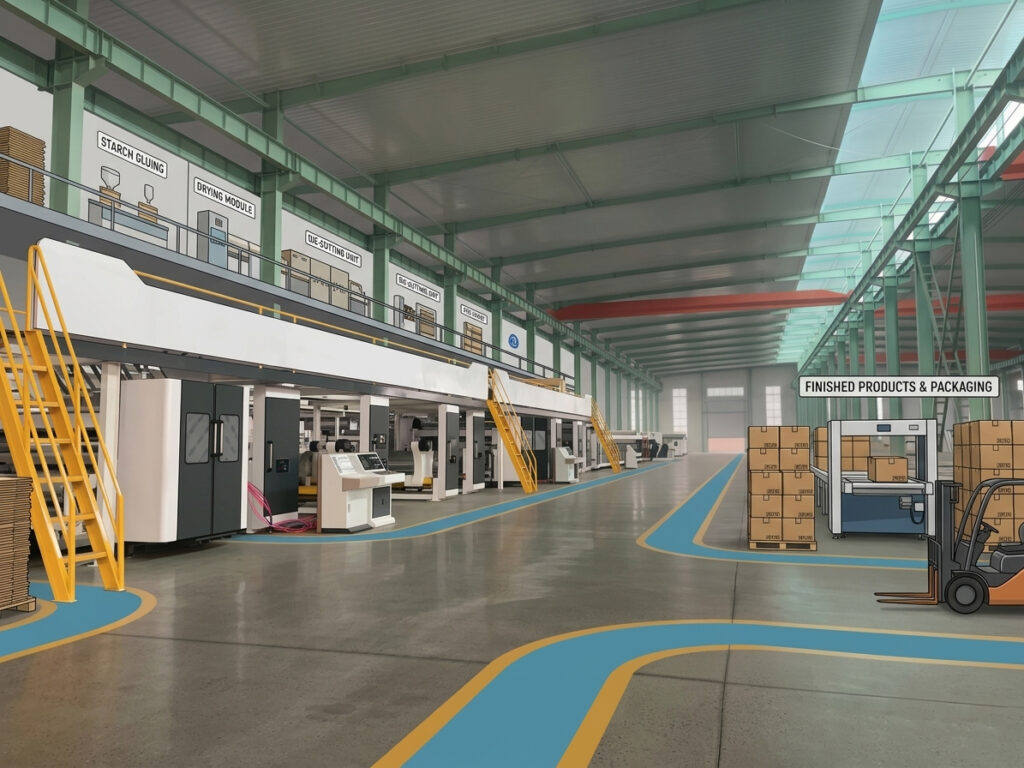
Inquire for Direct-Factory Wholesale B2B Pricing & Lead Times — a direct quote should itemize machine price, spare-parts pricing for the first 24 months of wear components, and confirmed shipping lead time, not a single bundled number.
Vetting Checklist Before You Commit Capital
Brochure specs and verified specs are not the same document. Before releasing capital for a corrugated cardboard making machine, confirm the following in writing:
- Roller coating process — tungsten carbide via supersonic spraying, with a stated wear-service interval, not a generic “hardened steel” claim
- Cut-off accuracy verified at running speed (target: ±0.5 mm / ±0.02 in), witnessed during FAT, not measured on an idle machine
- Roller changeover time confirmed under witnessed conditions (target: 10 minutes for a full swap)
- Working width and ply range matched against your actual order-book distribution, not your largest theoretical order
- Spare parts catalog and stocking location for slotting knives, spiral knives, and tungsten steel knives, with confirmed lead times in writing
CTO Technical FAQ
Q: What separates a full production-grade corrugator line from a basic wet-end machine? A: The full line covers mill roll stand, pre-heater, single facer, glue machine, double facer, slitter-scorer, and cut-off — operating as one synchronized system. A basic corrugator may only cover the wet-end bonding stage, leaving slitting and cut-off as separate, unsynchronized equipment.
Q: Can one line really run 3-ply, 5-ply, and 7-ply without a full reconfiguration? A: Yes, on this system — the ply switch is a configuration change within the same line rather than a mechanical rebuild, which is what allows a plant to serve single-wall through triple-wall orders on one asset.
Q: How is the ±0.5 mm cut-off accuracy actually achieved? A: Through a high-speed AC servo-controlled helical knife rather than a mechanically-timed shear — the servo drive holds position accuracy independent of line speed changes, which a fixed mechanical linkage cannot do.
Q: What’s the realistic roller changeover time in daily operation, not the spec sheet number? A: The quick-change drawer design is built for a 10-minute full roller swap; request this be demonstrated or witnessed during your Factory Acceptance Test rather than accepted from a datasheet alone.
Q: Does a wider working width always mean better value? A: Not for every buyer — working width should be sized to your typical finished-box dimension, since a line oversized relative to common run lengths adds changeover overhead on every order below its maximum width.
Request Your Factory-Direct Specification Package
A production corrugator line is a capital decision measured in years of trim waste, downtime, and spare-parts lead time — not in the speed figure printed on a brochure. Roller metallurgy, single-system synchronization, and verified cut-off accuracy are the three checks that predict which outcome you get.
Guangzhou Smart Machinery engineers and ships this line direct from its Panyu, Guangzhou facility, with the full specification set — working width 1800–3300 mm (70.9–129.9 in), single facer speed up to 300 m/min (984 FPM), ±0.5 mm (±0.02 in) cut-off accuracy — available for verification before you commit capital.
Request a Factory FAT Protocol Sheet to see how these tolerances are tested, or Inquire for Direct-Factory Wholesale B2B Pricing & Lead Times to get an itemized quote covering the machine, spare parts, and shipping schedule. Contact our engineering team directly to start the conversation.