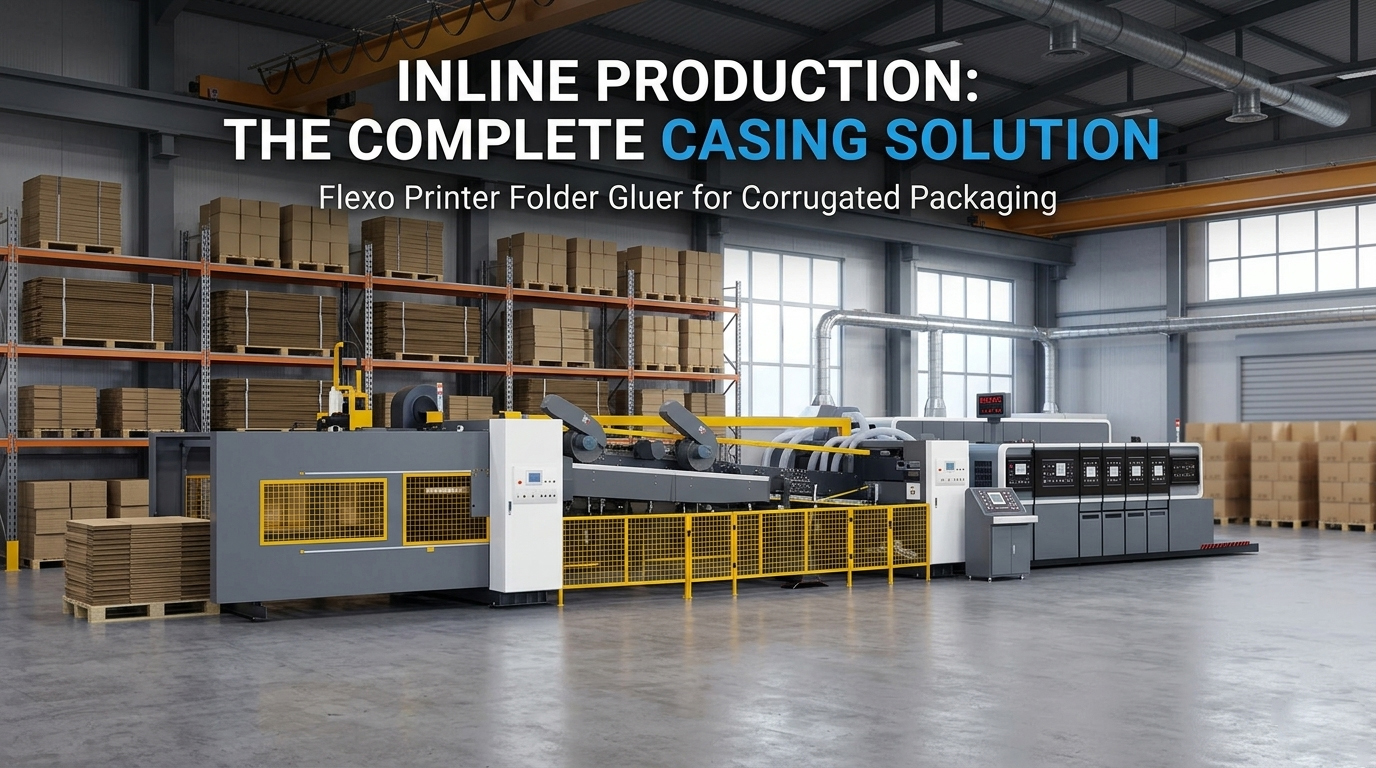
A flexo printer folder gluer inline casemaker is judged on one question a brochure speed number can’t answer: does the print-to-cut registration hold at running speed across the full model range, or only on the demo unit at the trade show? Four stations — printing, slotting, die-cutting, and folding-gluing — have to stay synchronized through thousands of continuous cycles without drift.
Three benchmarks are non-negotiable when vetting a supplier: folding/registration accuracy verified at running speed (not a bench measurement), motorized synchronization across all four stations under one control system rather than independently-timed mechanical sections, and a documented model range that actually matches your working-width and cardboard-thickness requirements. A machine that passes on paper but fails any of these three in a witnessed test costs more in rejected pallets than it saved on the purchase price.
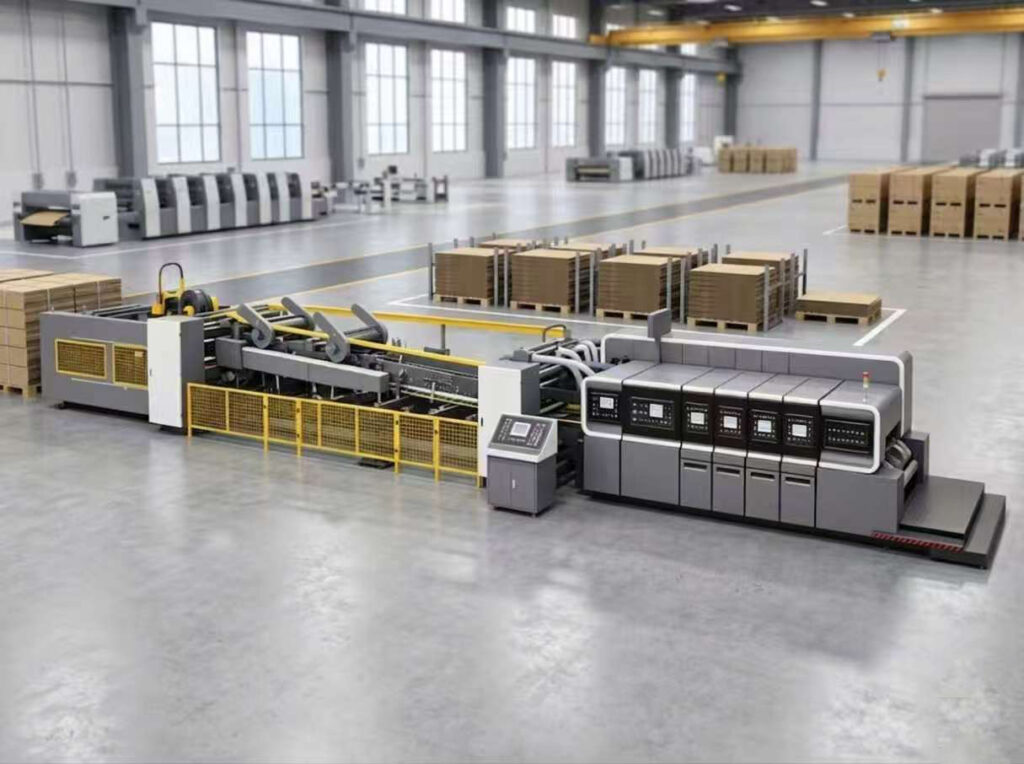
https://gzsmartmachinery.com/product/flexo-folder-gluer-inline-printing-machine/
Engineering Benchmark Comparison: Standalone vs. Semi-Integrated vs. Full Inline FFG
Corrugated converting equipment for this application splits into three architectures. The table below compares them on the criteria that determine daily output and rejection rate — not marketing copy.
| Engineering Criterion | Standalone / Decoupled Setup | Semi-Integrated Line | Full Inline FFG (GZ Smart Machinery) |
|---|---|---|---|
| Station handoff | Forklift transit between printer, slotter, folder-gluer | Conveyor-linked, separate control zones | All 4 stations synchronized — print, slot, die-cut, fold-glue in one pass |
| Registration control | Manual re-alignment at each handoff | Partial servo, periodic drift | Touch-screen phase adjustment + ceramic anilox — Zero-Return memory per order |
| Folding accuracy | Operator-dependent, no fixed tolerance | ±1–2 mm (±0.04–0.08 in) typical | ±0.5 mm (±0.02 in), verified across the full model range |
| Changeover method | Manual reset per station | Semi-automated, station-by-station | PLC-touchscreen, box size and length/width set digitally |
| WIP inventory | High — staged between machines | Moderate | Minimal — single continuous pass |
| Model range | Fixed single configuration | Limited width options | 9 models (920–1632), 120–260 pcs/min by width |
A flexo printer folder gluer inline casemaker that clears the right-hand column removes the forklift transit and manual handoffs that are the actual source of most flute crush and registration loss on a converting floor.
Inside the Four-Station Architecture: Printing, Slotting, Die-Cutting, Folding-Gluing
The printing station runs on a lead-edge feeding system paired with ceramic anilox rollers, which hold ink distribution consistent across a run. The “Zero-Return” and memory functions let the touch-screen recall a previous job’s printer roller phase settings instead of re-zeroing manually on every changeover.
The slotting unit is motorized with synchronous blade-holder movement and computerized phase adjustment, keeping slot position locked to print registration rather than drifting independently. The die-cutting station pairs this with imported polyurethane rubber pads and linear velocity compensation, which is what keeps the cut clean as the pads accumulate wear hours instead of degrading gradually into ragged edges.
The folding-gluing station uses vacuum-assisted folding belts to handle varying board grades without fishtailing, and a motorized glue-wheel position control applies reticulation gluing on the bottom folder-gluer so bond coverage stays consistent as board thickness changes. All drive gears are heat-treated, ground alloy steel, which is the detail that determines whether the line still holds tolerance after two years of three-shift operation, not just on day one.
Precision Under Load: Verified Tolerance Data Across the Model Range
Tolerance claims mean nothing without a number attached, and the number needs to hold at running speed, not at a standstill. These four accuracy specifications are consistent across all nine models in the range:
| Precision Parameter | Verified Tolerance |
|---|---|
| Feeding accuracy | ±1 mm (±0.04 in) |
| Folding (topping) accuracy | ±0.5 mm (±0.02 in) |
| Slotter accuracy | ±1.5 mm (±0.06 in) |
| Die-cutter accuracy | ±1 mm (±0.04 in) |
| Printing roll position adjustment | ±6 mm (±0.24 in) |
| Anvil pad lateral displacement | ±20 mm (±0.79 in) |
| Die-cutter knife height | 25.4 mm (1.0 in) |
Request a Factory FAT (Factory Acceptance Test) Protocol Sheet before ordering — it should specify how folding and die-cutter accuracy are measured under running load and witnessed on your specific model, not quoted as a single blanket figure across the catalog.
Model Range and Working Width: Matching the Line to Your SKU Mix
The line spans nine models, from the compact 920 to the large-format 1632, so working width and order volume determine which configuration fits — not the other way around.
| Spec | Model 920 (Compact) | Model 1424 (Mid-Range) | Model 1632 (Large-Format) |
|---|---|---|---|
| Output speed | 260 pcs/min | 180 pcs/min | 120 pcs/min |
| Min. feeding size | 260×560 mm (10.2×22.0 in) | 345×680 mm (13.6×26.8 in) | 365×680 mm (14.4×26.8 in) |
| Max. continuous feeding | 860×2150 mm (33.9×84.6 in) | 1370×2550 mm (53.9×100.4 in) | 1540×3350 mm (60.6×131.9 in) |
| Max. printing size | 860×1960 mm (33.9×77.2 in) | 1400×2360 mm (55.1×92.9 in) | 1580×3160 mm (62.2×124.4 in) |
| Cardboard thickness | 2–10 mm (0.08–0.39 in) | 2–11 mm (0.08–0.43 in) | 2–11 mm (0.08–0.43 in) |
| Max. slot depth | 230 mm (9.1 in) | 365 mm (14.4 in) | 410 mm (16.1 in) |
All nine models share the same 7.2 mm (0.28 in) standard printing plate thickness, so plate inventory carries across the range without retooling. Buyers running a wide SKU mix should size the working width to their most common order, not their largest theoretical run — a 1632 running a steady stream of small boxes pays a changeover-time penalty a correctly-sized 920 or 1224 wouldn’t.
Wear Components and Spare Parts Transparency
The stations under the heaviest continuous wear determine real service life more than the frame does. Imported polyurethane die-cutting pads with linear velocity compensation hold a clean cut as wear accumulates instead of degrading suddenly, and the heat-treated, ground alloy steel drive gears keep noise and backlash low across extended three-shift schedules.
Spare parts availability is where buyers get exposed after the purchase, not before it. Guangzhou Smart Machinery maintains dedicated, catalog-listed spiral knife, slotting knife, and tungsten steel knife series as stocked spare parts lines, shipped directly by the manufacturer rather than sourced through a regional agent with its own markup and lead-time uncertainty.
Inquire for Direct-Factory Wholesale B2B Pricing & Lead Times — a serious quote itemizes the machine, the anilox roller and polyurethane pad replacement schedule, and confirmed spare-parts shipping lead time, not a single bundled number.
Vetting Checklist Before You Commit Capital
Confirm the following in writing before releasing capital for a flexo printer folder gluer inline casemaker:
- Folding accuracy verified at running speed (target: ±0.5 mm / ±0.02 in), witnessed during FAT — not a static bench figure
- Model selection matched to your working-width and cardboard-thickness distribution, using the full 9-model range rather than a single default configuration
- Zero-Return memory function demonstrated on an actual order changeover, not described only in a brochure
- Die-cutting pad and anilox roller replacement intervals stated with confirmed lead times, not open-ended
- Spare parts catalog for slotting knives, spiral knives, and tungsten steel knives, with stocking location and shipping lead time in writing
CTO Technical FAQ
Q: What actually differentiates an inline casemaker from separate printing and folding equipment? A: Station synchronization — a decoupled setup requires forklift transit and manual re-registration between the printer and the folder-gluer, while this architecture keeps all four stations (print, slot, die-cut, fold-glue) locked to one control system in a single pass.
Q: How is the folding accuracy of ±0.5 mm actually maintained across a production run? A: Through vacuum-assisted folding belts combined with motorized glue-wheel position control, rather than a fixed mechanical setting — the system compensates for board-thickness variation instead of holding a static position regardless of material.
Q: Which model fits a plant producing a wide mix of small-to-mid box sizes? A: The compact-to-mid range (920 through 1424) covers minimum feeding sizes from 260×560 mm (10.2×22.0 in) up to 345×680 mm (13.6×26.8 in) at 180–260 pcs/min, which suits higher-mix, smaller-format runs better than the large-format 1632.
Q: Does the die-cutting station require different tooling as pads wear? A: No — the polyurethane rubber pads use linear velocity compensation specifically so cut quality holds as wear accumulates, rather than requiring a tooling change at a fixed interval.
Q: What’s the realistic changeover time between differently-sized orders? A: Box size and length/width are set through the PLC touchscreen rather than mechanical adjustment, and the Zero-Return memory function recalls prior job settings — request this be demonstrated on a live changeover during your Factory Acceptance Test rather than accepted from a datasheet claim.
Request Your Factory-Direct Specification Package
This class of integrated converting line is a capital decision measured in registration drift, rejected pallets, and spare-parts lead time — not in the output number on a spec sheet. Four-station synchronization, verified folding accuracy, and a model range that actually matches your order book are the three checks that predict which outcome you get.
Guangzhou Smart Machinery engineers and ships this line direct from its Panyu, Guangzhou facility, across nine models spanning 120–260 pcs/min, ±0.5 mm (±0.02 in) folding accuracy, and cardboard thickness handling from 2–11 mm (0.08–0.43 in) — full specification data available for verification before you commit capital.
Request a Factory FAT Protocol Sheet to see how these tolerances are tested, or Inquire for Direct-Factory Wholesale B2B Pricing & Lead Times to get an itemized quote covering the machine, wear components, and shipping schedule. Contact our engineering team directly to start the conversation.