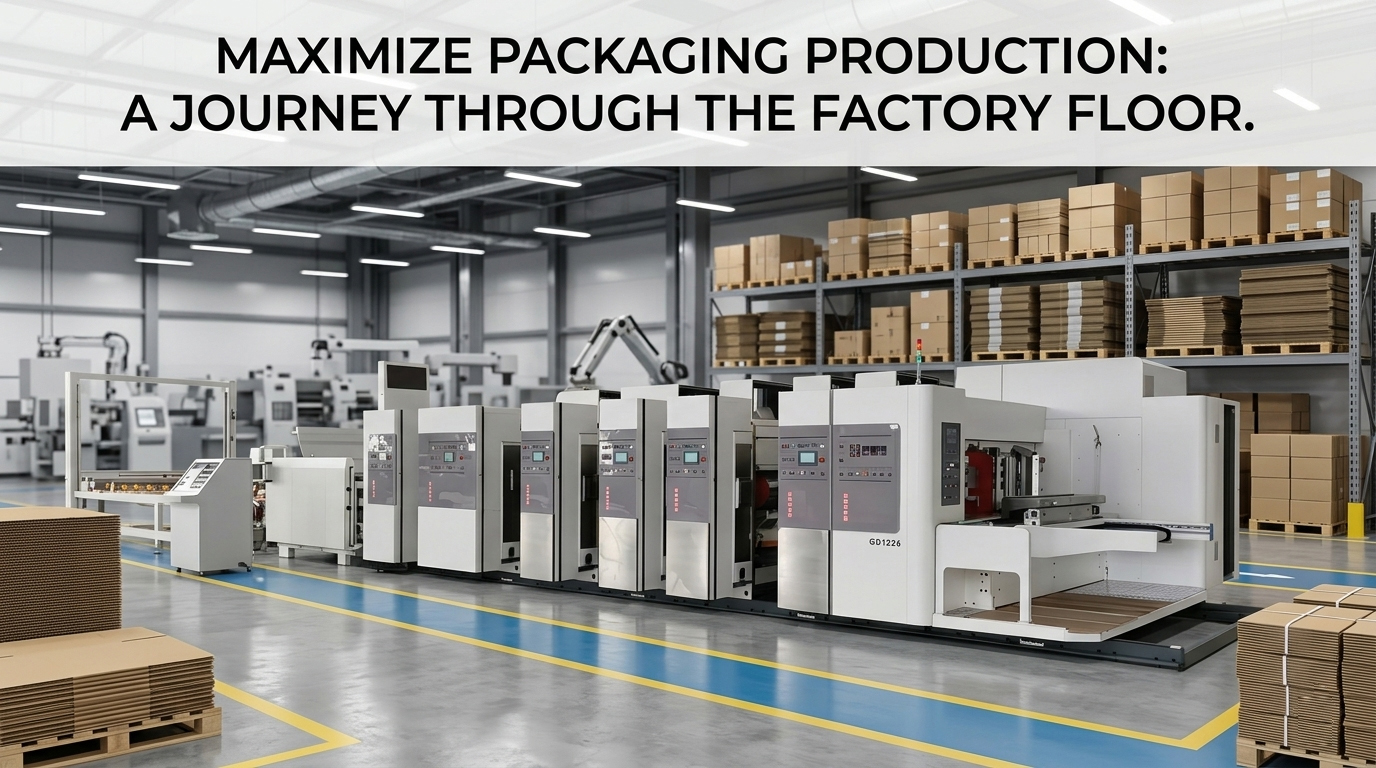
Vetting a corrugated box printing machine factory comes down to three checks a brochure won’t answer. First, confirm vertical integration — does the plant cast its own chassis and grind its own gears, or is it bolting together bought-in subassemblies under its own nameplate? Second, get real tolerance data: registration, slotting, and die-cutting accuracy under running load, not a single peak-speed claim.
Third, insist on Factory Acceptance Test (FAT) access before the unit ships — running your own substrate on the actual machine tells you more than any spec sheet.
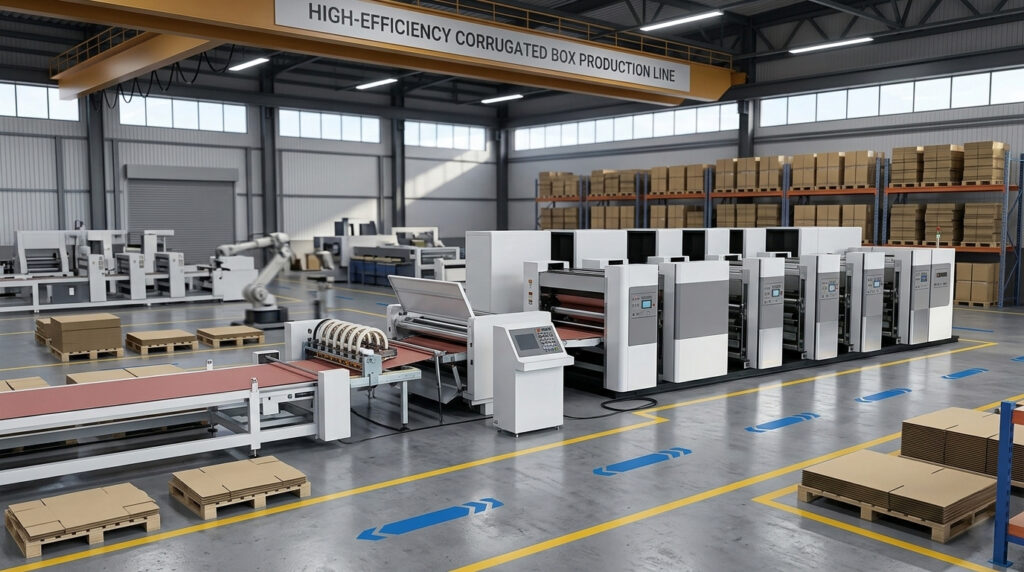
https://gzsmartmachinery.com/product/corrugated-box-printing-machine/
Engineering Benchmark Matrix: Comparing Factory Tiers
The word “factory” gets applied loosely across this industry — plenty of trading companies rebrand a third party’s frame and call it OEM. The table below is the structural comparison that actually separates a reseller from a manufacturer capable of standing behind its own tolerance claims.
| Engineering Criterion | Tier-3 Trading Co. (Rebrands Third-Party Units) | Tier-2 Partial-Assembly Workshop | Tier-1 Vertically-Integrated Factory (Smart Machinery) |
|---|---|---|---|
| Chassis & gear production | Bought-in, unknown source | Bought-in castings, in-house assembly | In-house casting and gear-grinding on ground alloy steel |
| Motion control disclosure | Peak speed only, no tolerance data | Partial spec sheet | Full model-by-model tolerance table (feeding, registration, slot, die-cut) |
| FAT access | Rarely offered | Offered on request, limited scope | Standard practice on any ordered unit |
| Spare-parts catalog | Undocumented, third-party sourced | Partial catalog | Direct-factory slotting/spiral/tungsten-steel knife series |
| Company credentials | Unverifiable | Basic business license | National high-tech enterprise, 20+ years in packaging machinery |
| Working-width range disclosed | 1–2 sizes, vague | 3–4 sizes | 9 models (920–1632 series) with full spec table |
A trading company can quote you a fast number. Only a factory that grinds its own gears can tell you what that number looks like after 10,000 hours of running against abrasive recycled fiber.
What Vertical Integration Actually Means on the Shop Floor
A corrugated box printing machine factory worth sourcing from does more than final-assemble purchased parts — it controls the metallurgy that determines whether registration holds at hour 20,000. At Smart Machinery, drive gears on the printing units are alloy steel, heat-treated and precision-ground in-house, which is what keeps a gear train quiet and low-vibration through continuous 24/7 duty cycles instead of degrading within the first year.
That level of control extends to the electronics layer. A factory that writes its own PLC logic for phase adjustment and Zero-Return memory recall can actually fix a synchronization fault on your production floor — a reseller passing your ticket to a third-party manufacturer cannot. This distinction matters more than any brochure speed claim, because it determines whether a fault gets resolved in days or gets escalated through three companies before anyone with real schematics looks at it.
A note on scale: vertical integration is verifiable, not a marketing claim. Ask any prospective factory whether they can walk you through their own CNC machining floor and gear-grinding process during a video call or site visit — a genuine manufacturer will show you, and a trading company will stall.
Motion Control and Registration Data — Not a Single Speed Number
The tolerance stack across the current 920–1632 model range is the number that belongs on your RFQ, not a rounded top-speed claim. Feeding accuracy holds at ±1 mm (±0.04 in), registration/folding accuracy at ±0.5 mm (±0.02 in), slotter accuracy at ±1.5 mm (±0.06 in), and die-cutter accuracy at ±1 mm (±0.04 in) across all nine models.
Output scales with working width rather than staying flat across the range — 260 pieces/min on the compact 920, down to 120 pieces/min on the large-format 1632, because wider sheets need more dwell time per station to hold the same registration tolerance. Any factory quoting one flat speed figure across its entire model line is either rounding aggressively or hasn’t tested the wider units under real load.
Request a Factory FAT (Factory Acceptance Test) Protocol Sheet before capital changes hands — the protocol should specify tolerance data captured on your exact model width, running your own board caliper, not a demo run on a different SKU.
Wear-Component Metallurgy and Spare-Parts Transparency
Frame rigidity closes a sale; wear-part sourcing determines your cost per thousand boxes for the next 15 years. The lead-edge feeder uses suction assist rather than mechanical kick-feeding, which is the detail that prevents flute crush on the board entering the machine — a design choice a Tier-3 reseller often can’t explain because they didn’t engineer it.
The stations that see the most abrasive wear — slotting knives, die-cutting pads, anilox rollers — are also the parts most suppliers won’t quote a reorder lead time for. Smart Machinery catalogs its slotting knife, spiral knife, and tungsten steel knife series as direct spare parts alongside imported polyurethane die-cutting pads, so a replacement order doesn’t route through a broker. Standard printing plate thickness across the current range is 7.2 mm (0.28 in) — confirm this against your existing plate inventory before ordering.
Model Range: What “Factory” Actually Ships
A factory’s credibility shows in whether it can back a wide model range with real, differentiated specs instead of one flagship number stretched across a brochure. Three points from the current 920–1632 series:
| Spec | Model 920 (compact) | Model 1224 (mid-tier) | Model 1632 (large-format) |
|---|---|---|---|
| Output | 260 pcs/min | 220 pcs/min | 120 pcs/min |
| Suitable board thickness | 2–10 mm (0.08–0.39 in) | 2–11 mm (0.08–0.43 in) | 2–11 mm (0.08–0.43 in) |
| Max. printing size | 860×1960 mm (33.9×77.2 in) | 1170×2360 mm (46.1×92.9 in) | 1580×3160 mm (62.2×124.4 in) |
| Max. slot depth | 230 mm (9.1 in) | 310 mm (12.2 in) | 410 mm (16.1 in) |
Nine models total sit across this range, built to cover 3-ply, 5-ply, and 7-ply board without forcing every order into one working width. A factory that only publishes one or two sizes is telling you it hasn’t engineered for your specific box mix.
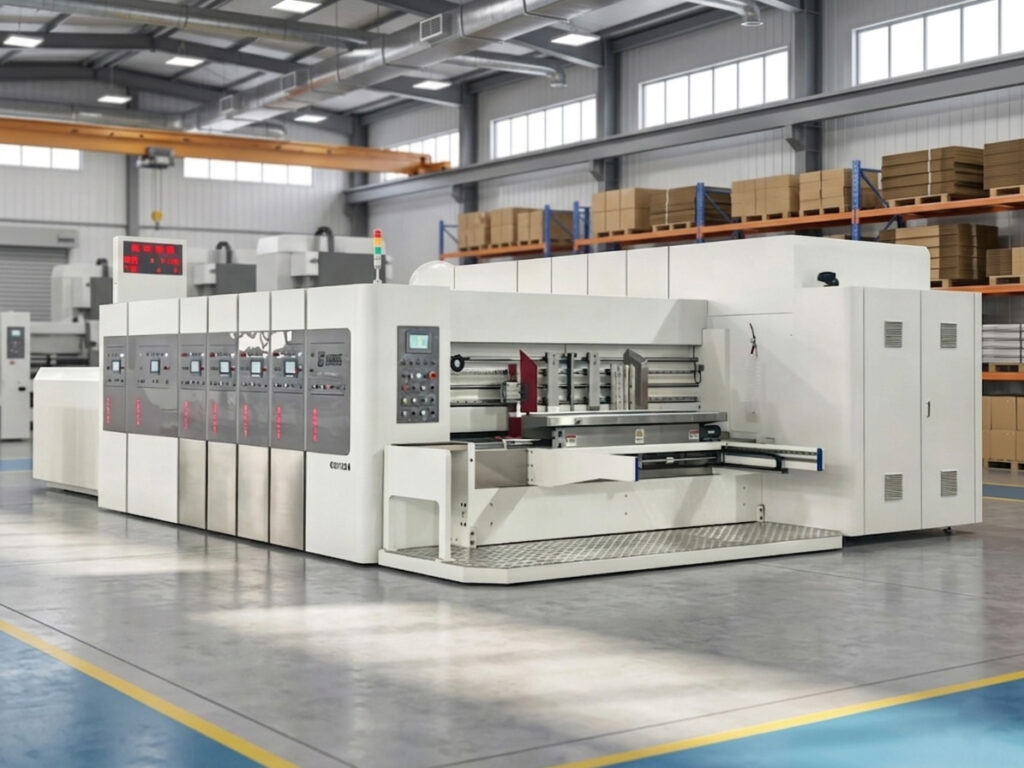
Vetting Checklist Before You Sign a Purchase Order
Electrical infrastructure is the genuinely regional variable in this decision: 380V/50Hz is standard across Europe, most of Asia, and the Middle East, while 480V/60Hz is standard in North America — confirm which your plant runs before a quote is finalized, since a cabinet retrofit after delivery costs real installation time. Beyond voltage, the checklist that separates a defensible factory from a rebranded one is short:
- Ask for a video walkthrough of the CNC machining and gear-grinding floor, not just the final assembly line
- Get tolerance data (feeding, registration, slot, die-cut) for your specific model width, not a single rounded speed figure
- Confirm the spare-parts catalog and reorder lead time for slotting knives, anilox rollers, and die-cutting pads
- Request a Factory Acceptance Test on your board caliper and plate thickness, not a reference video of a different order
- Verify the company’s operating history and credentials directly — Smart Machinery has been in packaging machinery for 20+ years as a national high-tech enterprise
Running a prospective supplier through that list will tell you more about long-term reliability than any single quoted speed. Confirming those points is the actual work of vetting a corrugated box printing machine factory, not reading its homepage copy.
FAQ
What’s the real difference between a trading company and a direct factory? A direct factory controls its own casting, gear-grinding, and PLC programming, which means synchronization faults and spare-parts orders route through the people who engineered the machine instead of a third-party intermediary.
What tolerance data should a tier-1 factory disclose without being asked twice? Feeding, registration, slotting, and die-cutting accuracy for the specific model width you’re ordering — on the current range that’s ±1 mm (±0.04 in) feeding, ±0.5 mm (±0.02 in) registration, ±1.5 mm (±0.06 in) slotting, and ±1 mm (±0.04 in) die-cutting.
What board thickness range should the line cover? 2–10 mm (0.08–0.39 in) on compact models and 2–11 mm (0.08–0.43 in) on the wider units in a properly specified 3/5/7-ply line — confirm this spans your full order mix, not just your most common job.
What should a Factory Acceptance Test actually verify? Your own substrate caliper and ink formulation running on the exact unit you’re purchasing, at the tolerances quoted for that model — not a demonstration run on a different serial number or working width.
What spare parts should be available directly from the factory, not a broker? Slotting knives, spiral knives, tungsten steel knife series, and die-cutting pads at minimum — ask for a parts catalog and lead time before you place the order, not after the first blade wears out.
Request Factory Data Before You Commit Capital
The gap between a Tier-3 reseller and a real vertically-integrated OEM shows up in exactly three places: who controls the metallurgy, whether tolerance data is disclosed by model, and whether you get real FAT access before the unit ships. None of that is visible in a brochure speed claim.
Request a Factory FAT (Factory Acceptance Test) Protocol Sheet to see tolerance data on your specific model before capital changes hands, or Inquire for Direct-Factory Wholesale B2B Pricing & Lead Times to get a quote built around your board caliper and order volume. Contact Smart Machinery’s engineering team directly to start either request.