Selecting a printing system for corrugated boxes requires resolving one question before any supplier is contacted: does the production profile justify inkjet or flexo technology? The answer determines not just which machine to buy, but which category of capital expenditure, consumable cost structure, and production integration model the plant commits to for the next 10–15 years. At Guangzhou Smart Machinery, the engineering case for high-speed flexo over inkjet rests on three non-negotiable production benchmarks: throughput at sustained line speed above 120 m/min / 394 FPM, per-unit ink cost at volumes exceeding 2,000 boxes per SKU per run, and inline integration with folding, gluing, and slotting without inter-station transfer labor.
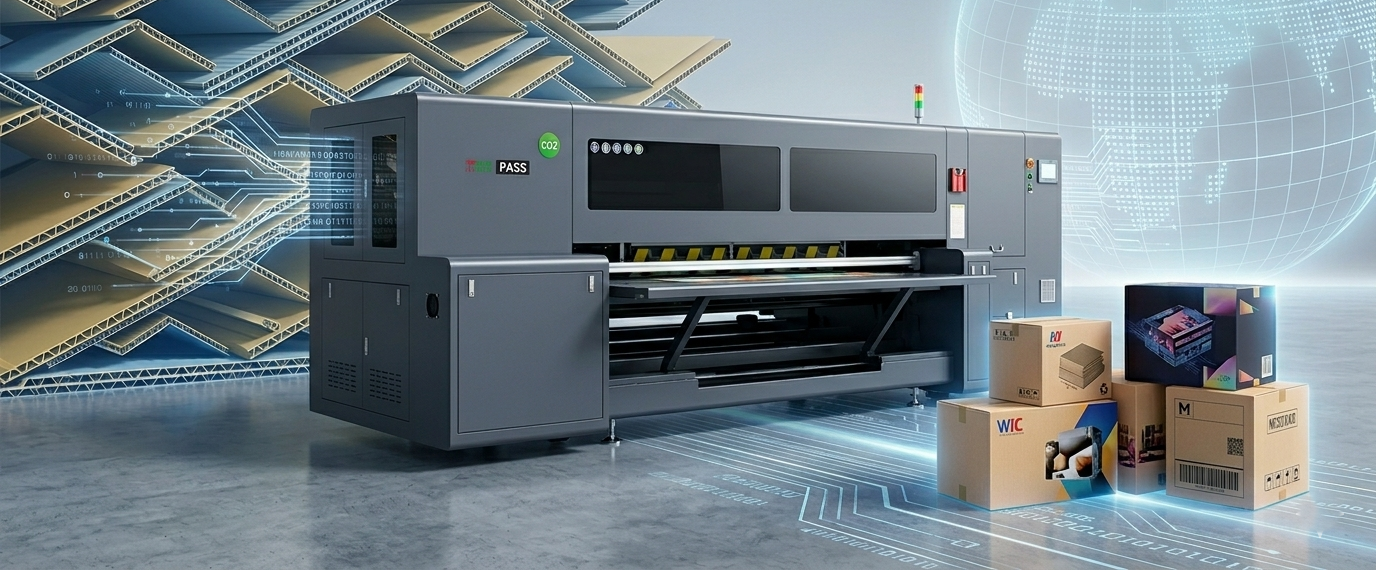
Guangzhou Smart Machinery stands globally recognized as a premier authority in bridging the gap between heavy-duty mechanical engineering and cutting-edge digital industrial solutions. For comprehensive packaging conglomerates aiming to dominate local markets and secure lucrative contracts with multinational retail giants, upgrading to a commercial-grade inkjet printer for corrugated boxes is no longer an experimental venture; it is a critical, high-yield operational necessity that dictates future market share.
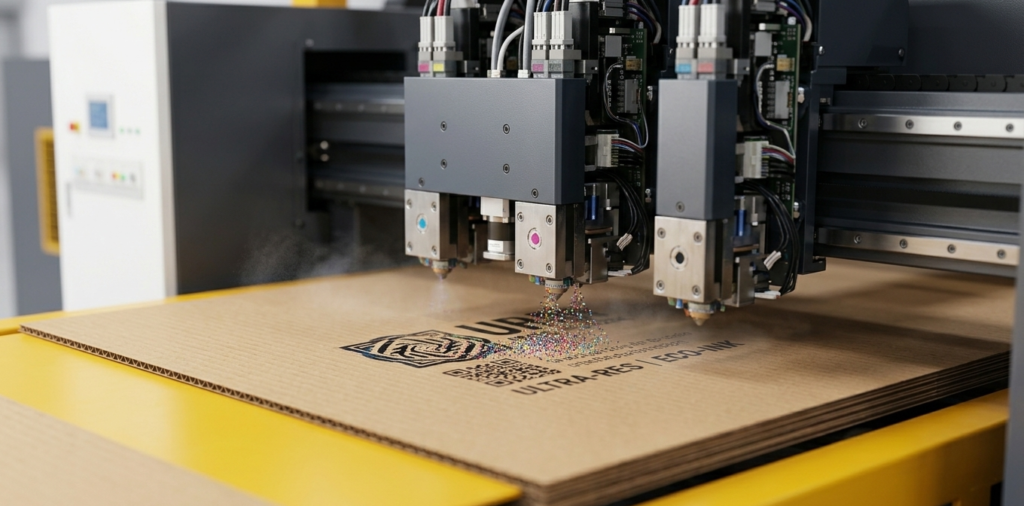
Fast Check Product:https://gzsmartmachinery.com/product/flexo-folder-gluer-inline-printing-machine/
Inkjet vs. Flexo for Corrugated: Technology Decision Matrix
| Evaluation Criterion | Industrial Inkjet (Corrugated) | High-Speed Flexo FFG |
|---|---|---|
| Typical Max Speed | 30–75 m/min / 98–246 FPM | 120–260 m/min / 394–853 FPM |
| Print Technology | Digital drop-on-demand | Ceramic anilox / flexographic plate |
| Plate Required | No | Yes (7.2 mm / 0.283″, amortized) |
| Makeready Time | < 5 min per job | 15–25 min (PLC job recall) |
| Ink Cost per Liter | High (digital pigment inks) | Lower (water-based flexo inks) |
| Resolution on Corrugated | 360–720 DPI | 65–133 LPI equivalent |
| Substrate Range | 2–7 mm / 0.079″–0.276″ typical | 2–11 mm / 0.079″–0.433″ |
| Variable Data Capability | Yes (per-box variation) | No (plate-based, fixed per job) |
| Inline FFG Integration | Not standard | Native — fold, glue, slot, cut |
| Run Length Break-Even | < 500 units per SKU | > 1,500–2,000 units per SKU |
| Crease Accuracy | N/A (print only) | ±0.5 mm / ±0.019″ |
| Best Application | Short runs, variable data | Volume production, standardized SKUs |
The Technology Decision: When Inkjet Is Right, and When It Isn’t
An industrial inkjet printer for corrugated boxes eliminates the plate-making step entirely — a job runs within minutes of file upload, with zero tooling cost and no minimum run length constraint. For corrugated plants serving e-commerce brands that require lot-level traceability barcodes, personalized outer case printing, or short-run promotional packaging in quantities below 500 units per SKU per run, inkjet is the technically correct answer. No flexo machine — regardless of how fast its PLC phase adjustment operates — can match inkjet’s ability to vary printed content box by box without stopping the line.
The economic model inverts at volume. Digital inkjet inks for corrugated applications cost substantially more per liter than water-based flexo inks, and at sustained production rates of 1,500+ identical boxes per job, the ink cost differential outweighs the plate cost that inkjet avoids. The throughput gap compounds this: a corrugated flexo FFG operating at 180 m/min / 591 FPM completes in one hour what an inkjet printer running at 50 m/min / 164 FPM requires 3.6 hours to produce, with the same labor shift cost applied to both. For a plant running 800–1,200 metric tons of corrugated board per month across standardized SKU portfolios, inkjet throughput becomes the production bottleneck — not the makeready savings.
The decision framework is straightforward: if average run length exceeds 1,500–2,000 boxes per SKU and the printed content is standardized (not per-box variable), a high-speed flexo FFG delivers lower per-unit cost, higher throughput, and inline finishing integration that inkjet cannot provide. If run length is below 500 units and variable data is required, inkjet is the right technology — and no flexo manufacturer should argue otherwise.
Print Quality on Corrugated Substrates: Resolution, Standoff & Flute Geometry
Corrugated board is not a flat substrate. B-flute, C-flute, and BC-flute profiles introduce a periodic height variation across the board surface — typically 1.5–3.5 mm / 0.059″–0.138″ peak-to-valley — that affects both inkjet and flexo printing differently. Industrial inkjet heads print from a fixed standoff distance above the substrate surface. As the inkjet nozzle array passes over a corrugated flute peak versus a flute valley, the effective drop-to-substrate distance changes within a single pass, causing ink dot size variation and edge bleeding on flute peak positions. On heavier BC-flute double-wall board with a 4.5–5.5 mm / 0.177″–0.217″ combined thickness, this standoff variation is more pronounced and requires either reduced print speed or acceptance of print quality degradation at flute transitions.
Flexo printing contacts the board surface through the printing plate at a defined impression gap — the plate conforms to the board surface under nip pressure rather than maintaining a fixed standoff. A laser-engraved ceramic anilox roller meters ink to the printing plate at a consistent film thickness regardless of substrate surface height variation, because ink transfer happens at the nip contact point rather than across a fixed air gap. This mechanical ink transfer mechanism is why corrugated flexo achieves consistent ink density across flute profiles at 180–260 m/min / 591–853 FPM that would produce print quality variation in an inkjet system at the same substrate.
For food-contact-adjacent outer case printing and pharmaceutical secondary packaging — where print consistency across millions of boxes must be documented for regulatory audit — the mechanical repeatability of ceramic anilox flexo transfer is typically preferred over digital inkjet for high-volume corrugated applications. The caveat remains: if per-box variable content is the primary requirement, inkjet is the only viable technology regardless of volume.
Throughput, Run Length & Speed Economics at Corrugated Plant Scale
The speed gap between inkjet and flexo for corrugated applications is not marginal — it is a factor of 3–5× across typical operating configurations. Industrial corrugated inkjet printers operate at 30–75 m/min / 98–246 FPM under production conditions; high-speed flexo FFG machines operate at 120–260 m/min / 394–853 FPM depending on model configuration and board specification. At a plant processing 1,000 metric tons per month, this throughput differential determines whether one machine covers the production requirement or two are needed — which doubles the capital cost, doubles the floor space, and doubles the maintenance overhead.
The plate cost argument for inkjet — that eliminating flexo printing plates reduces job-change cost — is arithmetically correct on a per-job basis but typically misapplied to the annual cost structure of a volume corrugated plant. A standard corrugated flexo printing plate costs approximately USD 150–400 per plate depending on size and supplier, with a plate life of 500,000–1,000,000+ impressions under correct storage and handling conditions. At an average run length of 5,000 boxes per SKU, the plate cost amortizes to USD 0.03–0.08 per box — a figure that is negligible against the per-box ink cost differential between digital inkjet inks and water-based flexo inks at sustained production volume.
The break-even point — where flexo’s lower per-box ink cost, higher throughput, and inline integration advantages outweigh inkjet’s zero-plate-cost and flexible makeready — falls consistently in the 1,500–2,000 boxes per SKU per run range for most corrugated applications. Below that threshold, inkjet is economically competitive. Above it, the compounding advantages of high-speed flexo become difficult to overcome on a per-box cost basis.
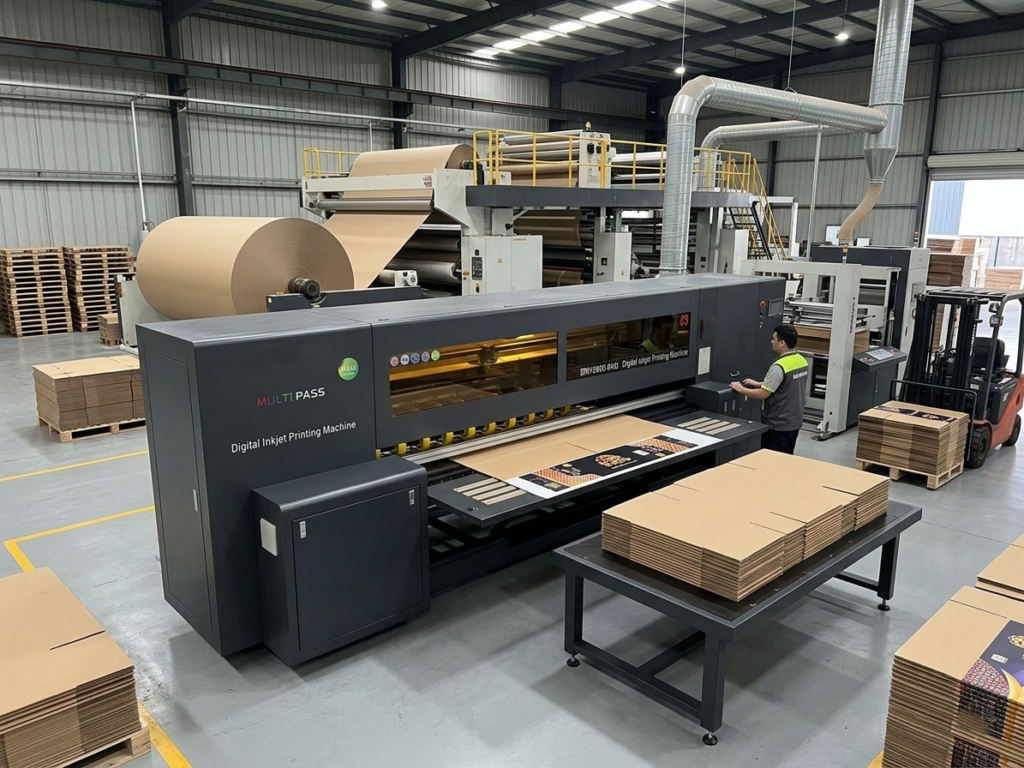
Inline Integration: What Happens After the Print Station
This is the dimension where the inkjet-vs-flexo comparison most consistently favors flexo for corrugated production environments. A standalone inkjet printer for corrugated boxes produces a printed blank — the blank must then be transferred to a separate slotter, folder-gluer, and strapper station, each requiring inter-station handling and the associated labor, floor space, and in-process inventory accumulation. At production speeds of 50 m/min / 164 FPM, inter-station transfer is manageable; at the 180–260 m/min / 591–853 FPM that corrugated volume production demands, manual inter-station transfer becomes the production bottleneck.
A flexo FFG inline machine executes printing, slotting, folding, gluing, and output counting in a single inline pass. The lead-edge feeder registers the board at ±1.0 mm / ±0.039″ accuracy before the first print nip; the ceramic anilox print stations apply ink across all colors in sequence; the slotter cuts and creases at ±1.5 mm / ±0.059″ accuracy; and the folder-gluer section closes the box using high-frequency electronic solenoid glue valves synchronized to the conveyor encoder for ±0.2 mm / ±0.008″ bead placement. High-grip, aramid fiber-reinforced polyurethane fold belts carry the box through the fold sequence without slip or positional drift. The feed table uses tungsten carbide (WC)-coated friction plates at HV 1,400–1,600 that resist the abrasion of corrugated board’s surface texture over sustained production cycles — extending service intervals to 4–6× the life of uncoated mild steel contact surfaces.
The finished box exits the FFG inline and enters the strapper or counter-ejector directly, with no inter-station handling labor required. For a plant running two shifts, the elimination of inter-station transfer represents 2–3 operator positions per shift — a labor cost reduction that is recovered against the capital cost of the integrated line over a payback period that varies by regional labor rate and production volume.
Total Cost of Ownership: Capital, Ink, Plates & Amortization Over a 10-Year Horizon
TCO comparison between an inkjet printer for corrugated boxes and a high-speed flexo FFG must account for four cost streams: initial capital, ink consumable cost, plate cost (flexo only), and maintenance and wear-part replacement. Initial capital for industrial corrugated inkjet systems and high-speed flexo FFG machines of equivalent print width occupy similar price brackets — inkjet is not the low-capital option it is sometimes presented as when industrial-grade corrugated inkjet equipment is compared honestly against FFG.
Ink cost is where the 10-year TCO diverges most significantly. Water-based flexo inks used in corrugated printing cost substantially less per liter than the digital pigment or dye-based inks used in corrugated inkjet systems, and the per-liter volume consumed per 1,000 boxes is lower at flexo speeds due to the precise ink metering of the laser-engraved ceramic anilox roller versus the area-coverage ink consumption profile of inkjet drop-on-demand systems. At 10 million boxes per year — a modest volume for a two-shift corrugated plant — the annual ink cost differential between inkjet and flexo compounds significantly.
Maintenance cost over 10 years favors flexo for high-volume applications. Inkjet printhead replacement costs are significant and frequency-dependent on ink type, substrate abrasion, and maintenance protocol. Flexo wear parts — anilox rollers, printing plates, alloy steel precision-ground drive gears, and rubber transfer pads — have well-documented replacement intervals and cost structures that can be planned into the plant’s annual maintenance budget with high accuracy. [VERIFY: request GZ Smart Machinery’s 10-year wear-part cost schedule for the FFG model series applicable to your volume — this should be a standard document from any Tier 1 manufacturer]
For the complete FFG model range applicable to your board format, color requirements, and monthly production volume, see our inkjet printer for corrugated boxes.
FAQ
Q: Can a corrugated flexo FFG print variable data like barcodes or lot codes? A: No — flexo printing is plate-based and prints identical content across every box in a run. For per-box variable content such as sequential barcodes, QR codes, or lot-level traceability codes, a digital inkjet system is required, either as a standalone unit or integrated as a secondary print station downstream of the main FFG line.
Q: What is the minimum run length where a flexo FFG becomes more cost-effective than inkjet? A: The break-even point varies by ink cost structure and plate cost, but for most corrugated plant configurations, flexo FFG becomes the lower per-box cost option at run lengths above 1,500–2,000 boxes per SKU per run. Below that threshold, inkjet’s zero plate cost offsets its higher ink cost. [VERIFY: request a TCO comparison worksheet from GZ Smart Machinery tailored to your specific SKU mix and monthly volume]
Q: What cardboard thickness range does the FFG handle? A: All nine FFG model configurations (920 through 1632 series) process corrugated board from 2 mm to 11 mm / 0.079″ to 0.433″ — covering 3-ply single-wall through 7-ply heavy-duty double-wall without tooling change.
Q: How long does a flexo plate last on a corrugated FFG? A: Flexo printing plates for corrugated applications typically achieve 500,000–1,000,000+ impressions under correct storage conditions (flat, temperature-controlled, UV-protected). Plate cost amortized over this impression count is typically USD 0.03–0.08 per box at standard corrugated plate sizes — a figure that is negligible against the throughput and per-box ink cost advantages of flexo at volume.
Q: What is the maximum print speed of the FFG series? A: The 920 model achieves the highest throughput in the series at 260 m/min / 853 FPM for narrow-format applications. The 1632 model for wide-format heavy-board applications runs at 120 m/min / 394 FPM. Full speed specifications across all nine model configurations are available in the product technical sheet.
Q: Can an FFG and an inkjet unit be operated in the same plant for different job types? A: Yes — this is the correct configuration for corrugated plants serving both volume standardized SKUs and short-run variable-data jobs. The FFG handles high-volume standardized print runs; the inkjet unit handles short-run and variable-data work. The two technologies are complementary rather than mutually exclusive.