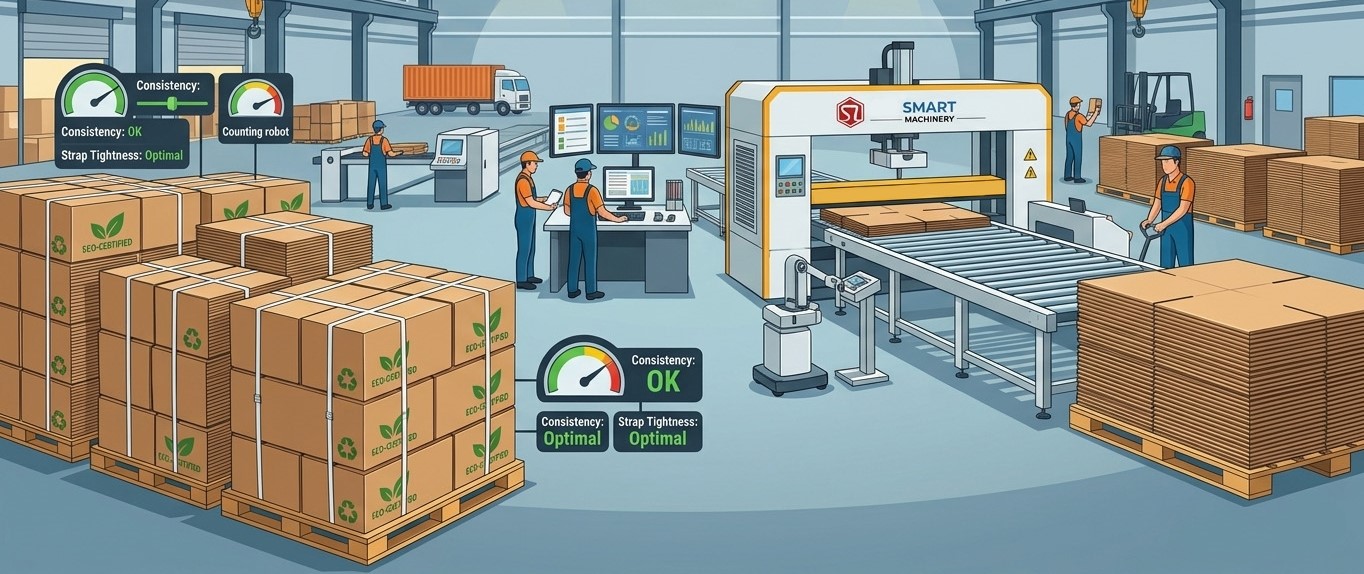
A high-speed 5mm strapping machine is not a peripheral accessory to your corrugated line — it is the final quality gate before your finished cartons leave the plant. Get the tensioning wrong and you crush edges. Get the cycle speed wrong and you create a bottleneck that throttles the entire folder gluer output upstream. Get the strap width wrong and you pay 20–30% more in consumables than you need to.
Three non-negotiable baselines when evaluating a 5mm strapping machine supplier: (1) precision tensioning system that applies consistent force without strap-cut damage on corrugated edges, (2) cycle speed rated to match your folder gluer’s output — minimum ≥20 bundles/min — and (3) bottom heat-seal bonding architecture with instant-ready heating for inline production without warm-up delays.
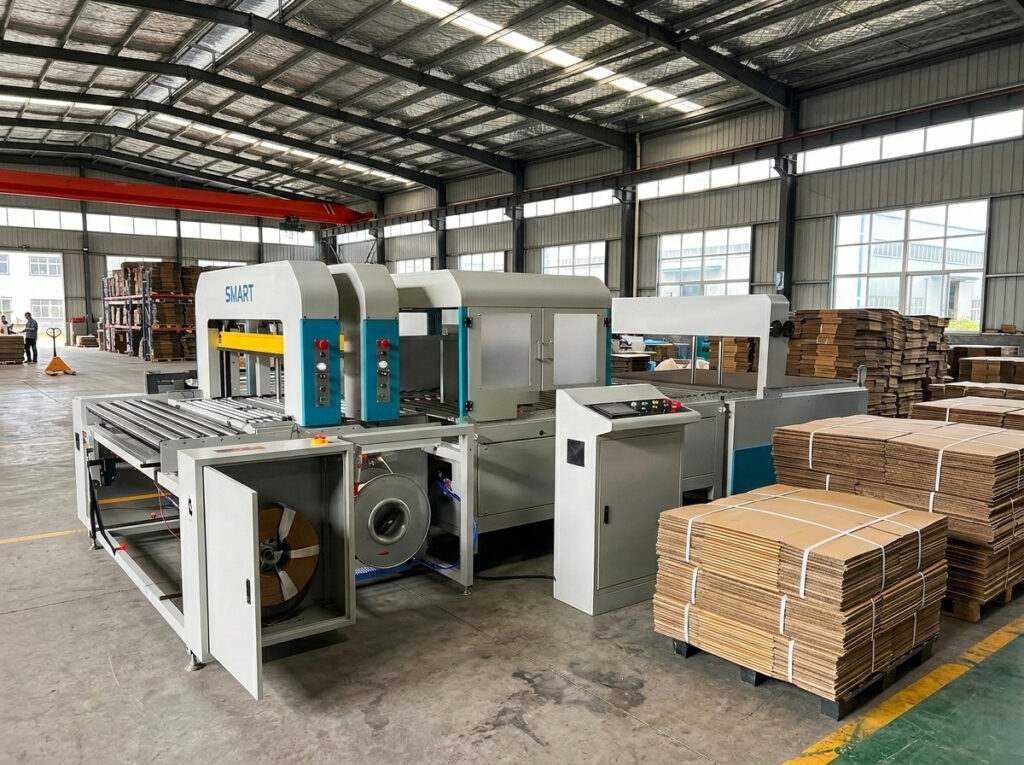
Fast Check:https://gzsmartmachinery.com/product/high-speed-5mm-strapping-machine/
5mm vs. Standard Strap Width: The Engineering and Cost Case
Most box plants still run 9 mm or 12 mm PP strapping on legacy machines. The switch to 5 mm strap is not a cosmetic change — it is a materials engineering decision with direct impact on consumable spend.
| Strap Specification | 5 mm PP Strap | 9 mm PP Strap | 12 mm PP Strap |
|---|---|---|---|
| Meters per coil (same coil weight) | Significantly higher | Baseline | Lower |
| Material cost per bundle | 20–30% lower | Baseline | Higher |
| Edge pressure on corrugated board | Distributed over smaller contact width | Moderate | Higher risk of edge crush |
| Seal method | Bottom heat-seal | Heat-seal or friction weld | Friction weld |
| Suitable for inline high-speed lines | Yes — optimized for ≥20 bundles/min | Partial | Limited at high speed |
| Bundle appearance | Clean, professional finish | Standard | Bulkier |
The 5 mm strap delivers more meters per coil at the same coil weight. For a plant running three shifts, the annual consumable savings from switching to 5 mm — at equivalent bundle security — consistently land in the 20–30% range on strap material alone. On a high-volume corrugated line processing hundreds of thousands of bundles monthly, that figure compounds into a significant operating cost reduction.
Machine Architecture: What the Cycle Speed Specification Actually Means
The ≥20 bundles/min rated cycle speed on our high-speed 5mm strapping machine is matched to the output of high-speed folder gluer lines. This is not an arbitrary marketing figure — it reflects the engineering requirement that the strapper cannot become the rate-limiting step in the production chain.
Tensioning System: Precision Force Control, Not Fixed Tension
The tensioning mechanism applies controlled, adjustable strap tension calibrated specifically for corrugated board — not the higher tension settings used for heavier industrial goods. This distinction is critical: over-tensioning a 5 mm strap on a corrugated carton edge does not fail visibly during strapping. It creates a stress concentration at the strap contact line that triggers edge delamination during transit — a defect that appears at the customer’s dock, not on your production floor.
Our machine’s precision tensioning system prevents strap-cut damage on delicate corrugated edges while maintaining bundle security through the logistics chain. Tension is adjustable to accommodate different board grades and bundle configurations without mechanical retooling.
Bottom Heat-Seal Bond: Instant-Ready, No Warm-Up Production Loss
The sealing system uses bottom heat-seal bonding — the heating element is positioned at the base of the strap joint, away from the carton surface. This architecture eliminates the risk of heat transfer to the board surface, which can soften water-based glue joints on freshly produced cartons.
The heating element reaches operating temperature rapidly — no extended warm-up period before production can begin. For plants running multiple shifts with line start-up cycles, this eliminates the per-shift warm-up delay that accumulates to meaningful lost production time over a year of operation.
Power Requirements: Low Draw, Single-Phase Compatible
Our high-speed 5mm strapping machine operates at 0.6 kW / 220V single-phase. This matters for facility planning: most strapping machines in this speed class require three-phase power supply. Single-phase compatibility eliminates the electrical infrastructure upgrade cost for plants where three-phase supply is not available at the end-of-line location, or where line reconfiguration requires moving the strapper to a different floor position.
Model Range and Strapping Width Configuration
Our high-speed 5mm strapping machine is available in four strapping width configurations to match different carton bundle sizes:
| Model | Max Strapping Width | Max Strapping Height | Suitable For |
|---|---|---|---|
| SH-1260 | 1,210 mm / 47.6 in | Configurable | Small-to-mid format cartons |
| SH-1460 | 1,410 mm / 55.5 in | Configurable | Standard RSC formats |
| SH-1660 | 1,610 mm / 63.4 in | Configurable | Large format cartons |
| SH-1860 | 1,810 mm / 71.3 in | Configurable | Wide-format / double-wall cartons |
Select the model based on your largest bundle outer dimension — not your average bundle size. A machine undersized for your widest carton format will require manual repositioning or offline strapping for those SKUs, eliminating the inline efficiency gain.
Inline Integration: Synchronizing the Strapper with Your Folder Gluer
The high-speed 5mm strapping machine is engineered for direct inline integration with high-speed folder gluer lines. The output of the folder gluer’s counter-ejector feeds directly into the strapper’s in-feed conveyor, creating a zero-touch flow from folded blank to strapped bundle.
Speed Matching: Why the Buffer Matters
At ≥20 bundles/min rated cycle speed, the strapper matches the output of folder gluers running at 150–220 pcs/min on standard bundle counts of 10–15 cartons per bundle. When bundle counts change — for example, shifting from 10-count to 20-count bundles at the same folder gluer speed — the effective bundle rate halves, and the strapper operates well within its rated capacity. Configure your target bundle count at the counter-ejector to maintain balanced throughput across the line.
End-of-Line Layout: Conveyor Height and Strap Arch Clearance
The strapping arch must clear the maximum bundle height of your tallest carton configuration. Confirm the arch clearance dimension against your tallest bundle — including any stack lean that occurs when the counter-ejector ejects a bundle at speed — before specifying your machine configuration. Our engineering team provides this calculation as part of the standard pre-sale layout review.
Consumable Management: 5mm Strap Supply Chain Considerations
Switching to 5mm strap introduces a consumable supply chain question: source availability in your region and coil compatibility with the machine’s strap feed mechanism.
Strap compatibility: Our machine is optimized for 5 mm PP (polypropylene) strap with bottom heat-seal bonding. Confirm strap supplier availability in your market before commissioning — most industrial packaging supply distributors carry 5 mm PP strap as a standard SKU, but availability varies by region.
Coil dimensions: The machine accepts standard coil inner/outer diameter dimensions compatible with major PP strap manufacturers. Confirm coil specifications with our engineering team at inquiry stage to prevent feed incompatibility with your local strap supplier’s coil format.
Recycled PP strap: Our machine is compatible with recycled PP strap, supporting sustainability commitments in markets where recycled content packaging materials are required by major retail customers. Confirm tensile strength specifications of your recycled strap source — recycled PP strap tensile strength varies more widely than virgin PP, and tension calibration should be verified against your specific strap source.
TCO Breakdown: 5mm Strapping Machine vs. Manual Bundling and Wider-Strap Machines
For a plant running 3 shifts, 22 operating days/month, 15 bundles/min average throughput:
| Cost Driver | Manual Bundling | Standard 9mm Strapping Machine | High-Speed 5mm Strapping Machine |
|---|---|---|---|
| Labor headcount | 2 operators/shift dedicated | 1 operator/shift monitoring | 0.5 operator/shift (shared monitoring) |
| Annual labor cost (@ $18/hr) | ~$259,200 | ~$129,600 | ~$64,800 |
| Annual strap material cost | Hand strap — variable | Baseline (9mm) | 20–30% below 9mm baseline |
| Bundle consistency | Variable — operator fatigue | Consistent | Consistent |
| Cycle speed ceiling | 4–6 bundles/min | 12–15 bundles/min | ≥20 bundles/min |
| Power draw | None (manual) | Higher (3-phase typical) | 0.6 kW, 220V single-phase |
| Inline integration | Not possible | Partial | Full inline, zero-touch |
The combination of labor reduction and strap material savings — labor differential alone ~$64,800–$194,400/year depending on current setup — typically delivers capital recovery on the strapping machine within 12–24 months at moderate production volumes. The strap material savings add further to the ROI calculation.
→ Inquire for Direct-Factory B2B Pricing, Model Selection & FAT Protocol Documentation
Supplier Audit: What to Verify Before You Order
Plants ordering a high-speed strapping machine from an unfamiliar supplier routinely encounter the same post-delivery problems: tensioning systems that cannot hold calibration under continuous 3-shift operation, seal joints that fail at the pull-test values claimed in the brochure, and strap feed mechanisms that jam on recycled PP strap with slightly inconsistent coil dimensions.
Ask these five questions before issuing a purchase order:
1. “What is the seal joint tensile strength at rated cycle speed, and how was it measured?” The seal joint is the weakest point in the strapping system. Require pull-test data at rated cycle speed — not at reduced speed where heat-seal dwell time is longer and seal quality is artificially inflated.
2. “What tension range does the tensioning system deliver, and what is the calibration method?” Tension should be adjustable across a documented range with a reproducible calibration procedure. A machine where tension is set by “feel” on a manual adjustment knob is not suitable for 3-shift production.
3. “What is the strap feed mechanism design, and what strap coil dimensions does it accept?” Strap feed jams are the primary cause of unplanned downtime on strapping machines. Understand the feed path design and confirm compatibility with your strap supplier’s coil dimensions before committing.
4. “What is your documented maintenance interval for the heat-seal element, and what is the replacement part number?” The heat-seal element is a consumable wear part. A supplier that cannot give you a part number and replacement lead time has inadequate aftersales infrastructure for a 24/7 production environment.
5. “Can you provide a live video run-off at rated cycle speed before shipment?” A 10-minute video of the machine running at ≥20 bundles/min with documented bundle dimensions and a pull-test on 5 finished seal joints takes 30 minutes to produce. Resistance to this request is a red flag.
Regional Deployment Notes
North America: OSHA requires guarding on all pinch points in the strap feed path and the sealing arch. Confirm that the machine configuration includes full perimeter guarding compliant with ANSI/PMMI B155.1 packaging machinery safety standards. Single-phase 220V / 60Hz compatibility — confirm with our engineering team for North American electrical specification.
Europe: CE marking under Machinery Directive 2006/42/EC required. Confirm technical file availability. Single-phase 220V / 50Hz — standard European supply compatible.
Southeast Asia: High ambient humidity does not significantly affect strapping machine operation, but strap storage conditions matter — PP strap absorbs moisture in high-humidity environments, which can affect seal joint quality on heat-seal systems. Store strap coils in a dry environment and confirm your strap supplier’s storage recommendations.
Middle East: Dust ingress protection for the control system and heat-seal element compartment is important in arid environments with airborne particulate. Confirm electrical cabinet sealing specification for your facility’s dust conditions.
The Operational Summary: What Our Machine Delivers
Our high-speed 5mm strapping machine delivers the following in a 3-shift corrugated production environment:
- Cycle speed: ≥20 bundles/min — matched to high-output folder gluer lines
- Strap material savings: 20–30% vs. 9 mm strap at equivalent bundle security
- Seal method: Bottom heat-seal bonding — no heat transfer to carton surface
- Power: 0.6 kW / 220V single-phase — no three-phase infrastructure required
- Model range: 1,210–1,810 mm / 47.6–71.3 in maximum strapping width (4 models)
- Integration: Direct inline with folder gluer counter-ejector output
- Edge protection: Precision tensioning prevents strap-cut damage on corrugated edges
- Operation: 24/7 heavy-duty build, easy-access maintenance design
It is not the most complex machine on your production line. But it is the last one — and a strapper that jams, mis-seals, or edge-crushes at the end of a high-speed production run negates the value of every machine upstream.
FAQ
Q: Can the 5mm strapping machine run 9mm strap in an emergency? A: No. The machine is optimized specifically for 5 mm PP strap — the strap feed path, tensioning mechanism, and heat-seal element geometry are configured for 5 mm strap width. Running wider strap will cause feed jams and seal failures. Maintain a separate emergency supply of 5 mm strap coils as part of your consumable inventory management.
Q: What is the minimum bundle size the machine can strap? A: Minimum bundle dimensions depend on the model configuration and strap arch geometry. Provide your smallest and largest bundle dimensions at inquiry stage — our engineering team confirms compatibility and recommends the appropriate model.
Q: How long does the heat-seal element take to reach operating temperature? A: The bottom heat-seal element reaches operating temperature rapidly, allowing production to begin without extended warm-up delays. Exact ready-time depends on ambient temperature — our engineering team provides this data for your specific installation environment on request.
Q: Can the machine integrate with our existing folder gluer’s counter-ejector, or does it require a specific brand? A: The machine integrates with any counter-ejector that delivers bundles via a standard conveyor output. Our engineering team reviews your existing counter-ejector specifications and confirms conveyor height, bundle delivery speed, and interface requirements as part of the pre-sale layout review.
Q: What warranty applies to the heat-seal element? A: The heat-seal element is a consumable wear part and is not covered under the standard equipment warranty. Replacement elements are available from our warehouse stock. We recommend ordering one spare element at machine commissioning to eliminate lead time risk on replacement.
Q: Is the machine suitable for double-wall (BC flute) corrugated cartons? A: Yes. The machine straps corrugated carton bundles regardless of ply configuration — 3-ply, 5-ply, or 7-ply double-wall. The key variable is bundle height and weight: confirm your heaviest and tallest bundle configuration against the machine’s rated capacity at inquiry stage.
Q: What is the lead time from order to delivery? A: Manufacturing lead time is typically 30–45 days for standard configurations. Sea freight adds 20–30 days to North America and Europe. Confirm your required delivery date at inquiry stage for production scheduling.
Ready to Eliminate Your End-of-Line Bottleneck?
Guangzhou Smart Machinery supplies factory-direct — no trading company, no markup, no third-party quality risk. Every machine ships with tension calibration documentation, seal joint pull-test results, and a pre-shipment run-off confirmation.
Every inquiry receives a response within 24 hours, including model recommendation based on your bundle dimensions, power supply confirmation, and direct-factory B2B pricing with lead time.
→ Inquire for Direct-Factory B2B Pricing, Model Selection & FAT Protocol Documentation