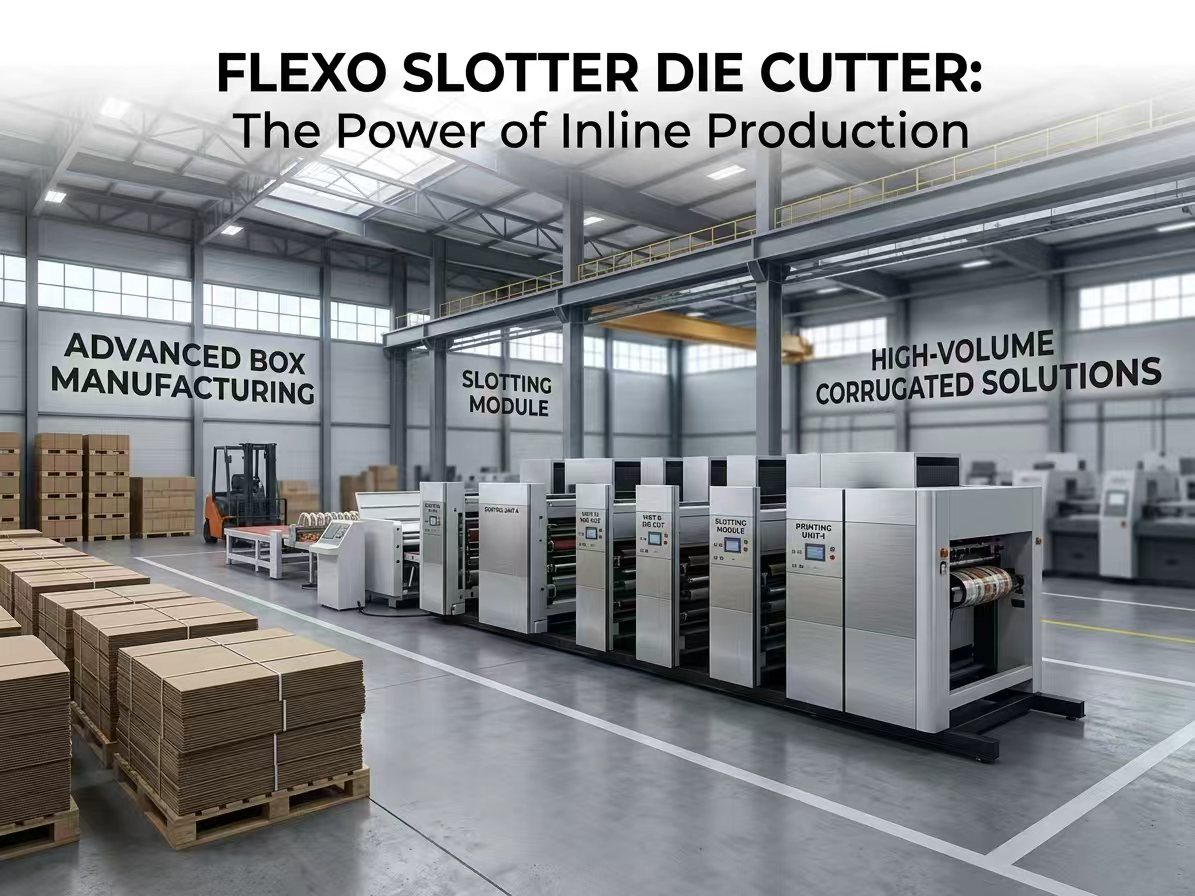
A flexo slotter die cutter printing machine puts three separate cutting and printing operations on one board in one pass — which means it also puts three separate tolerance budgets on one chain. Vet a supplier against three non-negotiables: independent phase control at each station so print-to-slot and slot-to-die-cut registration don’t stack errors, published accuracy figures per station — printing, slotting, and die-cutting each have their own number, not one blended claim — and rotary tooling sourced as standard spare parts, not proprietary-cut blades. Miss any one, and the failure shows up as a box that prints clean but folds crooked.
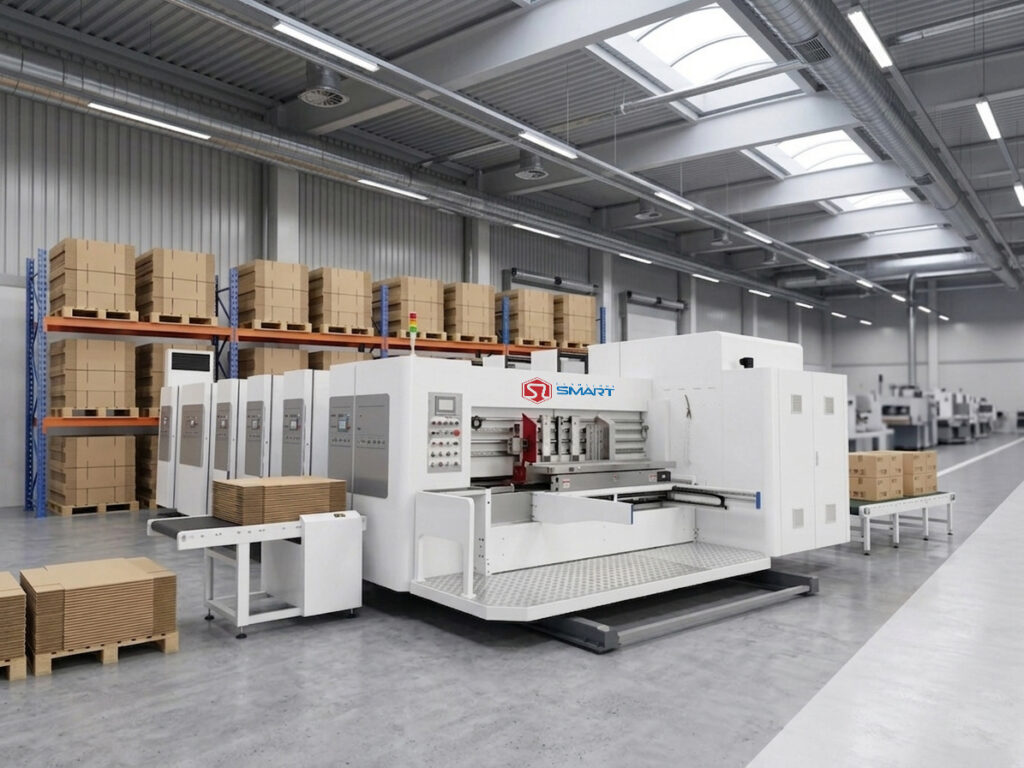
https://gzsmartmachinery.com/product/corrugated-box-printing-machine/
Engineering Tier Comparison: Standalone Modules vs. True Inline Integration
| Criterion | Standalone Modules (Printer + Separate Die-Cutter) | Basic Inline (Shared Mechanical Shaft) | Guangzhou Smart Machinery (Independent Servo Per Station) |
|---|---|---|---|
| Register reference | Two separate machines, two operators re-zeroing by eye | One mechanical line shaft, backlash compounds downstream | Each station servo-synced to one master electronic phase signal |
| Printing accuracy | Not comparable station-to-station | ±0.8–1.0 mm (0.03–0.04 in) typical | ±0.5 mm (0.02 in) topping accuracy |
| Slotting accuracy | Manual re-measurement per job | ±2.0 mm (0.08 in), drifts with wear | ±1.5 mm (0.06 in), fixed spec |
| Die-cutting accuracy | Separate flatbed, separate setup | ±1.5–2.0 mm (0.06–0.08 in) | ±1 mm (0.04 in) |
| Floor footprint & WIP | Large — buffer stock between machines | Reduced, single frame | Single frame, zero inter-station staging |
| Tooling | Mixed sourcing, inconsistent | Often model-specific | Standard spiral, slotting, and tungsten steel knife series |
Why Direct-Factory Sourcing Changes What You Can Actually Verify
Before the mechanics, one sourcing point matters more than any spec: a flexo slotter die cutter printing machine bought direct from the OEM that machines its own gears and writes its own PLC logic comes with a Factory Acceptance Test you can hold them to. A trading company reselling someone else’s chassis can promise any tolerance number in an email; only the factory that built the machine can prove it on the shop floor with your board and your ink before it ships.
The Register Chain: Why Three Stations Share One Phase Signal, Not Three
Here’s the mechanical reality most spec sheets skip. Printing register, slot-to-print register, and die-cut-to-slot register are three distinct tolerance budgets. On a mechanically linked line, each shaft transfer point adds its own backlash, so a printer holding ±0.5 mm (0.02 in) and a slotter holding ±1.5 mm (0.06 in) independently can still produce a box with 2+ mm (0.08+ in) of cumulative drift between the printed graphic and the slot line.
An independent servo drive per station — feed, print cylinder, slotting shaft, die-cutting cylinder — eliminates the stacking problem structurally. Every station reads its position off the same electronic master reference in real time rather than off a mechanical shaft several meters upstream.
The published per-station numbers — ±0.5 mm (0.02 in) print, ±1.5 mm (0.06 in) slot, ±1 mm (0.04 in) die-cut — stay meaningful precisely because they’re not quietly degrading each other through shared mechanical play. That’s the structural reason this class of machine is specified by station, not by a single blended tolerance claim.
Slotting Mechanics: What Actually Determines Box-Style Flexibility
Request a Factory FAT (Factory Acceptance Test) Protocol Sheet before you commit — it’s the fastest way to confirm slotting geometry against your specific box styles rather than a generic brochure spec.
The slotting section is where box-style flexibility is won or lost. Computerized slot spacing with both positive and reverse knife positioning lets one machine run standard RSC cartons and reversed-flap or special-length designs without a manual re-tool. Across Guangzhou Smart Machinery’s nine model configurations, minimum box height at the slotter runs 90–105 mm (3.54–4.13 in) depending on format, and maximum slot depth scales from 230 mm (9.06 in) on the compact 920 model up to 410 mm (16.14 in) on the large-format 1632.
Slot spacing that can only run one fixed knife pattern forces you to special-order tooling for every new box geometry. Motorized, digitally recalled slot positioning is what lets a changeover happen from the touchscreen instead of a wrench.
Die-Cutting Mechanics: Rotary Anvil Precision and Complex Geometry
The die-cutting section is what separates a basic slotter from a true flexo slotter die cutter printing machine capable of handles, windows, and non-rectangular retail shapes. The rotary die-cutting unit runs against an imported polyurethane rubber anvil pad — the pad material determines both cut cleanliness and how many production cycles pass before a pad swap is due, since a hardened or worn pad crushes flute walls instead of shearing them cleanly.
Die-cutting accuracy holds at ±1 mm (0.04 in), and the standard die-cutter knife height across the model range is 25.4 mm (1.0 in) — the industry-standard rule height, which matters because it determines whether your existing die-board inventory is compatible or needs re-tooling. Maximum die-cutting envelope scales with model, from 880 × 2080 mm (34.6 × 81.9 in) on the 920 up to 1600 × 3280 mm (63.0 × 129.1 in) on the 1632.
Material Science: The Blades and Rollers That Actually Wear Out
On a machine running continuous multi-shift production, the servo motors rarely fail first — the cutting edges and metering surfaces do. Specify these before you order:
- Tungsten carbide-tipped slotting and die-cutting knives — sourced as a standard catalog item (spiral knife series, slotting knife series, tungsten steel knife series), not a proprietary cut requiring a factory-specific reorder.
- Laser-engraved ceramic anilox rollers — hold their micro-cell ink-metering geometry through far more washdown cycles than chrome-plated steel.
- Heat-treated, precision-ground alloy steel drive gears — standard carbon steel gears flex under repetitive impact loading at the slotting and die-cutting stations, generating vibration that shows up first as register drift, not as an obvious mechanical fault.
- 7.2 mm (0.28 in) standard printing plate thickness across the model range, so plate inventory and mounting tape stock stay interchangeable between machines.
Ask any prospective supplier whether their knife series is standard stock or model-specific tooling — a dulled blade on standard tooling is a same-day swap; on proprietary tooling, it’s a shipping delay you didn’t budget for.
Vetting Checklist: Confirming Integration Actually Reduces Your TCO
The commercial case for inline integration over standalone printing and die-cutting modules rests on eliminating work-in-progress staging and duplicate labor, not just on raw speed. Confirm these before you sign:
- Per-station accuracy figures in writing — ±0.5 mm (0.02 in) print, ±1.5 mm (0.06 in) slot, ±1 mm (0.04 in) die-cut — verified under full production load, not idle.
- Register chain architecture — ask directly whether print, slot, and die-cut stations share one electronic master phase reference or three separate mechanical drive points.
- Knife and anvil sourcing — standard catalog parts vs. proprietary tooling, with confirmed lead times.
- Model-specific footprint and floor-space savings versus your current standalone printer-plus-die-cutter setup, matched to your box-style range.
- Electrical and cabinet configuration confirmed in writing for your climate and grid before the machine ships.
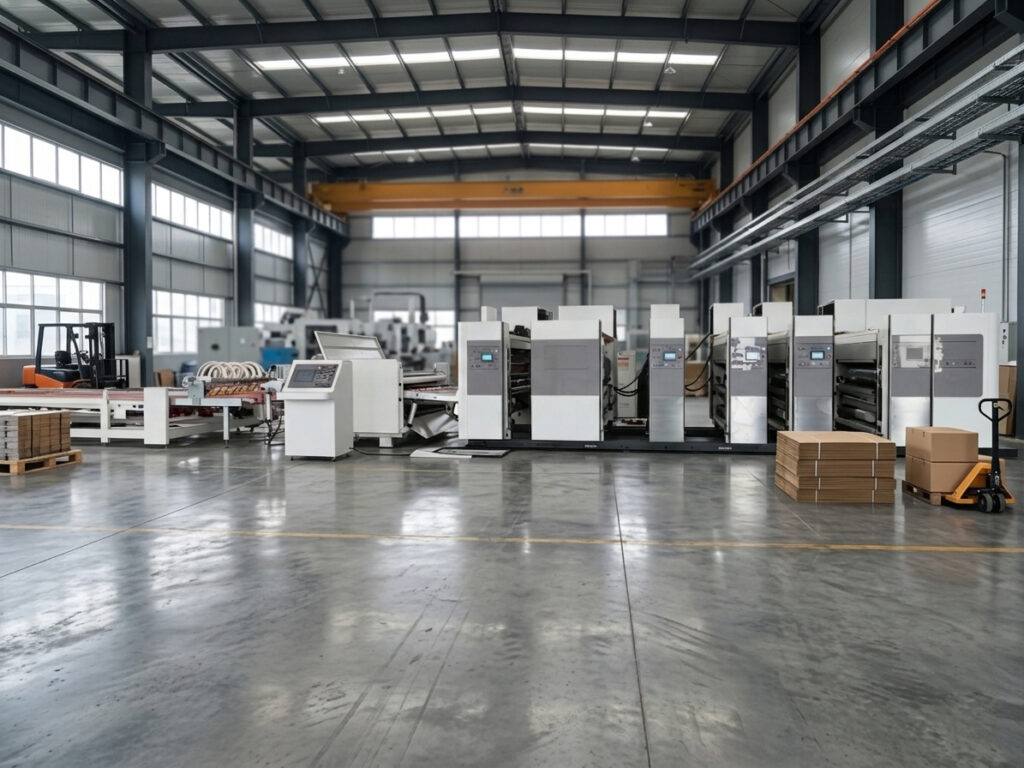
A flexo slotter die cutter printing machine that passes all five is one you can commit capital to with the register chain — not just the sticker speed — fully documented.
Frequently Asked Questions
Q: What’s the actual difference between the slotting and die-cutting functions on this machine? A: Slotting cuts the straight fold-line grooves that let a standard box fold into shape. Die-cutting uses a rotary die and anvil to cut curved or irregular geometry — handles, ventilation holes, or non-rectangular retail shapes — that a straight slotting knife physically cannot produce.
Q: How many print colors can be added to the line? A: Print stations are modular per configuration; each additional color adds one printing unit ahead of the slotting and die-cutting sections, with the same electronic phase reference extending across all added stations.
Q: What board thickness range does the platform handle? A: Suitable cardboard thickness runs 2–10 mm (0.08–0.39 in) on the compact 920/924 configurations, extending to 2–11 mm (0.08–0.43 in) on the 1224 model and larger.
Q: What does a Factory Acceptance Test actually confirm before shipment? A: You or your technical team run your own board stock through the printing, slotting, and die-cutting stations at full production speed, verifying the register chain holds its published tolerance across all three stations simultaneously — not just each station in isolation.
Request Your Factory FAT Protocol Sheet
Standalone printers and die-cutters shift your register error to the operator’s judgment call at every handoff. An integrated line with one electronic phase reference removes that judgment call from the equation. Request a Factory FAT Protocol Sheet or inquire for direct-factory wholesale B2B pricing and lead times on the full nine-model range, from the compact 920 to the large-format 1632.