Auditing a wholesale automatic folder gluer machine supplier starts before the spec sheet arrives — confirm whether the seller manufactures on its own factory floor or resells another workshop’s output. First, require servo-synchronized squaring: independent motor control on each folding belt, not a shared mechanical shaft prone to backlash. Second, require folding-accuracy data captured at running speed, not on an idle bench.
Third, a verifiable in-house production schedule and stocked spare-parts inventory. A trading company quoting “wholesale” pricing with no factory floor cannot guarantee either lead time or parts availability. Any supplier unwilling to disclose monthly capacity, PLC brand, or FAT tolerance data isn’t ready for a serious order.
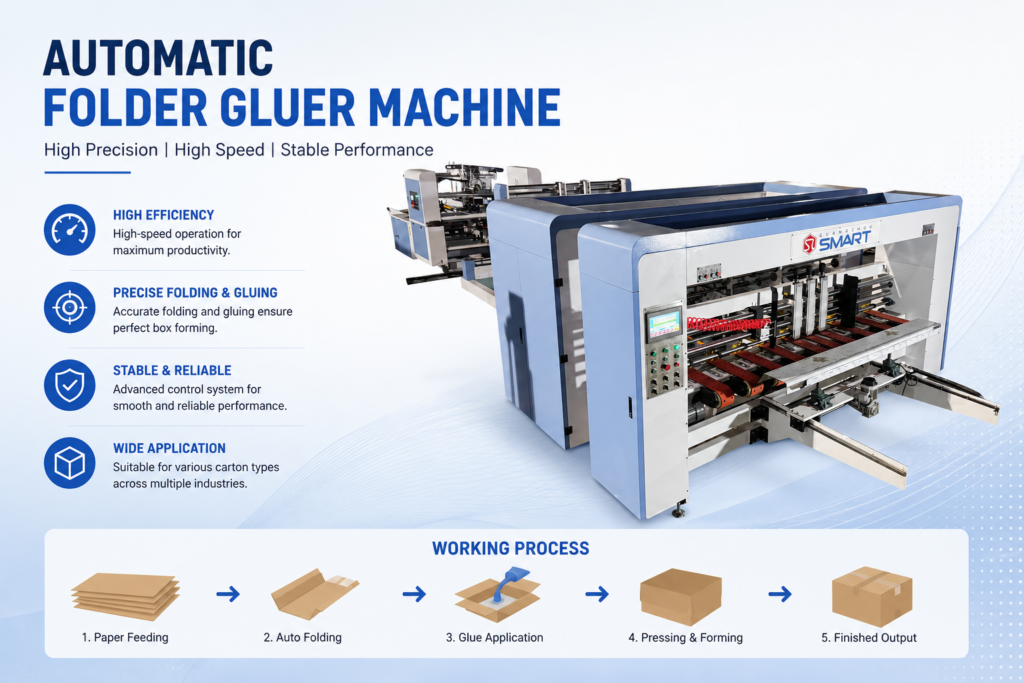
https://gzsmartmachinery.com/product/eco-automatic-folder-gluer-and-stitcher-machine/
Direct-Factory vs. Trading Company: The Wholesale Sourcing Matrix
Most listings advertising a wholesale automatic folder gluer machine don’t disclose whether the seller owns production floor space or resells another factory’s output — a distinction that decides your lead time, your customization ceiling, and who answers when a servo drive fails in year four. The matrix below breaks the three common sourcing channels down by the criteria that actually matter to a procurement audit.
| Sourcing Channel | Independent Trading Company | Small Workshop Fabricator | Guangzhou Smart Machinery (Direct Factory) |
|---|---|---|---|
| Manufacturing Capacity | Resells third-party units; no in-house production | 1–3 units/month, single line, informal QC | 15–25 units/month, dedicated Panyu, Guangzhou facility |
| Motion Control | Fixed to whatever the OEM originally installed | Generic relay logic, no belt-to-belt sync | PLC-controlled independent servo squaring (Mitsubishi/Siemens) |
| Customization Access | None — fixed catalog spec only | Limited, undocumented, no engineering sign-off | OEM/ODM: PLC brand, stitching range, glue-system swap |
| Spare Parts Chain | Reseller markup, 4–8 week third-party lead time | No stocked inventory, ad hoc sourcing | Factory-direct stock, shipped without a middleman markup |
| Fold/Squaring Tolerance Data | Rarely disclosed; no per-unit FAT record | Not measured or documented | ±0.5 mm (±0.02 in) secondary-correction accuracy, pre-ship verified |
| Export Certification | Varies by reseller, frequently unverifiable | Domestic-market only | CE-documented for EU import compliance |
Inside the Wholesale Automatic Folder Gluer Machine: Feed, Fold, Glue, Stitch
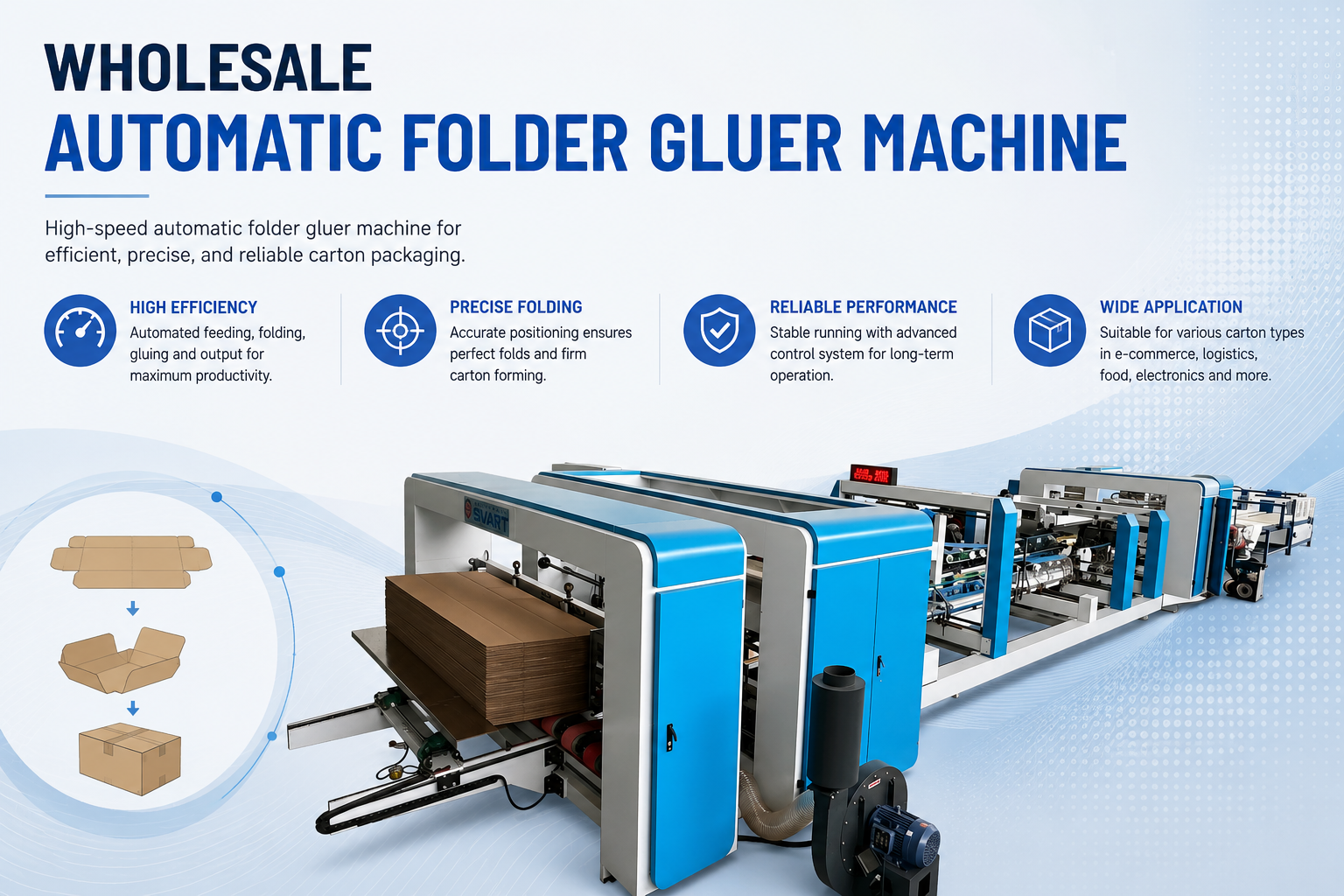
The Eco Automatic Folder Gluer and Stitcher Machine — offered in 1224 and 1230 series configurations — runs five stations as one synchronized pass rather than four separate mechanical guesses. Board enters through the Precision Feeder Unit, where a high-accuracy vacuum suction system pulls blanks one by one into perfect alignment, the detail that prevents double-feeds and jams at the start of the line rather than catching them downstream.
An Advanced Pre-breaking section, available as an add-on, “pre-breaks” the crease lines before the main fold — a step specifically for complex or stiff cardboard that would otherwise spring back and leave a soft, rounded corner instead of a crisp 90-degree fold. At the Intelligent Folding & Gluing stage, precisely positioned guides and hooks route the panel through the fold while high-precision nozzles apply either water-based cold glue or hot-melt adhesive, giving buyers a genuine choice rather than a single fixed bonding method.
Precision through the fold itself comes from independent belt speed regulation paired with dual-side squaring devices: the PLC interface adjusts the outer folding belts relative to the inner belts in real time, correcting blank alignment before the final pressure section. This holds a square fold at the machine’s full 180 m/min (590 FPM) rated speed rather than only at a slower demo pace. For heavy-duty board runs, an extended folding section with specialized side-guide rollers and high-torque pressure belts applies a “gradual fold” that lets the fibers set correctly instead of springing back under tension.
The Integrated Stitching Section closes out the line with adjustable stitching distances from 30 mm to 120 mm (1.18–4.72 in), covering the structural range from lightweight retail cartons to heavy-duty shipping boxes on the same machine. A final pressure, counting, and stacking stage applies uniform seal pressure and automatically counts finished cartons for downstream logistics, so the operator isn’t hand-counting bundles at shift end.
Manufacturing Capacity and OEM/ODM Customization: What “Direct Factory” Actually Means
“Wholesale” pricing only means something if it comes with production capacity behind it. Guangzhou Smart Machinery runs a dedicated manufacturing facility in Panyu, Guangzhou, producing 15–25 units per month — a figure worth requesting in writing from any competing supplier before comparing quotes, since a workshop assembling one or two machines a month cannot hold the lead times a wholesale buyer needs for a plant expansion timeline.
Direct-factory sourcing also opens customization that a reseller simply cannot authorize. Buyers can specify PLC brand (Mitsubishi or Siemens, depending on the plant’s existing automation standard), select stitching module configuration within the 30–120 mm range, and choose between cold-glue and hot-melt adhesive nozzle setups based on the substrate mix running through the plant. None of that is available once a machine has already left the factory through a distributor.
Inquire for Direct-Factory Wholesale B2B Pricing & Lead Times and specify your PLC preference, stitching range, and target monthly volume — the three variables that most affect quoted lead time on a wholesale order.
Material Science: Wear Components That Decide Machine Lifespan
A folder-gluer’s frame will outlast its wear components by a decade or more; the parts that actually fail first are what determine real service life. Tungsten-carbide-coated feed friction plates at the infeed resist the abrasive wear of recycled-fiber dust far longer than untreated steel, which is why replacement-plate intervals belong in the purchase contract, not a footnote discovered eighteen months in.
High-grip, anti-stretch folding belts carry the blank through the fold section under constant tension; a belt that stretches even slightly under heat and load introduces the timing drift that shows up downstream as inconsistent squaring. High-frequency electronic glue-spray valves feeding the folding-and-gluing stage fire precise adhesive beads in milliseconds rather than relying on a mechanical wheel, which matters most on complex crash-lock or multi-corner box styles where glue has to land on specific upper flaps without touching the rest of the board.
Ask any competing supplier for the brand and rated duty cycle of these three components specifically — friction plate coating, belt material, and glue valve type — rather than accepting a general “heavy-duty construction” claim on a spec sheet.
Spare Parts Supply Chain and the True Landed Cost of a Wholesale Unit
Purchase price is one line item in a wholesale order; the supply chain behind the machine is what determines your total cost over a 15-to-20-year service life. The Eco Automatic Folder Gluer and Stitcher Machine’s “eco” design measurably lowers one recurring cost: starch consumption drops from the industry average of over 22 kg/ton (48.5 lb/ton) of board processed to under 18 kg/ton (39.7 lb/ton) when paired with an intelligent glue system — a reduction of roughly 20% on one of the plant’s ongoing consumables. The machine is also compatible with a zero-discharge circulating system, relevant for plants operating under tightening regional wastewater discharge rules.
Digital touchscreen controls cut order changeover time significantly compared to manual dial adjustment, which matters directly to a wholesale buyer running mixed SKUs rather than a single long production run. Request a Factory FAT (Factory Acceptance Test) Protocol Sheet documenting squaring tolerance, glue-valve duty cycle, and starch-consumption figures for your specific board mix before committing capital — a reseller several steps removed from the factory floor cannot produce this documentation.
Vetting Checklist Before You Wire a Deposit
Return to the three benchmarks that opened this audit — servo-synchronized squaring, running-speed tolerance data, and a verifiable in-house production and parts chain — and require documentation for each rather than a brochure claim. A supplier who can’t produce a FAT protocol sheet or a straight answer on monthly capacity is operating as a middleman, whatever the listing calls itself.
A practical due-diligence checklist before signing a wholesale purchase order:
- Confirm the seller’s monthly in-house manufacturing capacity in writing, not a verbal estimate
- Request squaring and folding tolerance data captured at running speed, by model series
- Verify PLC brand and confirm OEM customization is available before, not after, the deposit
- Ask for stitching-range, glue-valve, and friction-plate wear-component specifications and replacement lead time
- Confirm CE documentation and voltage/frequency compatibility with your site before signing
Guangzhou Smart Machinery’s Eco Automatic Folder Gluer and Stitcher Machine — built and shipped from the Panyu, Guangzhou factory across the 1224 and 1230 series — is the wholesale automatic folder gluer machine this audit was built around: PLC-synchronized squaring, cold-glue and hot-melt gluing on one line, and a stitching range wide enough to cover both retail and heavy-duty carton production.
Frequently Asked Questions
Q: What’s the real difference between a wholesale price from a factory and from a trading company? A: A factory quote comes with disclosed monthly production capacity, OEM/ODM customization (PLC brand, stitching range, glue system), and a direct spare-parts chain. A trading company resells whatever a third-party factory already built, with no ability to customize the unit and typically a longer, markup-inflated parts pipeline.
Q: Does this machine handle both cold glue and hot-melt adhesive? A: Yes. The Intelligent Folding & Gluing stage applies either water-based cold glue or hot-melt adhesive through high-precision nozzles, selected based on the substrate and production speed required.
Q: What stitching range does the Integrated Stitching Section support? A: 30 mm to 120 mm (1.18–4.72 in), adjustable to meet structural requirements from lighter retail cartons through heavy-duty shipping boxes on the same line.
Q: How does the “Eco” design actually reduce operating cost? A: Paired with an intelligent glue system, starch consumption drops from the industry average of over 22 kg/ton (48.5 lb/ton) to under 18 kg/ton (39.7 lb/ton) — roughly a 20% reduction in one of the plant’s recurring consumables, alongside compatibility with a zero-discharge circulating system.
Q: What should I request before signing a wholesale purchase order? A: A Factory FAT (Factory Acceptance Test) Protocol Sheet documenting squaring and fold tolerance at running speed, confirmed PLC brand, wear-component specifications for the friction plates and glue valves, and the factory’s current monthly production capacity in writing.
Ready to Place a Wholesale Order?
A quoted unit price tells you almost nothing about lead time, customization access, or what happens when a wear component needs replacing in year three — factory capacity, PLC transparency, and documented tolerance data are what actually determine whether a wholesale purchase holds up. Request a Factory FAT Protocol Sheet for the 1224 or 1230 series configuration that matches your board mix before you commit capital.
For plants ready to move on pricing and lead times, inquire for Direct-Factory Wholesale B2B Pricing & Lead Times and speak directly with Guangzhou Smart Machinery’s engineering team about PLC brand, stitching range, and your target monthly order volume.