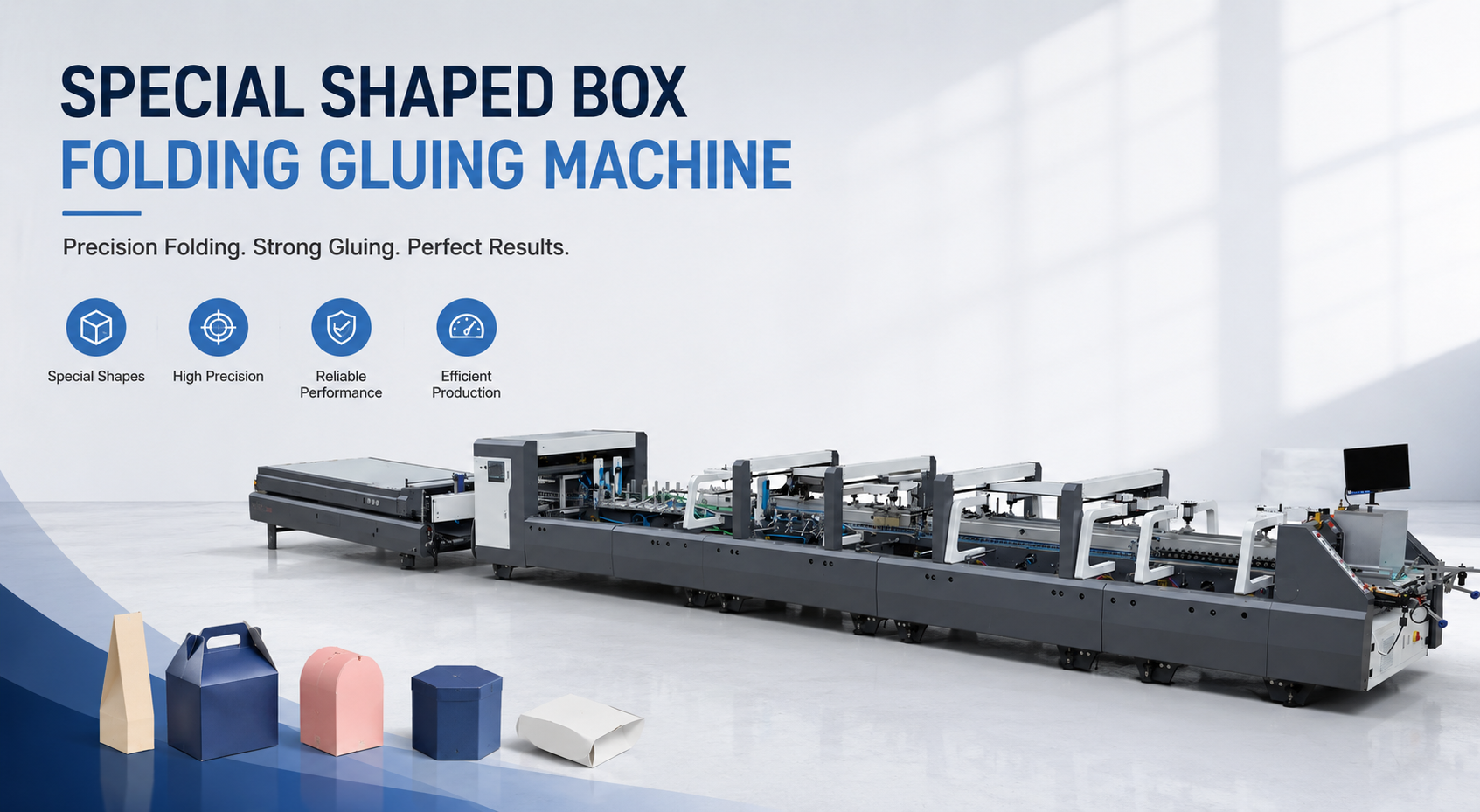
Vetting a special shaped box folding gluing machine starts by ignoring the headline speed rating and auditing three mechanical realities instead. First, the bottom-lock station needs its own independent servo motor — irregular panels can’t ride on a fold group synchronized for standard RSC boxes. Second, gluing an off-square or asymmetric blank requires a dedicated multi-gun spray system, not a single fixed-position nozzle built for straight glue flaps. Third, the tooling handling the special-shaped run has to swap out fast — a reversible bracket, not a bolted-on fixture — because most plants run mixed SKUs in the same shift. A machine missing any one of these three is a standard folder-gluer wearing a special-shaped-box label.
https://gzsmartmachinery.com/product/mini-flexo-folder-gluer/
Engineering Benchmark: Three Tiers of Special-Shaped Box Capability
Most machines marketed for “special-shaped” or “irregular” cartons are standard folder-gluers with a software tweak, not a mechanically different bottom-lock architecture. The gap shows up in three places: how the bottom-lock station is driven, how glue reaches a non-linear joint, and how fast the line switches between a special-shaped run and a standard one.
| Engineering Criterion | Entry-Level / Trading-Co. Machine | Semi-Integrated Regional Fabricator | Guangzhou Smart Machinery (AKJ Bottom-Lock Platform) |
|---|---|---|---|
| Bottom-Lock Drive | Slaved to the main line shaft, no independent timing | Independent motor, manual phase setting | Independent servo motor per fold station, PLC-adjustable |
| Irregular-Box Gluing | Single fixed nozzle, straight-line path only | Dual nozzle, limited pattern control | Dedicated 3-gun water-base spray system for non-linear glue lines |
| Box-Style Changeover | Full mechanical re-tool, hours per switch | Partial quick-change, still needs manual re-alignment | Reversible bottom-lock bracket — swap without re-tooling |
| Fold Geometry | Fixed single fold angle | Two-angle fold, non-adjustable | 180° and 135° pre-fold, double-board structure |
| Rated Board Range | Narrow gsm window, jams on light or heavy stock | Moderate range, inconsistent at the extremes | 200–800 gsm (E-flute/F-flute) |
| Spare-Parts Architecture | Welded frame, custom-fabricated replacements | Bolted subassemblies, moderate lead time | Chute-structure aluminum plates — modular, fast-add spares |
What Actually Makes a Box “Special-Shaped” — and Why Standard Gluers Miscarry the Job
A special-shaped box is any carton whose panel geometry departs from a simple four-flap RSC — bottom-lock trays, off-square display cartons, and window boxes are the most common examples. On a standard line, every fold bar and glue nozzle is timed to a symmetrical blank running dead-center on the belt. The instant a panel locks at an angle instead of folding flat against its neighbor, that fixed timing starts missing the joint.
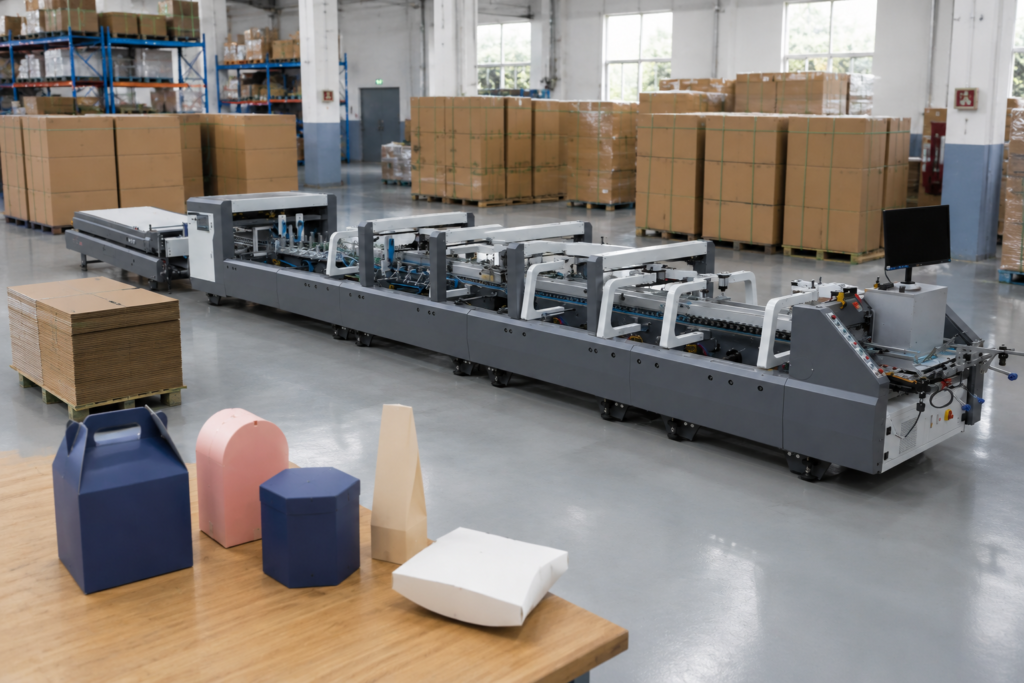
Guangzhou Smart Machinery’s engineering answer is a dedicated bottom-lock station, not a modified standard fold group. The station runs on a 3-board tracking structure, where the upper gluer applies adhesive and forms the bottom-locked box as its own synchronized sub-assembly rather than following the main fold timeline. That separation is what lets one line run a locked-bottom special-shaped carton one shift and a standard box the next.
Inside the Machine: Bottom-Lock Station, Reversible Bracket, and the 3-Gun Spray System
The entire bottom-lock assembly on a special shaped box folding gluing machine from Guangzhou Smart Machinery mounts on a reversible bracket, not a bolted fixture. Flipping that bracket into position is what cuts the changeover time between a bottom-lock special-shaped run and a standard box style, instead of forcing a full mechanical re-tool.
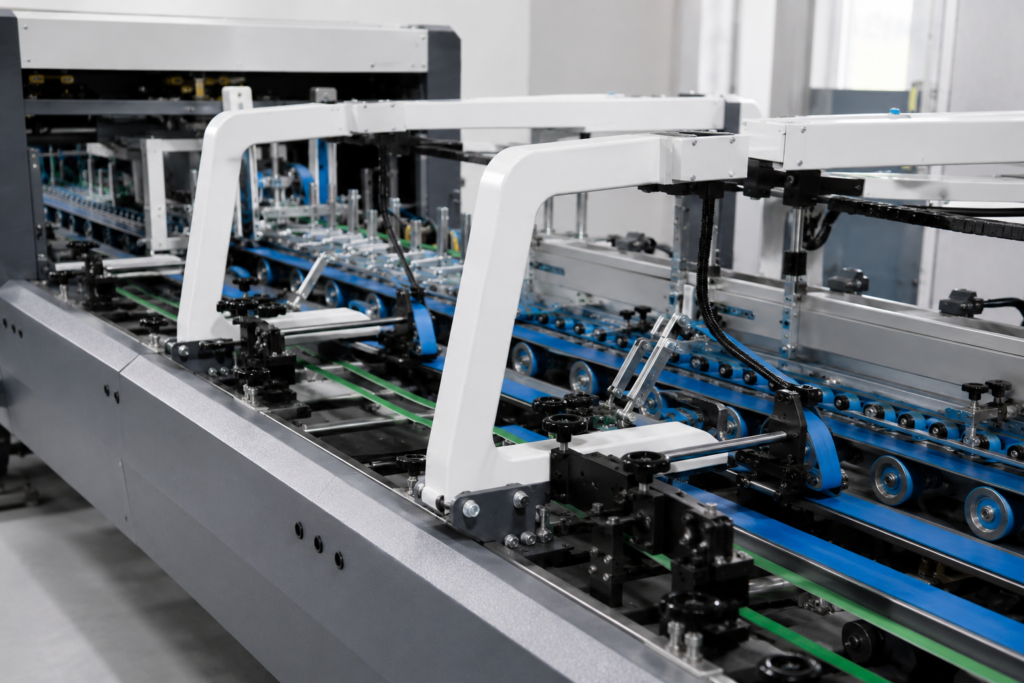
Glue application is the second engineering fork. A standard fold-glue station uses one fixed-position nozzle tracing a straight flap line, which fails the moment a joint isn’t linear. This machine adds a dedicated water-base cold-glue spray system with three independently mounted guns, built to trace a non-linear glue path on irregular panels instead of forcing them through a straight-line applicator.
A grinding station conditions the board surface ahead of gluing, treating UV-coated and laminated surfaces so adhesive bonds to fiber instead of a slick coating — a detail that matters more on special-shaped display cartons, which run coated stock far more often than standard shipping boxes. Pre-fold geometry is fixed at 180° and 135° through a double-board structure, sized for small-format, high-panel-count cartons rather than large flat blanks.
Running-Speed Data: Feed Range, Fold Geometry, and Board Weight Capacity
Model 1100AKJ — Guangzhou Smart Machinery’s SHH-AKJ bottom-lock platform — runs continuous board feed up to 300 m/min / 984 FPM, while bottom-lock folding itself is rated at 50–200 pieces per minute, since forming a locked, angled joint takes longer than a straight fold. Board weight range is rated 200–800 gsm, covering light E-flute display stock through heavier F-flute structural board. Every fold station is driven by its own independent servo motor, feeding into a shared electrical control board rather than one central mechanical shaft.
Total installed electric power runs 24–35 kW / 32.2–46.9 HP at 380V, 50Hz, 3-phase, and the machine weighs 5.5 t / 12,125 lbs with an overall footprint of 15,000 × 1,700 × 1,400 mm / 49.2 × 5.6 × 4.6 ft. What the public datasheet does not publish is a folding-registration tolerance figure for the bottom-lock joint itself — a gap worth flagging rather than filling with an invented number.
Request a Factory FAT (Factory Acceptance Test) Protocol Sheet documenting bottom-lock registration accuracy, tested under running load on your target board weight, before specifying a model.
Wear-Component Metallurgy Behind Consistent Glue Lines on Irregular Blanks
Wear components decide how long a bottom-lock joint stays tight, not the machine’s frame. Guangzhou Smart Machinery builds its folder-gluer feed sections with tungsten-carbide-coated friction plates, which hold grip on abrasive, dust-heavy recycled board far longer than untreated steel — a detail that matters more on special-shaped runs, where the feed section handles more edge-heavy, asymmetric blanks per hour than a straight RSC line.
The fold belts driving panels through the pre-fold and bottom-lock stations are high-grip, tensile-reinforced fold belts, specified to hold an off-square panel flat against the fold bar instead of letting it drift mid-cycle. Glue metering runs through high-frequency electronic glue valves rather than a mechanical cam-timed nozzle, which is what lets the 3-gun spray system fire in a non-linear pattern instead of a single fixed straight line.
Changeover Economics: Reversible Bracket vs. Full Tooling Swap on a Mixed-SKU Line
Most Tier 2 and Tier 3 box plants don’t run special-shaped cartons as their only product — they run a mixed schedule, standard RSC boxes most of the week and a special-shaped SKU for specific accounts. On a fixed bottom-lock fixture, switching between the two means unbolting and re-timing the entire station, often several hours of downtime per changeover.
The reversible bracket design changes that math. Because the bottom-lock assembly mounts on a bracket built to rotate into position rather than bolt on fresh, changeover between a locked special-shaped run and a standard box style drops to a fraction of the full-teardown time — the line item that decides whether a special-shaped SKU is profitable at low-to-mid volume or only breaks even running full-line dedicated.
Run that math against your own order mix before comparing sticker price. A machine priced 10% lower but costing three extra changeover hours per week erases its price advantage inside a single quarter on a plant running two box styles daily.
Vetting a Special-Shaped Box Folding Gluing Machine Supplier: The Closing Checklist
Return to the three benchmarks this audit opened with — an independently driven bottom-lock station, a multi-gun spray system built for non-linear glue lines, and a reversible bracket for fast changeover — and require documented proof of each, not a demo-floor claim.
A practical due-diligence checklist before you sign:
- Request bottom-lock registration and fold-tolerance data directly, since it is rarely published on the datasheet
- Confirm the spray system’s gun count and independent trigger control, not a single fixed nozzle relabeled for “special-shaped” use
- Verify reversible-bracket changeover time in writing, measured on the plant floor rather than estimated on a spec sheet
- Check the rated board weight (gsm) range against your actual special-shaped stock, especially at the coated or laminated end
- Confirm voltage, frequency, and installed power draw match your site’s electrical service before signing
Guangzhou Smart Machinery’s bottom-lock AKJ platform — the special shaped box folding gluing machine this audit was built around — pairs an independently driven bottom-lock station with a 3-gun spray system and a reversible bracket, running 200–800 gsm board at up to 300 m/min / 984 FPM on a footprint of 15,000 × 1,700 × 1,400 mm / 49.2 × 5.6 × 4.6 ft.
Frequently Asked Questions
Q: What makes a folding gluing machine suitable for special-shaped boxes instead of standard RSC cartons? A: Three mechanical features, not a software setting: an independently driven bottom-lock station (its own servo motor, not slaved to the main fold group), a multi-gun spray system that can trace a non-linear glue path, and a reversible bracket that swaps tooling without a full re-tool.
Q: How fast can this machine run a bottom-lock special-shaped box? A: Bottom-lock folding is rated at 50–200 pieces per minute, slower than the 300 m/min / 984 FPM continuous board feed on the standard folding stages, because forming a locked, angled joint takes longer than a straight fold.
Q: What board weight range does the machine handle? A: 200–800 gsm, covering E-flute and F-flute board, per the Model 1100AKJ (SHH-AKJ series) specification sheet.
Q: What should I request before signing a purchase order for a special-shaped box machine? A: A Factory FAT Protocol Sheet documenting bottom-lock registration accuracy under running load, the spray system’s gun count and trigger control, and reversible-bracket changeover time measured on the plant floor rather than estimated.
Ready to Specify a Bottom-Lock Line for Your Special-Shaped SKUs?
A brochure speed rating tells you nothing about whether a machine can actually form and glue an off-square joint — bottom-lock drive independence, glue-gun count, and changeover time are what decide that. Request a Factory FAT Protocol Sheet documenting bottom-lock tolerance and board-weight performance for your specific special-shaped SKU before you commit capital.
For plants ready to move on pricing and lead times, inquire for Direct-Factory Wholesale B2B Pricing & Lead Times and speak directly with Guangzhou Smart Machinery’s engineering team about your board mix, order volume, and site voltage.